
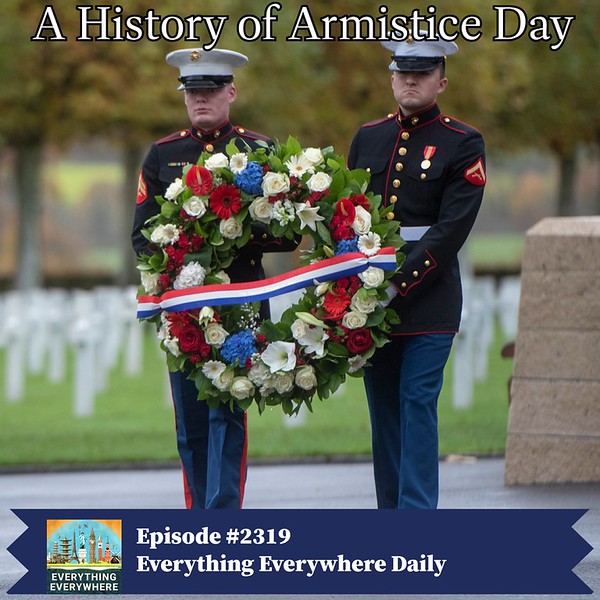
Episode – 2319 : A History of Armistice Day
This episode can be found at: https://everything-everywhere.com/a-history-of-armistice-day/
Podcast Transcript
On the eleventh hour of the eleventh day of the eleventh month in 1918, the guns of the First World War fell silent.
After four years of unprecedented carnage, the world faced the enormous task of honoring those who had served and died.
What began as a commemoration of a single moment in history evolved into very different traditions around the globe, reflecting how nations remember war, sacrifice, and peace.
Learn more about the history of Armistice Day and its many forms around the world on this episode of Everything Everywhere Daily.
WWI was a shock to humanity that shattered assumptions about what it meant to be civilized. Industrialization created a level of destruction that overwhelmed human comprehension. Somewhere between 15 and 22 million people were killed in a little over four years. The world had never seen anything like it.
The war left a lasting scar on every nation that participated in what was then known as the Great War. While families mourned those they lost, there were also efforts by every participating country to honor their dead more formally.
Efforts to honor those lost in the war established many traditions that still exist today. Over time, different methods for commemorating veterans emerged worldwide, all rooted in the gravity of participation in the Great War.
One of the first days of remembrance was held in Britain.
On November 11, 1919, one year after the war ended, Britain held its first Armistice Day. King George V marked it with a 2-minute silence at 11:00 AM. It was more than a moment of silence, however. Across the country, the government halted all rail and vehicle traffic at the same time.
Adding to the remembrance, in 1921 millions of poppies were distributed by the Royal British Legion to be worn on the lapel to honor the fallen
Red poppies became a powerful symbol of the fallen during World War I. In the spring and summer of 1915, millions of dormant red poppy seeds bloomed across the trenches and no-man’s-land of Belgium and France.
The magnificence of the poppy bloom was captured in the famous poem, In Flanders Fields, by John McCrae, who wrote:
In Flanders fields the poppies blow
Between the crosses, row on row,
That mark our place; and in the sky
The larks, still bravely singing, fly
Scarce heard amid the guns below.
The ceremony held in 1919 concluded at the Cenotaph at Whitehall in London, a tomb with no remains inside, which was built as a monument to those whose remains could not be laid to rest.
The Cenotaph became the centerpiece of British remembrance. Originally built as a temporary memorial for the victory celebrations in July 1919, it proved so popular that King George V unveiled a permanent version, made of Portland stone, on November 11, 1920.
After the Second World War, Armistice Day became Remembrance Day to honor those who died in all wars.
When Britain declared war on Germany in 1914, they didn’t just enter the war at nation, the entire British Empire entered the war. Many former British colonies celebrate their own Remembrance Days and also honor specific events in their own history.
In several African countries with historical ties to the British Empire, Remembrance Day traditions include ceremonies honoring soldiers who served in the two world wars. However, observances vary significantly across the continent, reflecting each nation’s colonial history, independence struggles, and military traditions.
Australia and New Zealand commemorate ANZAC Day, which I covered in a previous episode, focusing on the Australian and New Zealand Army Corps’ efforts to knock the Ottomans out of the war on the Gallipoli Peninsula.
Another version of the holiday evolved in the United States. As in the Commonwealth, early commemorations centered on the armistice that ended the war.
Yet, while the United States’ entry into the war in 1917 proved decisive in breaking the war’s stalemate, the American scale of sacrifice on the Western Front bore an entirely different character than that of the European powers.
Unlike the battlefields that tore apart Europe, the American homeland remained untouched. The nations of Europe had endured years war, losing an entire generation in their own backyard, which shaped how the continent would mourn until the Second World War.
The United States established Armistice Day in 1926, in part to commemorate the end of all wars. The congressional resolution noted it was to be “a day to be dedicated to the cause of world peace and to be thereafter celebrated and known as ‘Armistice Day'”.
In 1945, Raymond Weeks of Birmingham, Alabama, proposed establishing a day to honor all veterans, living and dead, that would coincide with Armistice Day.
In 1954, President Dwight D. Eisenhower signed legislation officially changing its name from Armistice Day to Veterans Day. Congress briefly moved the holiday to the fourth Monday in October with the passage of the Uniform Monday Holiday Act in 1968, which sought to standardize the dates of several federal holidays.
The backlash was swift; most states and veterans groups refused to abandon November 11th. Recognizing the date’s gravity in American History, Gerald Ford returned the holiday to November 11, where it has remained ever since.
Unlike the Commonwealth model’s somber reverence, America’s version blends reverence with community celebration. American Presidents lead the way by laying wreaths at Arlington National Cemetery. At the same time, local events honor the day with displays of gratitude, including parades, marching bands, and public recognition for local veterans.
Federal, state, and local government workers receive a paid holiday with offices closed, but private sector companies are not required to give the day off, resulting in mixed practices. Public school closures also vary widely by district.
France and Belgium have their own version of the holiday. In these nations, November 11 is not a day of public celebration or casual gratitude. It is a solemn, deeply impactful national day of mourning.
The physical reality of World War I in these countries demanded a different perspective, as France and Belgium were the site of the great battles of the Western Front.
Millions of soldiers died on the battlefields of France and Belgium, which witnessed some of the deadliest fighting of the entire war. The devastation of the Western Front permanently transformed the landscape and national consciousness of both countries.
During the conflict, there were cities, towns, and villages that were completely erased, and the landscape still bears the physical scars of trenches, craters, and unexploded munitions. If you recall my episode on Zone Rouge, there is still unexploded ordnance that is discovered every year.
French historians use the term nation meurtrie, or bruised nation, to characterize their experience and shape their commemorations. Le 11 Novembre is an official public holiday in France. Its observance follows a strict, solemn program honoring the French who died in WWI.
National remembrance centers on the Tomb of the Unknown Soldier beneath the Arc de Triomphe in Paris. Every November 11, the French President presides over a ceremony at the Arc de Triomphe, including a wreath-laying and the symbolic rekindling of the Eternal Flame, which has burned since 1923. Participants often wear the bleuet de France, a blue cornflower that serves as France’s national remembrance symbol, much as the red poppy does in Britain and the Commonwealth.
The French honor the cornflower because it was one of the few plants that kept growing in the mud of the trenches and across No Man’s Land.
The reverence in Paris is reflected across the country, as citizens in every French village and town gather at their local war memorial to lay wreaths and read the names of the fallen.
Belgium’s official national ceremony takes place at the Tomb of the Unknown Soldier in Brussels, where the king traditionally lays a wreath.
Another major center of remembrance is the Menin Gate in Ypres, a monument inscribed with the names of nearly 55,000 missing soldiers of the British Empire who died during World War I and have no known grave.
Since 1928, buglers from the Ypres fire brigade have sounded the Last Post each evening beneath the arches of the Menin Gate. The tradition has continued almost uninterrupted, with the most significant exception being the German occupation of Belgium during World War II.
Surprisingly, many commemorations are also held in Germany. Volkstrauertag, or People’s Mourning Day, approaches the commemoration from a very different angle than tin other countries.
Volkstrauertag is defined by an anti-militarist perspective as well as a collective remorse and grief for all those who have died in war. Observed in mid-November, Volkstrauertag does not celebrate military victory or the glory of military sacrifice. Instead, it is marked by a somber sense of critical self-reflection for Germany’s accountability for WWI, WWII, and the Holocaust.
Der Spiegel, a weekly German news magazine, noted: German remembrance remains a painful tightrope walk. Whoever commemorates the victims must never forget that this country unleashed war and the frenzy of annihilation upon the world. Mourning one’s own dead loses all moral legitimacy if it obscures the view of German guilt.
Given Germany’s role in these atrocities, the day is dedicated to the mourning of all victims of war and tyranny the world over.
Germany’s national Volkstrauertag ceremony takes place in the Bundestag, where the country’s political leaders gather to commemorate the victims of war and tyranny.
Another important site of remembrance is Berlin’s Neue Wache, a 19th-century guardhouse that serves as Germany’s central memorial to the victims of war and dictatorship.
Inside the guardhouse’s open-roofed chamber rests a powerful sculpture by Käthe Kollwitz, Mother with her Dead Son, a depiction of a grieving mother cradling her murdered child. The setting is somber, devoid of flags, and music.
The national ceremony brings together the German President, Chancellor, Parliamentarians, and foreign dignitaries in quiet reflection, acknowledging the loss of life and the responsibility for the catastrophic historical events that led to it.
This German remembrance day represents a distinct departure from other countries, serving as a stark warning from history about the evils of state-sponsored violence.
Although remembrance traditions differ around the world, they all share a common origin in the unprecedented devastation of the First World War. More than a century later, November 11 remains a day when nations pause to reflect on the sacrifices made in war.
Some honor their veterans with parades and celebrations, others mourn their fallen with moments of silence, and still others use the occasion to confront the darker chapters of their history. These differences reflect how each country experienced war and how those experiences shaped its national identity. Yet beneath these different traditions lies a universal recognition that the human cost of war should never be forgotten, and that remembering the past is essential to preserving peace in the future.
Automatically extracted from this episode; not independently verified. Please report possible errors below.
People mentioned in episode #2319
- King George V
- John McCrae
- Raymond Weeks
- Dwight D. Eisenhower
- Gerald Ford
- Käthe Kollwitz
Places mentioned in episode #2319
- London
- Brussels
- Paris
- Ypres
- Birmingham
- Gallipoli Peninsula
- Berlin
Historical events in episode #2319
- November 11, 1918 — End of the First World War (impact 90/100)
- November 11, 1919 — First Armistice Day in Britain (impact 60/100)
- November 11, 1920 — Permanent Cenotaph unveiled (impact 30/100)
- 1926 — Establishment of Armistice Day in the United States (impact 40/100)
- 1954 — Armistice Day renamed Veterans Day (impact 15/100)
- November 11, 1923 — Eternal Flame lit at Arc de Triomphe (impact 30/100)
Episode topics
- Culture
- History
- Military
- War
- World Wars