
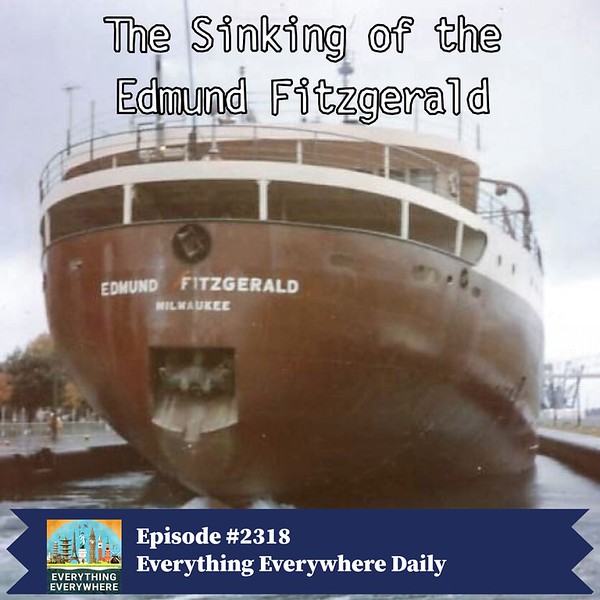
Episode – 2318 : The Sinking of the Edmund Fitzgerald
This episode can be found at: https://everything-everywhere.com/the-sinking-of-the-edmund-fitzgerald/
Podcast Transcript
In November 1975, a massive freighter was making what should have been a routine voyage across Lake Superior.
It was one of the largest ships on the lakes, commanded by an experienced captain and carrying thousands of tons of iron ore.
But as it crossed Lake Superior, a powerful storm turned an ordinary voyage into one of the most famous maritime disasters in American history.
Learn more about the final voyage and sinking of the Edmund Fitzgerald on this episode of Everything Everywhere Daily.
The SS Edmund Fitzgerald was built specifically to sail on the Great Lakes and carry a single cargo known as taconite, a low-grade, iron-bearing rock.
The ship carried dense, heavy loads of taconite pellets from Duluth, Minnesota, and Superior, Wisconsin, to steel mills in Detroit, Toledo, and Cleveland.
Shipping across the Great Lakes was dangerous business, which made it very lucrative. In 1956, Northwestern Mutual, a life insurance firm out of Milwaukee, WI. entered the shipbuilding business when it hired the Great Lakes Engineering Works in River Rouge, Michigan, to build a 729-foot Great Lakes bulk carrier for $10 million.
Under the leadership of the company’s president, Edmund Fitzgerald, they owned the ship but turned it over to shipping conglomerate Oglebay Norton to manage and operate.
Oglebay Norton was a Great Lakes fleet management and logistics firm that operated, maintained, and managed the day-to-day functions of ships like the Edmund Fitzgerald. Part of their job was to account for Lake Superior’s conditions when they sent a ship out, as the lake is notoriously volatile. One moment it can be calm as glass; the next, a storm can arise.
At its worst, Lake Superior can produce some of the world’s most powerful storm systems, especially as autumn transitions to winter. Explosive bomb cyclones ignite when warm southern air collides with plunging Canadian Arctic fronts over the lake’s lingering heat, producing hurricane-force winds and extreme drops in barometric pressure.
Unlike the open ocean, Lake Superior has a relatively limited fetch, the distance over which wind can blow across the water. During intense storms, this can produce steep, closely spaced waves with shorter periods than typical ocean swells, creating especially punishing conditions for large freighters.
November storms often create wave activity that exceeds that of the world’s oceans. These conditions expose long taconite freighters to devastating consecutive rogue waves like the famous “Three Sisters.”
Three Sisters wave patterns are a notorious phenomenon in which three consecutive massive rogue waves strike a vessel in rapid succession, without a normal wave rhythm.
Lake Superior’s wave dynamics create enormous problems for laker-style ships like the Edmund Fitzgerald. Large freighters can experience enormous structural stresses when their long hulls span multiple shorter waves.
When a wave supports the middle of a ship while its ends are unsupported, the hull experiences hogging. When the bow and stern rest on wave crests while the middle spans a trough, the hull experiences sagging. Both conditions can place significant bending stresses on the vessel’s structure.
The famous “Gales of November” on Lake Superior are credited with sinking more than 200 significant vessels in records dating back to the mid-19th century.
At 729 feet long and 75 feet wide, the Edmund Fitzgerald was one of the largest bulk carriers ever built for Great Lakes service. The ship’s engineers used a pioneering modular construction method, fabricating the ship in massive sections and welding them together. This design differed from other large bulk carriers because it didn’t use the same pattern of overlapping steel plates held together with tens of thousands of rivets.
The shift from rivets to smooth welding saved an incredible 1.2 million pounds, making the Edmond Fitzgerald the lightest and fastest laker on the Great Lakes. This weight loss meant it could ride higher and carry an even heavier payload than other ships.
The Edmund Fitzgerald had a payload capacity of just over 26,000 tons of taconite pellets, but Oglebay Norton routinely exceeded that capacity, setting a record of 30,000 tons in 1968.
The dropping of the ship, the largest freshwater drop at that time, was so volatile that it drenched spectators and even triggered a fatal heart attack in one ship enthusiast in the crowd.
After its completion, Elizabeth Fitzgerald, the wife of the Northwestern Mutual chairman and the ship’s namesake, christened the ship on June 8, 1958. The christening was prophetic, as Fitzgerald had to swing 3 times before the bottle broke. Sailors’ superstition holds that a bottle not breaking on the first swing is bad luck.
When the Fitzgerald was fully loaded, it sat about 15 feet above the waterline, which caused major problems during storms when waves rose to more than 25 feet.
The Edmund Fitzgerald was commanded by one of the most decorated captains on the Great Lakes: Captain Ernest McSorley. He captained nine ships over a thirty-one-year run, starting as one of the youngest skippers on the circuit.
McSorley was revered by his peers, as noted by historian John U. Bacon in his book The Gales of November: (McSorley) was, without question, the best captain on the Great Lakes. Even his rivals told me this. One of the guys on the ship with him three years earlier said that man could take 729 feet of iron and park between two other ships within five feet, like you’re backing up a pickup truck. This guy was the best!
In November of 1975, McSorley wanted to get one last run in. He planned to use his bonus from the late-season run to support, his wife of 26 years, Nellie, who was quietly battling a severe illness. He intended to retire at the close of the shipping season to care for her full-time.
The Edmund Fitzgerald left Superior, WI for the last time on Sunday afternoon, November 9th, on an unseasonably warm day. Despite the good weather, McSorley and Captain Bernie Cooper of the SS Arthur M. Anderson, a companion laker that set steam with the Edmund Fitzgerald, were very concerned about weather over the next 24 hours.
To avoid the low-pressure system threatening Lake Superior with violent winds across the southern part of the lake, the two ships set a northern course to avoid the worst of any possible storm.
Both crews knew they were sailing into difficult conditions. Their fears were confirmed as the barometers dropped, but they trusted their captains to guide them safely to Whitefish Point, a peninsula in Upper Michigan which marked the entry to Whitefish Bay.
Sailors on Lake Superior were accustomed to large waves and turbulent weather, but they were not prepared for the events of November 10th, 1975. That day, a series of catastrophic events pounded the Edmund Fitzgerald.
On the afternoon of November 10, the Edmund Fitzgerald lost both its radar systems, severely complicating navigation in a storm. Captain McSorley contacted Captain Cooper aboard the Arthur M. Anderson and asked the trailing vessel to provide radar navigation assistance as they approached Whitefish Bay.
Without radar, the ship sailed blind amid a violent storm, leaving the crew unable to see the coast or other ships. Compounding its problems, the Whitefish Point Lighthouse station lost both its primary and auxiliary power, cutting off radio contact.
Perhaps the greatest calamity the Edmund Fitzgerald faced occurred near Caribou Island on the lake’s east side. McSorley had navigated the waters around Caribou Island many times, but this time he was operating without either of the ship’s radar systems, relying on radio communications with the Arthur M. Anderson for navigation assistance amid extremely poor visibility and rough seas.
Captain Cooper, on his trailing ship, believed the Fitzgerald passed too close to Caribou Island and scraped the lake bottom near Six Fathom Shoal, where the water is only 36 (12 m) ft deep.
Passing too close may have caused the Edmund Fitzgerald to strike the lake bottom and compromise the ship’s structural integrity by buckling her hull or weakening the welds along the seams.
Throughout the day, McSorley and Cooper were in contact. During the late afternoon, McSorley told Cooper he planned to reduce speed because the ship was listing to one side.
While they never admitted it in their correspondence, Marine experts largely agree that the listing likely resulted from grounding the Fitzgerald near the shoals around Caribou Island.
Reducing speed also gave the Arthur Anderson a chance to gain ground on the Edmund Fitzgerald. Unfortunately, the distance between the two ships was about 15 miles, a gap that was insurmountable in such treacherous conditions.
Shortly after 7:00 pm, McSorley reported to Cooper and the Arthur Anderson that they had sustained heavy damage, with heavy water coming over the deck and a bulkhead caving in, signaling a catastrophic emergency.
Most likely, tons of water crashed onto the deck, which was compounded by the violent hogging or sagging of the hull, which in turn buckled the steel walls of the ship.
The structural collapse of the Edmund Fitzgerald revealed two terrifying truths: the watertight boundaries had failed, allowing water to flood the ship, and Lake Superior’s force was actively tearing the ship apart from the inside out.
When Cooper asked McSorely how they were doing, McSorely responded with his last correspondence at 7:10 PM: We are holding our own.
After that transmission, the Edmund Fitzgerald was never heard from again.
Experts believe the Edmund Fitzgerald sank several minutes after that message and that it was likely an instantaneous event. It is unlikely that a captain as experienced as McSorely, with a track record like his, would have let the ship go down without following safety protocols or sending a distress signal.
Exactly what happened during the Edmund Fitzgerald’s final moments remains unknown. One theory suggests that a succession of Three Sisters waves overwhelmed the already damaged vessel.
Official investigators, however, concluded that flooding of the cargo hold was the most probable cause of the disaster. The Coast Guard emphasized ineffective hatch closures, while the National Transportation Safety Board concluded that the collapse of one or more hatch covers triggered catastrophic flooding. Whether the ship broke apart at the surface, during its descent, or when it struck the bottom of Lake Superior remains disputed.
The two halves plunged straight down through 530 feet of water, only 17 miles from its destination, Whitefish Point. Tragically, Whitefish Point Station was helpless: the Coast Guard had no vessels suitable for the conditions, and their closest vessel was a day away in Duluth, Minnesota.
One of the few search vessels in the area was the Arthur Anderson, whose crew valiantly risked their own lives in a vain search for the lives of the 29 aboard the Edmund Fitzgerald.
The wreck of the SS Edmund Fitzgerald was discovered on November 14, 1975, four days after it sank. The first underwater photographic examination took place in May 1976, using a remotely operated vehicle.
Out of respect for the families, the Canadian government declared the site a marine grave for the 29 crew members, and all salvage operations and artifact recovery are off limits.
The last expedition to the site was in 1995 to retrieve the bell from the Edmund Fitzgerald, which is rung annually 29 times from the Great Lakes Shipwreck Museum in Whitefish Point, Michigan.
Frustrated by the media coverage of the event, in 1976, Canadian musician Gordon Lightfoot memorialized the ship and its crew in the famous song, The Wreck of the Edmund Fitzgerald. The Lightfoot song has helped keep the Edmund Fitzgerald and its crew alive in popular culture, contributing to historical awareness and safety reforms.
Across the Great Lakes, historians estimate there have been approximately 6,000 shipwrecks since Europeans arrived in North America. Thanks in part to Lightfoot’s exposure and the sacrifice of the 29 men aboard the Edmund Fitzgerald, no comparable large commercial lake freighter has been lost since then.
The sinking of the Edmund Fitzgerald remains one of the greatest disasters in Great Lakes history. The disaster led to improvements in maritime safety and remains a sobering reminder that even the largest ships, commanded by the most experienced captains, are no match for the forces of nature.
More than half a century later Gordon Lightfoot’s famous song ensures that the story of the Edmund Fitzgerald and the 29 men who perished aboard her will not be forgotten.
Automatically extracted from this episode; not independently verified. Please report possible errors below.
People mentioned in episode #2318
- Edmund Fitzgerald
- Captain Ernest McSorley
- Captain Bernie Cooper
- John U. Bacon
- Gordon Lightfoot
- Elizabeth Fitzgerald
Places mentioned in episode #2318
- Lake Superior
- Duluth, Minnesota
- Superior, Wisconsin
- Detroit
- Toledo
- Cleveland
- River Rouge, Michigan
- Whitefish Point
- Caribou Island
- Six Fathom Shoal
- Whitefish Bay
- Whitefish Point Station
Historical events in episode #2318
- November 1975 — Sinking of the Edmund Fitzgerald (impact 20/100)
- June 8, 1958 — Christening of the Edmund Fitzgerald (impact 10/100)
- November 10, 1975 — Final voyage of the Edmund Fitzgerald (impact 20/100)
- November 14, 1975 — Discovery of the wreck (impact 40/100)
- 1976 — Underwater photographic examination (impact 10/100)
Episode topics
- Geography