
Episode – 2315 : The Battle of Panipat
This episode can be found at: https://everything-everywhere.com/the-battle-of-panipat/
Podcast Transcript
On April 21, 1526, on a remote battlefield just a day’s ride from Delhi, India, one of the most important battles in history took place.
On one side were the Delhi Sultanate forces, numbering more than 50,000 and flanked by several hundred armored battle elephants.
On the other side were 12,000 Central Asians with the latest technology. The outcome of this battle would establish one of India’s greatest empires and reshape the world.
Learn more about the First Battle of Panipat on this episode of Everything Everywhere Daily.
Zahir ud-Din Muhammad Babur, or Babur as he is more commonly known, had a remarkable lineage and spent his life trying to fill his ancestors’ very large shoes. Babur was the great-great-great-grandson of Timur, who founded the Timurid Empire more than 125 years earlier, and whom I covered in a previous episode
Babur’s connection to the Timurid royal house also gave him many advantages. He was highly educated and is regarded as a brilliant poet and writer, often passing the time on campaign pursuing his literary interests.
Babur’s passion for letters and books fueled his obsession, leading him to conquer Samarkand, a great Silk Road city and center of cultural excellence. He dreamed of elevating Samarkand as his ancestors had done, leaving it even more magnificent than he found it. Unfortunately, he conquered the city three times, but seldom held it for even a year.
Adding to the weight of expectations on Babur was his mother’s lineage, as she was a direct descendant of Genghis Khan. Despite his impressive bloodlines, he spent his youth as a dispossessed prince, fighting for survival before finally capturing Kabul and harnessing the wealth and military technologies circulating across the Silk Roads.
After his failed attempts to bring Samarkand under his control, Babur began to study the technological revolutions taking place in the West. The Ottomans were the undisputed pioneers of early gunpowder warfare; their matchlock rifles inspired Babur and became central to his plan to move into South Asia.
Before the introduction of the matchlock trigger mechanism in the middle of the 15th century, gunpowder weapons were a dreadful combination of awkward, dangerous, and inefficient.
As Babur acquired more Ottoman matchlocks and trained his men, he sent teams across the Indus River into the Delhi Sultanate to assess Northern India, an area he aimed to conquer.
After being rebuffed in his attempt to control a coveted Silk Road center like Samarkand, he instead sought to control the “Grand Trunk Road”. The Grand Trunk stretches across Northern India, serving as the ancient, vital artery connecting Central Asia to the Indian subcontinent.
Indian rulers as early as Ashoka of the Mauryan Dynasty made state-sponsored efforts to improve the road by paving sections of it, turning it into a highway for commerce. By the early 1520s, Babur recognized its strategic value and sought to control it.
To secure the road, Babur would have to dethrone the reigning Delhi Sultan.
After establishing a mountain base in Kabul, Babur began launching missions into the region, taking one piece at a time before launching a final campaign against the powerful Delhi Sultanate. After so many military failures, Babur knew that to defeat South Asia’s most formidable military force, he needed gunpowder technology.
Sultan Ibrahim Lodi ruled a fractured empire known as the Lodi Dynasty. Originating in the early 13th century, the Delhi Sultanate was never a monolithic empire ruled by a single group. Instead, it operated as a shifting succession of distinct, foreign dynasties that seized power in Northern India, culminating in the Afghan Lodi house.
Unlike his Afghan predecessors, who knew governing the region required a delicate balance of power-sharing with tribal nobility, Ibrahim demanded absolute, centralized royal subservience. Chronicles from this period suggest that his autocratic decrees alienated senior chiefs and regional governors, including members of his own family.
Babur, by contrast, developed a reputation for camaraderie and fairness with his men. As his reputation grew, prominent governors in the northern reaches of the Delhi Sultanate conspired against Lodi even encouraging Babur to come to the region to reassert order.
This toxic political environment fractured the Sultanate, and Babur took advantage. After years of launching quiet raids across the border into the Delhi Sultanate, Babur began escalating his campaign in 1525.
Late that year, during the harsh winter in the Hindu Kush mountains, Babur descended into the Punjab region of Northern India, then known as Hindustan. Here he defeated disaffected tribes and absorbed troops who had broken away from the Lodi Dynasty.
From there, Babur took the Grand Trunk Road, 300 miles (500 km) straight to Delhi, the seat of Lodi power and prestige.
As Babur and his men marched, Ibrahim Lodi mobilized tens of thousands of troops, along with the Sultan’s fierce battle elephants. Ibrahim’s forces marched toward Babur in what would become one of history’s great collisions.
Little did Ibrahim know that Babur had chosen the Yamuna River as his battlefield, just off the Grand Trunk Road, near a town called Panipat.
Babur arrived at Panipat in early April and used Ibrahim’s mobilization time to prepare the battlefield he needed to win.
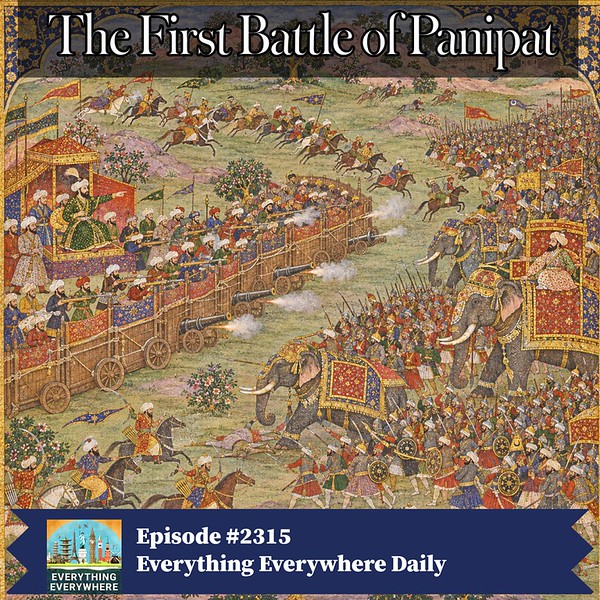
Babur’s forces felled trees, dug trenches, and built his legendary araba. The araba was a defensive formation of carts tied together with rawhide ropes, protecting artillery and matchlockmen while leaving gaps through which cavalry could launch counterattacks. The rope and wagon’s flexibility let the men tighten for defense or open up for counter-offensives.
Accounts suggest the spaces between the wagons allowed for charges of up to 100 men.
The araba’s most important feature was its ability to limit the Delhi Sultanate’s cavalry charges and the influence of battle elephants. His men were outnumbered and couldn’t win an open cavalry battle against a much larger force with battle elephants.
Babur effectively limited his opponent’s greatest strength. According to Babur, the strategy was very successful in stopping Lodi’s advance: Our matchlockmen fired from behind the carts and harassed the enemy… The enemy’s advance was checked by the carts and the fire of our matchlocks. Their massive army became crowded and confused; their elephants, terrified by the noise and fire, turned back upon their own ranks.
While Babur capitalized on the araba’s ability to withstand the Sultanate’s charge, he deployed a classic Turkic-Mongol flanking maneuver known as the Tulughma, using sweeping mobile cavalry units to trap the enemy from all sides.
Babur positioned his army with the town of Panipat protecting his right flank, while trenches and felled trees protected his left. Across his front, he had his defensive barrier of carts, all of which forced Ibrahim Lodi’s much larger army to attack through a narrow front.
But perhaps Babur’s greatest battlefield advantage was his use of cannon. Like the matchlock, Babur adopted Ottoman cannon for the battlefield and used them with precision to negate his enemy’s greatest strength.
Babur described the technological adoption in his memoir: Ustad Ali Quli discharged his big stone-mortar cannon balls on the right and left… The noise and smoke of the discharge threw the enemy into great confusion.
This strategy was particularly effective against the Sultan’s forces, who employed no gunpowder weapons, and were thrown into complete disarray.
With the impregnable shield for Babur’s field artillery and matchlockmen created by the araba, the Delhi Sultanate army almost immediately dissolved into an uncoordinated mass. The Sultanate forces were shocked by their adversary’s preparation and technology. They took the field expecting to run roughshod over a much smaller adversary.
The most surprising development of the day for the Sultanate was the complete ineffectiveness of their armored battle elephants. War elephants had been effective in South Asia for over a millennium, yet against cannon and matchlock guns, they were completely neutralized.
Terrified by the sound, smoke, and being pelted by bullets and balls, the elephants retreated in confusion and fear, trampling the forces of the Sultanate. Rather than breaking Babur’s lines, the terrified elephants instantly transformed the battlefield, turning Lodi’s prized asset into his greatest obstacle.
Babur described the disarray in his autobiography when he wrote: Our matchlockmen and archers having been ordered to shoot at the elephants, the elephants became unmanageable. They could not be driven forward; they turned back and crushed their own people.
The battle began shortly after sunrise, and accounts suggest it was over by noon.
The day was devastating for the Delhi Sultanate; they had been soundly defeated, their forces had fled in disarray, and their leader, Sultan Ibrahim Lodi, was killed on the battlefield.
From the ashes of Panipat, Babur founded the Mughal Empire. Babur intended to settle and lead Hindustan as an emperor of a new state founded on a mixture of Persian, Islamic, and Central Asian principles, while his successors added indigenous Hindu and Indian ideas to forge a cultural blend that would change Asian history.
By seizing the Sultanate’s treasures and, through the massive building projects and urban networks his successors established along the Grand Trunk Road, the Mughals shifted the Islamic world’s economic and cultural center toward India.
The Battle of Panipat also marked an important turning point in India’s political and cultural history. Although the subcontinent had maintained overland connections with Central Asia and Persia for centuries, Babur’s conquest brought a new dynasty to power with ties in Central Asia.
Under his successors, the Mughal Empire strengthened these connections and fostered a remarkable synthesis of Persian, Central Asian, and Indian artistic, architectural, and political traditions.
Panipat stands as one of history’s earliest and most decisive demonstrations of the “Gunpowder Revolution”, but it was not the first such battle. By integrating Ottoman field artillery and massed matchlocks with traditional nomadic cavalry tactics, Babur proved that gunpowder could permanently shatter armies reliant on sheer mass and war elephants.
Twelve years before the Battle of Panipat, Ottoman Sultan Selim I deployed similar strategies at the Battle of Chaldiran, using massed matchlocks and field artillery behind a chained-cart barricade to shatter the cavalry-heavy Safavid Empire in Persia. While the Safavids possessed some early firearms, they had no answer to the crushing scale of Ottoman artillery.
Babur imported this exact tactical blueprint to India, where Ibrahim Lodi’s forces had no gunpowder weapons, creating a complete technological mismatch at Panipat.
The fighting on display at Panipat and Chaldiran was happening across Eurasia. In Europe, armies were transitioning from heavily armored knights to lighter infantry and harquebus-type firearms.
The Battle of Panipat deserves its place among World History’s most important battles.
The Mughal Empire, established by Babur, became one of the wealthiest, most powerful, and culturally influential empires in world history. At its height in the late 17th century, it governed approximately 150 million people, nearly a quarter of the world’s population.
The empire became a major center of global commerce, particularly in textiles, spices, and luxury goods, and its agricultural wealth supported enormous cities.. Monuments such as the Taj Mahal and the Red Fort remain enduring symbols of this Mughal Empire’s legacy. It remained in power across most of India until its eventual decline and the British arrival in the 19th century.
It all came about because of the success of a failed general in 1526 who dared to adopt a new technology.
Automatically extracted from this episode; not independently verified. Please report possible errors below.
People mentioned in episode #2315
- Zahir ud-Din Muhammad Babur
- Ibrahim Lodi
- Timur
- Genghis Khan
- Selim I
Places mentioned in episode #2315
- Delhi
- Samarkand
- Kabul
- Punjab
- Panipat
- Hindustan
- Yamuna River
Historical events in episode #2315
- April 21, 1526 — Battle of Panipat (impact 70/100)
- 1525 — Babur escalated his campaign (impact 60/100)
- early 13th century — Delhi Sultanate formation (impact 70/100)
- late 17th century — Mughal Empire height (impact 80/100)
- 1526 — Mughal Empire founded (impact 85/100)
Episode topics
- History
- Military
- War