
Episode – 2305 : Rubber
This episode can be found at: https://everything-everywhere.com/the-history-of-rubber/
Podcast Transcript
For thousands of years, humanity has used a remarkable material whose properties seem inexplicable.
It can stretch several times its original length, absorb enormous amounts of energy, and return to its original shape.
Its discovery led to scientific breakthroughs, enormous fortunes, brutal exploitation, and even influenced the outcome of wars.
Today, it is found in everything from automobile tires to medical equipment, yet its origins are surprisingly ancient.
Learn more about the fascinating history and science of rubber on this episode of Everything Everywhere Daily.
When people first think of rubber, they may picture an artificial substance invented in a lab. However, rubber is actually a natural substance produced by plants. The material is technically classified as a polymer, which is a large molecule made of small, repeating chemical units.
Natural polymers are found in nature and are vital to life. One example is DNA, made of small, repeating chemical units that form a larger molecule that carries genetic information.
Natural rubber is an essential raw material. It occurs in over 2,500 plant species and is collected as a liquid called latex. The plant stores this milky liquid in latex vessel cells.
Most harvested natural rubber comes from the Brazilian rubber tree, known as Hevea brasiliensis. The tree can reach 30 meters in height and is native to the Amazon.
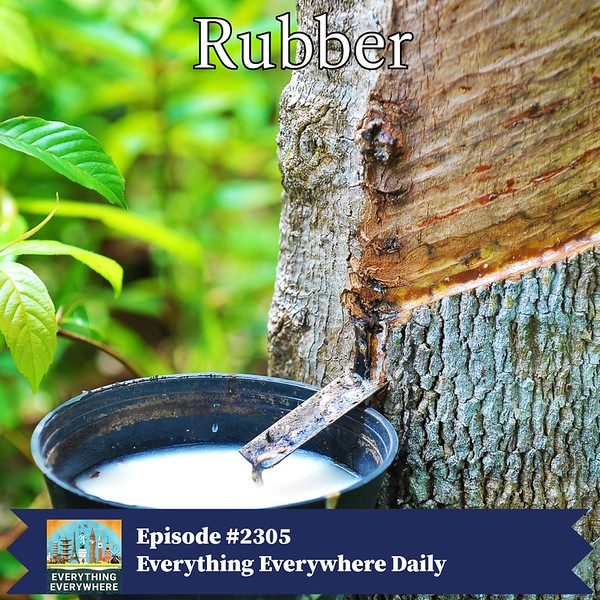
To harvest rubber, workers make shallow cuts through the bark to reach latex-bearing vessels near the cambium. From there, sap begins to flow, and it contains about 33% rubber. To collect the material, workers place a small cup below the tree to catch it.
Extracting rubber from the sap requires several steps.
First, workers add water to the latex sap to filter it. From there, the diluted mixture is treated with acid. This causes the rubber particles to coagulate. After the particles come together, they are taken and rolled into a thin sheet. The rolled rubber is still not usable because it contains too much protein, which could cause it to rot. To combat this risk, the sheets are then smoked in a smoking chamber. After smoking, workers stack the rubber sheets into bales and send them to mixing mills, which completes the rubber process.
We don’t actually know the biological reason plants produce latex. The most popular theory is that it helps plants heal after being damaged. The plant secretes latex from the wound to cover the damage and keep harmful bacteria or insects out.
The use of rubber dates back to 1600 BC, to people in Central America and Mexico. Archaeological evidence shows that the Olmec people used natural latex from the Panama rubber tree to make balls for Mesoamerican ballgames.
Later, the Aztec and Maya also used rubber to make balls and toys. The Aztecs found other uses for the polymer, including making containers and waterproofing their clothing.
It is said that Christopher Columbus was the first European to encounter rubber. This occurred during his second trip to the Americas from 1493 to 1496. He came across the substance while visiting the island of Hispanolia and watched the natives play with a bouncy ball. Columbus also reportedly brought a rubber ball back to Spain in 1496.
A Spanish missionary named Fray Juan de Torquemada also observed the material in 1615. He reported seeing the native population, as well as Spanish settlers in the New World, wearing clothing, shoes, and hats made with cloth and latex. He noted that this step made the material stronger and waterproof. However, a problem remained: rubber became sticky when it was warm and hardened and cracked when it was cold.
In 1736, French explorer Charles Maria de La Condamine introduced rubber to the Académie Royale des Sciences. About 15 years later, François Fresnea presented a paper to the Académie about the material’s properties. This is considered to be the first scientific paper on rubber.
From there, more research and experimentation about the material occurred. In 1770, an Englishman named Joseph Priestley discovered that rubber was good at rubbing pencil markings off a piece of paper. This gave the material the name “rubber.”
Another key discovery came in 1839, when American Charles Goodyear made a breakthrough. He invented a process called vulcanization. This chemical process cures and hardens rubber. This improved the material’s tensile strength and kept the rubber stable across temperatures.
Goodyear discovered vulcanization while searching for a more practical way to treat the material. This discovery was made when Goodyear accidentally dropped rubber mixed with sulfur onto a hot stove.
To protect his discovery, Goodyear patented the process in June of 1844. Despite the patent, he fought numerous legal battles as other people infringed on it. This culminated in his invention making millions for others and him dying in $200,000 worth of debt.
After his discovery, demand for rubber increased, and people pushed to extract more rubber from trees. At the time, the Brazilian Amazon was the only source of natural rubber.
This gave rubber plantations a de facto monopoly, making rubber extremely expensive. This became a problem as industries in North America and Europe developed and found more uses for rubber.
Eventually, a man named Henry Alexander Wickham smuggled rubber seeds out of Brazil in 1876. He hid 70,000 rubber seeds in banana leaves and brought them back to England. Only 2,700 of the 70,000 seeds germinated, but it was enough to kick start rubber cultivation outside of Brazil.
The initial plantations were in South and Southeast Asia, in tropical environments like India, Sri Lanka, and Indonesia. This helped break the Brazilian monopoly and ensure a global supply of rubber.
Henry Ridley, head of Singapore’s botanical garden, promoted the development of rubber plantations in Malaysia. Ridley initially convinced two coffee growers to plant 2 acres of Brazilian Rubber trees. After 12 years, the crops were thriving, and Malaysia was undercutting Brazilian rubber while producing more efficiently. Production doubled every two years for several years.
In the early 1900s, Africa also became a significant source of rubber, specifically from the Congo Free State. Driven by King Leopold II’s desire to exploit the country’s natural wealth, his personal rule over the Congo Free State led to the intense subjugation of the native population. A major reason the colonial state was profitable was forced labor in rubber production. The conditions that people had to live under in the Congo were horrific and were covered in a previous episode.
In South America, the indigenous population was impacted by the production of rubber. Atrocities were also committed there, including the Putumayo Genocide in the Peruvian Amazon, which killed tens of thousands.
As the rubber industry grew, people found more uses for it. In 1888, a Scotsman named John Dunlop created the first commercially successful bicycle tire. It wasn’t the first rubber tire, but it was one of the first that found success in the market.
After the automobile industry took off in the 1910s, rubber became an increasingly desired commodity for tire production. People also used it in everything from basic household supplies to the medical industry and toys. The paper and carpet industry used it most.
Rubber was particularly valuable because it could be manufactured as a fiber. Commonly called elastic, it revolutionized the textile sector due to its exceptional stretch and high recovery.
Because of the massive demand for rubber and the rapid growth of the automotive industry, people began to seek a synthetic alternative to natural rubber.
In 1909, German chemist Fritz Hofmann created one of the first synthetic rubbers by chemically linking methyl isoprene molecules into long polymer chains, producing a rubber-like material.
Earlier experiments by Gustave Bouchardat in 1879 and William Tilden in the 1880s produced rubber-like polymers, but Hofmann’s work helped establish industrial production of synthetic rubber.
Synthetic, or artificial, rubber has replaced natural rubber for many uses. However, this material is not as high-quality as natural rubber. Synthetic rubber lacks some of natural rubber’s properties, so natural rubber remains necessary.
The United States also worked to develop its own synthetic rubber. The government and the rubber industry initiated this effort and developed styrene-butadiene rubber, or SBR.
Despite these new rubbers, natural rubber remained the most popular source. However, World War II was about to change the rubber industry, as it changed everything else.
When World War II broke out, Southeast Asia was the world’s primary rubber supplier, with Malaya as the largest region. Initially, the colony produced enough rubber to supply the industrial and military needs of the British Empire and its allies.
Natural rubber was extremely useful to the military as it was used in its vehicles and aircraft. The resource was also used around fuel tanks. This meant that if a plane’s wing was pierced during combat, natural rubber could partially seal the hole, making it more likely the aircraft would return home.
However, when Japan entered the war, things changed. In December 1941, they invaded Malaya, cutting off Allied access to most of the global rubber supply and creating a temporary rubber shortage among the Allies.
After the war, Countries realized the danger of relying on one region for rubber production which led to more investment in creating synthetic alternatives.
Synthetic rubber is made through a specific, step-by-step process. It typically starts with a liquid hydrocarbon mixture derived from coal or oil, known as “naphtha.”
Manufacturers chemically link small molecules, called monomers, into long polymer chains. For example, manufacturers produce styrene-butadiene rubber by polymerizing styrene and butadiene, chemicals commonly obtained through petrochemicals. Manufacturers can then mix the resulting synthetic rubber with additives and vulcanize it to improve its strength and elasticity.
After synthetic rubber was developed, it quickly replaced natural rubber. By 1964, synthetic rubber constituted 75% of the overall rubber market.
In 1973, the OPEC oil embargo drastically changed the rubber market.
Oil is a key resource for making synthetic rubber. When oil prices rose, synthetic rubber prices doubled. This threatened the synthetic market.
High oil prices led consumers to adopt radial tires, which use less fuel. Radial tires have reinforcing cords that run perpendicular to the direction of travel, allowing the sidewalls to flex independently of the tread for better traction, fuel efficiency, and durability.
Before the embargo, radial tires made up less than 10% of the market. By the end of the 1980s, 97% of all cars were rolling on radial tires.
The global rubber market, including natural and synthetic rubber, was valued at approximately $51 billion in 2025, with worldwide consumption estimated at 32.5 million metric tons annually. Natural rubber meets roughly half of that demand, and synthetic rubber meets the other half, with tire manufacturing accounting for more than half of global consumption.
Few materials have had as profound an impact on the modern world as rubber. What began as a substance harvested and used by ancient peoples eventually became one of the foundations of modern industrial society.
Despite the development of synthetic alternatives, natural rubber remains an essential resource that modern technology has yet to fully replace. From the tires that move us to the countless products we use every day, rubber is a material that is so commonplace we rarely stop to appreciate just how remarkable it really is.