
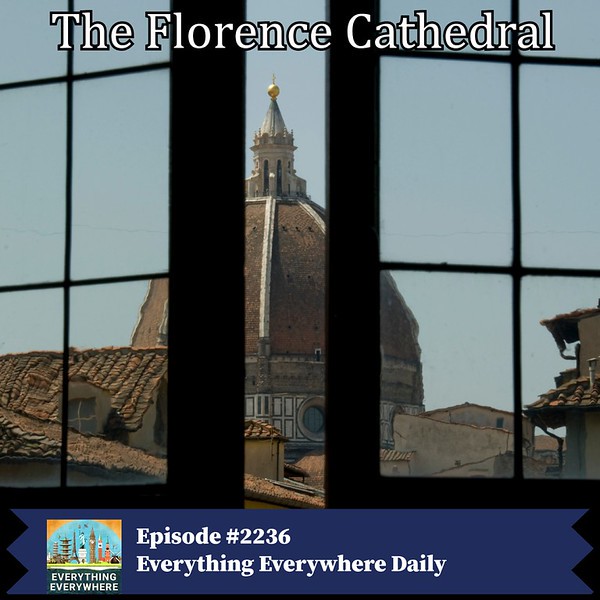
Episode – 2236 : The Florence. Cathedral
Podcast Transcript
For more than a century, one of Europe’s richest cities worked on a building it didn’t know how to finish.
Its designers created an enormous space that seemed impossible to cover, leaving future generations with one of the Middle Ages’ greatest engineering challenges.
The solution would require new machines, new construction techniques, and one of history’s most brilliant architects.
Learn more about the long and remarkable history of Santa Maria del Fiore, aka the Florence Cathedral, on this episode of Everything Everywhere Daily.
One of the most impressive and architecturally important cathedrals in Europe is the Cathedral of Florence, Italy.
Formally known as Santa Maria del Fiore, which translates to Saint Mary of the Flower, it is the 3rd largest cathedral in Italy and the fifth-largest in the world.
Made from three marble varieties from around Italy, its white, green, and pink facade pales in comparison to the colossal octagonal dome of red terracotta brick that rises more than 375 feet (114 meters) above street level.
Italy, as we know it today, didn’t exist in the late 13th century as a unified nation; instead, it was a patchwork of rival city-states along the Italian Peninsula. Each city-state had its own economy and political system, but all shared a single goal of using architecture to broadcast their wealth and cultural superiority.
Florence was a wealthy plutocracy fueled by the wool trade and international finance, most famously led by the powerhouse Medici banking family, which I’ve covered in a previous episode.
In the 13th century, Florentines had much to be proud of, but their cathedral was an embarrassment. To Italians, a cathedral was the civic heart and sacred symbol of a city.
Down the road in Pisa, a stunning white marble cathedral and its leaning bell tower showcased its wealth
Meanwhile, to the south, arch-rival Siena poured fortunes into a soaring Gothic cathedral with dramatic black-and-white striped marble and mosaic floors.
By contrast, the Florence cathedral, the Santa Reparata, was dark, cramped, and decaying. By 1296, the city’s governing council had had enough; they resolved to build a church that would tower over their rivals in Pisa and Siena.
They hired master architect Arnolfo di Cambio to design the cathedral, while the city awarded other major construction contracts through public competitions.
Di Cambio laid the cornerstone on September 8, 1296. Rather than tearing Santa Reparata down all at once, builders erected the new cathedral’s massive outer walls directly around the old church to maintain the continuity of church services.
The city’s wealthiest and most powerful merchant guild, the Wool Merchants Guild, directed the project’s funding and created an administrative board called the Opera del Duomo, or roughly, the Cathedral Works Department.
To raise revenue, they taxed imported wool and levied contributions on citizens’ wills. In 13th-century Italy, wills required contributions to civic and religious works.
To adorn the cathedral, the Opera del Duomo commissioned the greatest artistic talents of the age, including Giotto, who built the magnificent, free-standing bell tower that still stands beside the cathedral today.
By the early 1400s, after more than a century of construction, the vast nave or central part of the church, the chapels, and the immense octagonal drum were essentially finished. The drum is the vertical wall or base that supports a dome and raises it above the rest of the building,
There was just one problem, and it was a big one. The original plans called for the largest dome built since the Roman Pantheon.
The drum was 170 feet (52 m) above the cathedral floor and 144 feet (44m) across diagonally.
Nobody in history had ever built such a dome.
Under the standard practices of the day, building an arch required masons to build a temporary wooden framework spanning from the ground to the roof. They would then lay stone bricks across the scaffold until the dome’s keystone was put into place, making the arch self-supporting.
One major problem was building the centering scaffold, as it would have required nearly 1,000 trees, 170 feet high. The problem was that the region around Florence in Tuscany did not have those kinds of trees.
Engineers also speculated that the weight of the lumber alone would crush the cathedral floor. To make matters worse, the Florentines rejected the obvious solution. In Northern Europe, Gothic cathedrals used stone arms called flying buttresses that extended from the walls to support the roof’s weight.
Florentines rejected the Gothic style as barbaric and ugly, and the city council formally banned its use. The new dome had to support its own immense weight from within. By 1418 and with no solution in sight, the Opera del Duomo had had enough of the inaction.
On August 19, 1418, they announced a public architectural competition, with the winner receiving a prize of 200 gold florins, a fortune at the time. The contest drew dozens of leading architects, masons, and artists from across Europe to submit their plans.
One proposal suggested filling the cathedral with a mountain of dirt mixed with silver coins; workers would build the dome on top of the mountain of dirt. Once the stonework was done, the city would invite poor Florentines to dig out the earth, allowing them to keep the coins.
Not surprisingly, the judges considered the idea absurd and rejected it immediately.
Among the top contenders, Lorenzo Ghiberti and Filippo Brunelleschi had emerged as the likeliest choices.
This must have felt like deja vu for the two artists, for it was just 17 years earlier, in 1401, that Ghiberti beat Brunelleschi in the famed competition to cast the bronze North Doors for the cathedral baptistery across the square. That success led directly to Ghiberti being awarded the commission for the East Doors.
Eager to win the dome competition, Brunelleschi faced an uphill battle. He was a goldsmith, not a stone mason, nor an architect. He had no building credits to his name, and he was widely disliked for being ill-tempered.
Yet for this particular task, Brunelleschi was well prepared. He had spent much of the previous decade in Rome, taking copious notes, sketching ancient ruins, and reverse-engineering the colossal dome of the Pantheon, a structure with nearly the same diameter that had stood for more than a thousand years.
When Brunelleschi returned for the competition in 1418, he made an audacious claim: he would build the dome without any wooden central scaffolding, thus preserving the floor. The unbelievable part was that Brunelleschi claimed his dome would support itself in mid-air as it rose.
The judges demanded blueprints and models, but Brunelleschi refused, fearing Ghiberti would steal his proprietary ideas.
When the committee refused to award the commission without proof, Brunelleschi responded with a challenge of his own. Brunelleschi’s challenge was compiled by a 16th-century biographer, Giorgio Vasari, who noted:
The wardens and the consuls would have wished that Filippo show his model, just as the others had done; which he had no mind to do, but proposed to them that whoever could make an egg stand upright on a flat sheet of marble should build the cupola, for in that way their intellect would be made manifest. An egg was brought, and all those masters tried to make it stand upright, but not one of them knew the way. Filippo was told to make it stand; and taking it with great courtesy, he struck its end against the flat marble, and made it stand upright.
The craftsmen took offense, saying that they could have done the same thing; and Filippo, laughing, replied that they would also know how to vault the cupola, if they had seen the model or the design.
The demonstration proved his point. Brunelleschi received the commission in April 1420, but it came with a catch. His rival Lorenzo Ghiberti must serve as his co-superintendent, sharing the credit.
To execute his plan, Brunelleschi adopted a series of brilliant strategies developed from Roman techniques.
Brunelleschi created a two-layer dome, with a four-foot cavity separating the layers. Brunelleschi supported the dome with a series of concentric ribs, much like a barrel made of stone and iron, which supported the structure as it tapered toward the top.
The ingenious plan was based on placing vertical bricks in a zigzag pattern among horizontal rows in a herringbone pattern. The vertical bricks anchored the layer above into the lower rows, creating a self-locking pattern that directed the weight downward.
To lift tons of bricks, mortar, and ribs, Brunelleschi devised a new machine for which he received a patent in 1421: the reversible ox-hoist. This is widely considered the first patent in history.
The hoist was powered by a pair of oxen walking continuously in a single direction, driving a unique gear transmission system that let the engineer reverse the oxen’s pull without unyoking them and turning them around.
Near the top, he devised a second custom-built machine, a small 360-degree crane that allowed the masons to position massive stone blocks with great precision.
To ensure the workers worked their hardest, he built kitchens up the scaffold so the men could eat without walking all the way down and back up. He also wisely insisted that their wine be watered down for safety reasons.
Over the course of sixteen years of elevated construction, only one worker suffered a fatal fall, a significant achievement in the 15th century, made possible by Brunelleschi’s mandatory safety netting and sober workers.
Brunelleschi’s mechanical systems were so advanced that decades later, a young Leonardo da Vinci meticulously sketched these very cranes and hoists in his notebooks.
Perhaps his proudest achievement was discrediting his hated rival and removing Ghiberti from the project entirely. At a key point in the building process, Brunelleschi feigned illness, leaving Ghiberti in charge.
During his absence, Ghiberti predictably bungled the installation of several features. Upon his ‘recovery,’ Brunelleschi pointed out the glaring structural errors to the committee, which promptly removed Ghiberti and granted Brunelleschi sole credit and authority.
Pope Eugene IV consecrated the nearly complete structure in a lavish ceremony in the spring of 1436.
After finishing the dome and winning the competition for the design of the marble lantern that adorns the top of the Duomo in 1446, Brunelleschi died.
Florence felt vindicated. Brunelleschi had given them the greatest cathedral of its age. However, the cathedral’s journey wasn’t quite complete, as the base of the dome was bare red brick.
The Opera del Duomo commissioned Baccio d’Agnolo to add a marble gallery along the bottom of the dome’s eight sections. Only one section was ever completed. Before completing the project, the committee sought public advice on d’Agnolo’s work.
Among the voices they heard from was none other than Michelangelo. He was not pleased and offered a poor review of the project, noting that it looked like “a cage for crickets”.
d’Agnolo was devastated by the public criticism and never returned to the project, and Michelangelo was tasked with improving it.
Unfortunately, his design would have come at extraordinary expense, and it was ultimately decided to leave the base incomplete. Today, d’Agnolo’s work is visible on only 1 of the 8 sections of the lower dome.
Pope Paul III later commissioned Michelangelo to build the Basilica of St. Peter in 1546. He promised to take the Duomo with him in spirit, when he remarked: I am going to Rome to make her sister—larger, yes, but not more beautiful.
The cathedral continued to evolve after Michelangelo.
In the late 16th century, Giorgio Vasari and Federico Zuccari covered the dome’s interior with a colossal fresco of The Last Judgment, ignoring Brunelleschi’s plans for inlaid gold paneling.
In 1587, the city dismantled the unfinished original facade, leaving the church’s front bare until the late 19th century, when Emilio De Fabris installed the stunning Neo-Gothic marble front as part of celebrations honouring Italy’s unification.
Twentieth-century archaeologists wrote the final chapter in the Duomo’s story.
Digging beneath the floor between 1965 and 1974, they uncovered the ancient crypt of Santa Reparata and the tomb of Filippo Brunelleschi.
Brunelleschi’s grave bears a fitting inscription: Here lies the body of the man of great genius, Filippo Brunelleschi the Florentine.
The story of the Florence Cathedral spans centuries. Begun in the Middle Ages, and expanded as Florence grew in wealth and power, it became both a religious monument and a symbol of the city itself.
More than six centuries after its dome was completed, Santa Maria del Fiore still dominates Florence, standing as one of the clearest examples of what sustained civic ambition and engineering can achieve.
This episode can be found at: https://everything-everywhere.com/episode-2236-the-florence-cathedral/