
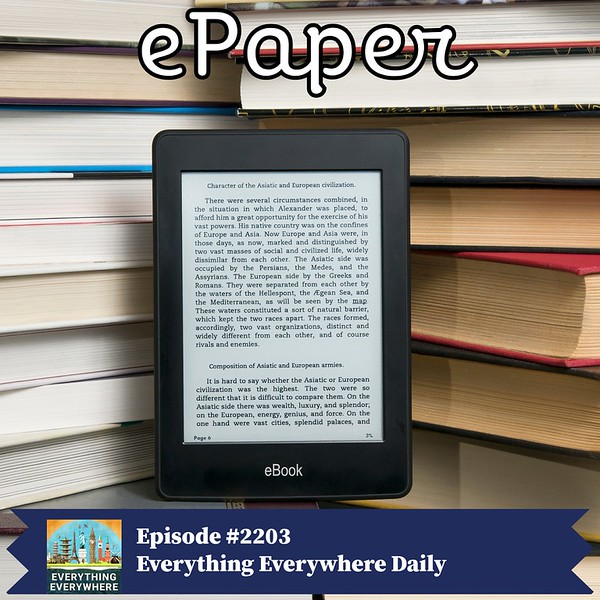
Episode – 2203 : All About ePaper
Podcast Transcript
For centuries, the printed page was one of the most efficient ways to preserve and share information.
In the digital age, engineers sought to reproduce the best qualities of paper without sacrificing many of the benefits of a screen.
The result was a technology that uses remarkably little power, remains readable in bright sunlight, and can hold an image even when the electricity is turned off.
Learn more about the history and technology of e-ink and electronic paper on this episode of Everything Everywhere Daily.
Before I start, I should make a note about terminology. The terms e-ink and e-paper are used interchangeably. However, E Ink is a company and trademark, while electronic paper, or e-paper, is the broader category of display technologies.
E Ink Holdings has become so dominant in the market that its brand name is often used generically, much as “Kleenex” is sometimes used for facial tissue.
Also, to put e-paper into context, I’ll briefly describe how LCD displays, which are used in most devices today, work.
An LCD, or liquid-crystal display, uses a backlight that shines through a layer of liquid crystals. Each pixel contains red, green, and blue subpixels. Electrical signals change the alignment of the liquid crystals, controlling how much light passes through each colored subpixel. By combining different amounts of red, green, and blue light, the screen produces millions of colors.
There are other similar technologies and variations of LCD, but for the purposes of this episode, they all have in common that they actively emit light and require continuous power to produce an image. If your battery dies or you lose power, the screen will go blank.
Researchers wondered if it was possible to create a display that had some of the best features of a screen, in that it could be updated and refreshed, but also shared some of the best features of good old-fashioned paper.
The fundamental idea behind electronic paper emerged from display research in the 1960s and 1970s, when cathode ray tubes, or CRTs, were still the dominant form of display technology. Engineers were trying to create screens that would be thin, portable, readable in ordinary light, and capable of retaining an image without constantly drawing power.
One of the first important technologies in this field was developed at the Xerox Palo Alto Research Center, better known as Xerox PARC. During the 1970s, researcher Nicholas Sheridon created a system called Gyricon, a name derived from Greek words associated with rotation and images.
Gyricon consisted of millions of tiny plastic spheres embedded in a flexible transparent sheet. Each sphere was black on one side and white on the other. The two sides carried different electrical charges, positive or negative. When an electric field was applied, the spheres rotated so that either the black or white side faced the viewer.
What was genius about this system was that once the spheres had turned, they stayed in position without requiring continuous power. In principle, a Gyricon sheet could display text or images, retain them indefinitely, and then be rewritten.
Sheridon constructed an early prototype in 1975 and patented the twisting-ball display concept in 1978. Xerox eventually created a subsidiary to commercialize Gyricon, particularly for reusable signs, but the company struggled to produce displays cheaply enough. Xerox closed the subsidiary in 2005, although the work established many of the principles later associated with electronic paper.
The direct ancestor of modern E Ink was developed at the MIT Media Lab during the 1990s.
Physicist Joseph Jacobson imagined an electronic book that could store many titles while retaining the physical qualities of paper. Working with several MIT students, Jacobson’s group developed a new form of microencapsulated electrophoretic ink.
That is a mouthful, but the technology is conceptually pretty simple to understand.
Rather than attempting to manufacture perfectly divided black-and-white spheres, the researchers suspended electrically charged pigment particles in a fluid. They then enclosed the fluid in microscopic capsules.
Instead of half of a sphere having an electrical charge and a different color, a whole sphere had its own charge and its own color. When the electrical charge was changed, the spheres would rise or fall in the microcapsule. The movement in a fluid due to an electrical charge is known as electrophoresis.
The breakthrough was important because microencapsulation made electrophoretic displays more durable and easier to manufacture. Each capsule served as a tiny, controlled container, preventing particles from spreading across the screen, reducing leakage and uneven movement.
The team published its work in the scientific journal Nature in July 1998. The paper described an electrophoretic ink that combined low power consumption, high reflectivity, wide viewing angles, and the ability to manufacture displays via printing and coating processes.
The research team founded E Ink Corporation in 1997 to commercialize the technology. The company emerged from the MIT Media Lab and initially experimented with signs and other large displays before focusing on high-resolution panels for handheld devices.
A modern black-and-white electrophoretic display contains several layers.
At the front is a transparent protective surface. Beneath it is the electrophoretic material, made from millions of microscopic capsules or small compartments. Behind this is an array of electrodes controlled by thin-film transistors.
Each microscopic capsule contains a clear fluid and two types of pigment particles. In a common arrangement, the white particles have one electrical charge and the black particles have the opposite charge.
When a voltage is applied across a capsule, the electric field attracts one group of particles toward the front and pushes the other group toward the back. When white particles move to the viewing surface, that area appears white. When black particles move to the surface, it appears black. Intermediate shades of gray can be created by combining particle positions, pulse sequences, and spatial dithering.
E Ink describes its capsules as being approximately the diameter of a human hair.
One of the defining properties of electrophoretic displays is bistability.
As I mentioned earlier, a conventional display requires electrical power to maintain or illuminate the image. In an e-ink display, the pigment particles tend to remain where they have been placed after the electric field is removed.
As a result, an e-ink screen generally uses most of its display-related power only when the image changes. Once a page, price, or sign has been drawn, the screen can retain it for days, months, or longer without consuming power to keep the image visible.
The electronic ink is only part of the display. A practical screen also requires a backplane capable of controlling individual pixels.
Each pixel is connected to a thin-film transistor. The transistor applies carefully timed positive and negative voltage pulses that move the pigments. These sequences are called waveforms.
Changing a pixel is not always as simple as applying one voltage. The particles have inertia, interact with the fluid, and may retain some memory of their previous positions. The controller may move them through several intermediate states before settling on the intended shade.
E Ink’s first commercial demonstrations involved large signs rather than books. Its first prototype signs shown in 1999, could be updated electronically while retaining their information without continuous power. The company also worked with Lucent Technologies on flexible display prototypes around 2000.
The first widely recognized consumer e-reader using E Ink technology was Sony’s LIBRIé, introduced in Japan in 2004. It demonstrated that electrophoretic displays could support a viable consumer device.
The e-ink product that many of you are probably best familiar with is the Amazon Kindle.
Amazon introduced the original Kindle on November 19, 2007. It combined an E Ink screen with wireless book purchasing and delivery.
Earlier e-readers often required users to connect the device to a computer and manually transfer files. The Kindle allowed readers to browse, purchase, and download books directly.
The Kindle did not invent electronic reading, and it was not the first e-reader. Its importance came from integrating the screen, bookstore, wireless network, and publishing ecosystem into one product.
The success of the Kindle greatly increased production volumes for electrophoretic panels. Competing products from Sony, Barnes & Noble, Kobo, PocketBook, and other manufacturers expanded the market.
Here, I want to interject my own personal experience with the Kindle. The Kindle was released about six months after I began traveling around the world.
When you travel, you have a lot of downtime. I would always have a book with me. The problem is that books are heavy, and finding English-language books in a non-English-speaking country is usually difficult and expensive. They are also heavy, and I found myself carrying several books because I couldn’t bring myself to get rid of them.
After a few years, I purchased a Kindle for myself, and it was literally a game-changer. I now had something lightweight with access to the world’s biggest bookstore at my fingertips.
The power of the Kindle was evident in 2014, when I was boarding a ship in Cape Town bound for the island of St Helena. I was on the ship and realized I had nothing to read for almost a month without internet access.I ran up to the top deck of the ship, downloaded the entire Game of Thrones series via 3G in just a few minutes, and was set for the voyage.
Black-and-white e-ink displays have been appearing in stores recently because they can automatically display and update prices.
One of the biggest advances in e-ink has been the development of color e-ink displays. One of the most popular technologies was developed by eInk Corporation as Advanced Color ePaper (ACeP).
In a multi-pigment system, particles of different colors exhibit distinct electrical properties. Carefully designed voltage sequences separate and position the desired pigments at the viewing surface.
A full-color system may use cyan, magenta, yellow, and white particles. By placing different combinations near the surface, it can reproduce a broad range of colors.
The colors are not as vibrant or as bright as they are on a normal LCD monitor, but the quality is surprisingly good. There are now products on the market that are color eInk displays to hang on the wall that are the size of a framed picture or a poster.
The brilliant thing about them is that they use little electricity, and you can change the image to whatever you want at any time.
Another advantage of e-paper over LCD monitors is that it can be used in full sunlight. If you have ever tried to view the screen on your smartphone on a sunny day, you’ve probably experienced the problem. They work better without direct light on the screen.
E-paper works well in the sun because there is no backlight. There are e-paper signs that are being installed for outdoor use, which require a low-power solution that can be read easily in sunlight.
One of the biggest weaknesses of e-paper devices has been the refresh rate of the screen. Some of the first-generation devices took a noticeably long time to refresh the screen with new content.
Some of the newest generation of e-paper screens have gotten remarkably better. I saw a YouTube video of someone who had hacked an e-paper and managed to get a 60 hertz refresh rate. With it, he was able to get it to function as a reasonably good laptop monitor, albeit in black and white.
I can safely say that you will probably never have a television made out of e-paper. The image quality just can’t match what a high-end LCD monitor can produce. That said, there are e-paper smartphones on the market.
But that was never its purpose. E-paper serves a very definite niche. Any signage or device that doesn’t need to be refreshed constantly is a perfect candidate for an e-paper screen.
If you haven’t seen them out in the wild, you’ll probably be seeing more of them in the years to come.This episode can be found at: https://everything-everywhere.com/all-about-epaper-and-eink/