
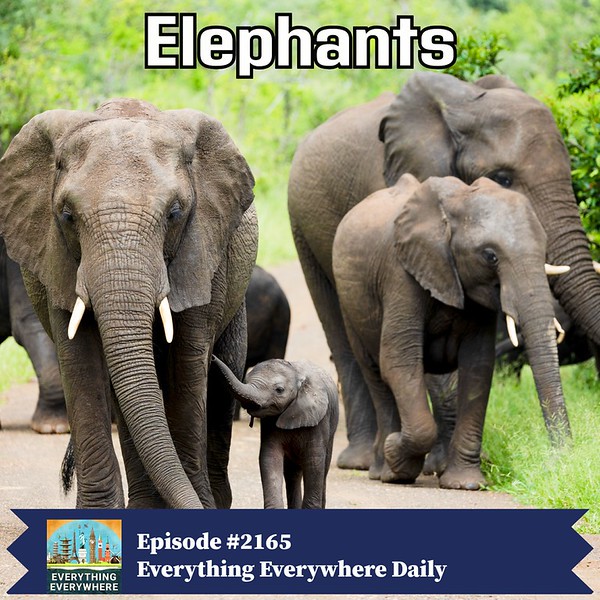
Episode – 2165 : Elephants: Nature’s Largest Land Animals
Podcast Transcript
Elephants are the largest land animals on Earth, capable of extraordinary intelligence, complex communication, and deep social bonds.
For thousands of years, they have shaped ecosystems, carried armies, inspired cultures, and become symbols of both power and vulnerability.
They also have one of the most unique and versatile appendages in the animal kingdom.
Learn more about elephants on this episode of Everything Everywhere Daily.
Elephants are awesome, and I think most of you can get behind that.
Elephants are massive land animals native to Africa and Asia. They are the largest land animals on Earth, weighing an average of 4 to 6 tons and reaching a length of 10 to 16 feet (3 to 5 meters). Elephants are a unique species because of their trunks, large ears, and massive bodies.
There are three different types of elephants. The African Savannah, or bush, elephant is the largest elephant species, while the African forest elephant and the Asian elephant are roughly the same size.
Asian elephants differ from African elephants in several ways. For example, Asian elephants have much smaller ears than African elephants. Their tusks are also different. All African elephants, regardless of sex, grow tusks. In Asian elephants, only males grow tusks.
Tusks are a very important and versatile tool for elephants. Like humans who can be left- or right-handed, elephants can be left- or right-tusked. You can tell which side is dominant for an elephant based on the wear and tear of its tusks.
Biologically, tusks are just elongated incisors. These extended teeth protect the elephant’s trunk when it forages for food or scrapes bark off trees. The tusks can also be used to lift and move objects or dig holes during a drought. They are also a defensive mechanism.
The most notable characteristic of both African and Asian elephants is their trunk. Elephants use their trunks for a host of tasks, including communication, making trumpet warnings, and greeting other elephants. They also use trunks to drink, bathe, and pick up objects.
Elephant society is a matriarchy, a social system primarily led by females. Social units are primarily composed of calves and females, while males tend to live in small bachelor groups or alone.
Female elephants are pregnant for 22 months, the longest gestation period of any land mammal. They give birth once every 4 to 5 years. Once an elephant calf is born, the herd cares for it. If the calf is female, she is likely to live in that herd for the rest of her life. Male calves stay with the herd until they reach puberty.
Forest elephant herds tend to be smaller than their savannah counterparts, being primarily composed of a mother elephant and her children. This is not a hard rule, though, as forest elephants often form larger groups in clearings where food is more abundant.
Elephants require large amounts of land to survive. As the seasons change, elephants migrate to areas with more food and water. This migration pattern is part of why they have such strong memories. Remembering complex routes is essential for survival.
Because they have strong memories, elephants also have high intelligence. They are among the few creatures to use tools and recognize their reflections. Elephants have been observed stripping bark from trees and chewing it into a ball. They use those balls to block watering holes and cover them in sand. When they want a drink, they can uncover and unplug the hole to drink safely.
Elephants are considered keystone species, meaning they play a disproportionately important role in maintaining their ecosystem compared to other animals. If elephants were to disappear from their ecosystem, their habitats could potentially collapse.
They do this in several ways. The first is by shaping their environment. Elephants knock down trees, eat saplings, and strip trees of bark. This prevents dense brush from taking over their environment, keeping grasslands open and allowing other animals to graze.
Elephants also provide access to water for other creatures. During the dry season, they use their trunks to dig in dry river beds. It is common for elephants to find water under the surface this way. This supplies watering holes that other species depend on to survive.
Elephants also disperse seeds. They consume large amounts of fruit and vegetation. When they relieve themselves, they deposit seeds across the landscape. Walking for long periods allows them to spread seeds and provides new fertilizer, which helps plant growth.
Elephants also create micro-ecosystems. Because they are so large, their footsteps leave divots in the ground. These divots can fill with rainwater, which insects and frogs use to help reproduce and feed.
Humans and elephants have coexisted for thousands of years. While still wild creatures, elephants can be tamed and trained to work with people. This process is different from domestication, in which animals are bred over generations to live closely with humans, as with dogs and horses.
Tamed animals have not been selectively bred over time to develop specific traits like domestic animals. This means that Elephants remain wild, maintaining their natural behaviors and instincts even after being tamed.
Despite still being wild animals, elephants can be friendly and compliant towards humans, allowing for a working relationship to form between the two species.
Early human-elephant relations can be traced back 4,000 years to the Indus Valley Civilization. While we don’t know for sure whether elephants were tamed, we do know they were important ideological and spiritual symbols, as evidenced by artifacts found at archeological sites.
One of the earliest recorded uses of elephants by humans was for war. Due to their size, elephants essentially served as the tanks of the ancient world.
The earliest known record of war elephants dates back to 1500 BC in South Asia. Evidence is found in Ancient Sanskrit texts such as the Mahabharata and the Ramayana.
Within both poems, there are elaborate descriptions of using elephants in battle. Ancient Indian armies were typically divided into four parts: infantry, cavalry, elephants, and chariots. Elephants were the preferred mode of transport for warriors.
Elephants became a crucial part of ancient Indian warfare, as armies without them were at a massive disadvantage.
Elephants are naturally feared by horses, making their presence on the battlefield a counter to cavalry. They also have the ability to charge at 20 miles per hour, allowing them to smash through barriers that a traditional cavalry could not.
Despite the pros, war elephants could also be a liability. If the elephant was startled or hurt, there was a chance that the creature could go berserk and trample their own army.
Additionally, over time, tactical countermeasures were developed, such as opening their army’s lines so the elephants could charge right through. This tactic was used to counter elephants at the Battle of Zama between Rome and Carthage in 202 BC.
As time progressed, more and more ancient societies began to employ elephants, spreading the practice across the Mediterranean and Northern Africa.
Perhaps the most famous use of war elephants was by the Carthaginian general Hannibal, who marched elephants over the Alps in 218 BC. The elephants played a vital role at the Battle of the Trebia, but almost all of them died during the first winter in Northern Italy.
The practice of using Elephants as weapons began to die off in the 18th and 19th centuries. This is because, as warfare progressed, namely due to improvements in artillery, elephants became obsolete.
In Ancient society, elephants had a few other uses. One of these was a food source. They were hunted for their meat, which could sustain a group of people for weeks.
It was also common for elephants to be hunted for their ivory. Ivory, taken from elephant tusks, was highly prized in many ancient cultures. It was often used by wealthy people to make jewelry, statues, and weapons. Its value spurred a widespread ivory trade, making it important in ancient maritime commerce.
Elephants have also been used to perform labor. In Asia, elephants have been used for centuries as a beast of burden. Their strength and agility have been vital tools for helping farm owners plow fields.
Additionally, elephants were valuable aids in transportation. Again, their size and intelligence have aided people for centuries in carrying supplies, tools, and people across difficult terrain.
Finally, elephants help in the forestry industry. Their strength allows them to carry and transport heavy logs. Chains are strapped to elephants so they can move logs through dense trails and drop them in clear areas.
Elephants are still employed in Asia today. There are an estimated 13,000 to 16,500 working elephants. Most of these creatures were brought in from the wild between the ages of 10 and 20. This range is preferred because it is when elephants are most trainable and are capable of working for extended periods of time.
In modern Asia, elephants are typically used to pull and carry objects and people. They are selected over mechanical tools because they can complete the same tasks while more easily navigating rough terrain.
Elephants have also been a spiritual symbol for centuries in Southeast Asia, particularly in Buddhism and Hinduism. In Hinduism, the elephant is considered to be one of the most sacred creatures. They are viewed as symbolizing divinity, royalty, strength, and wisdom.
The most notable embodiment of the elephant in Hinduism is the deity, Lord Ganesha. The deity has an elephant-shaped head that is meant to represent wisdom, listening, patience, efficiency, and adaptability. He is highly celebrated as a god of new beginnings and a patron of art and science.
Elephants are also prominent in Buddhism as symbols of mental fortitude, patience, and enlightenment. One of the most notable symbols in Buddhism is the “While Elephant,” which is representative of training and later being fully in control of your mind.
I previously did a full episode on White Elephants and how receiving one was considered both a blessing and a curse.
Elephants are also seen as figures in African spirituality. In Ashanti folklore, elephants were considered the physical embodiment of the spirits of their former chiefs. Symbolically, many cultures viewed the elephants as symbols of justice, wisdom, and leadership.
Despite their size and strength, elephants are at risk. The species is considered endangered due to a variety of human-caused factors.
The first risk to elephants is habitat loss. Because the creature is so large, it consumes large amounts of food and water. Humans have begun invading their spaces in savannahs and forests to build settlements, farms, and roads, limiting their access to food and their ability to survive.
Because the elephant’s range is restricted, populations become isolated and are forced to adopt different strategies to obtain food. It is common for elephants to break into human settlements and forage in farmlands, causing significant crop damage. This often leads to retaliation, with humans injuring or killing elephants to protect their land.
The biggest threat to elephants, however, is poaching. The illegal ivory trade incentivizes poachers to kill thousands of elephants every year just for their tusks. Though African elephants are more at risk, Asian elephants are also poached for their meat, skin, and tail hair.
Internationally, the biggest tool in the fight against the illegal ivory trade is the Convention on International Trade in Endangered Species of Wild Fauna and Flora, or CITES, which banned most international commercial trade in elephant ivory in 1989. Many countries have also closed or restricted domestic ivory markets because legal markets can provide cover for illegal ivory.
There have also been public campaigns in major consumer countries, especially in Asia, to reduce the status value of ivory. China’s closure of its legal ivory market was especially important because it had been one of the largest consumer markets.
Elephants are among the most remarkable animals on Earth, not only because of their size, but because of their intelligence, memory, family bonds, and long involvement in human history. They have carried armies, shaped landscapes, and inspired religions.
The Executive Producer of Everything Everywhere Daily is Charles Daniel. The Associate Producers are Austin Oetken and Cameron Kieffer.
Research and writing for this episode were provided by THE Olivia Ashe.
I want to remind everyone that the 6th anniversary episode of Everything Everywhere Daily is coming up on July 1, and I’m going to turn the show over to all of you. You can record a brief audio message at https://www.speakpipe.com/EverythingEverywhere and tell me who you are, where you are from, and what your favorite episode is. There is a link to the site at the top of the show notes.
Today’s review comes from listener Total Human on Apple Podcasts in the United States. They write:
Great pod!
This podcast teaches you something new every day! | listen to this
on my way to school, and most of the topics are those that I didn’t
previously know. After the episode, however, I know a lot about said
topic, and sometimes I even teach it to others. Keep up the good
Work!
Thanks, Total Human! You have discovered one of the major benefits of the podcast, learning about things you didn’t even know that you didn’t know.
Remember, if you leave a review of the podcast on any of the major podcast apps, you can have it read on the show.This episode can be found at: https://everything-everywhere.com/elephants-natures-largest-land-animals/