
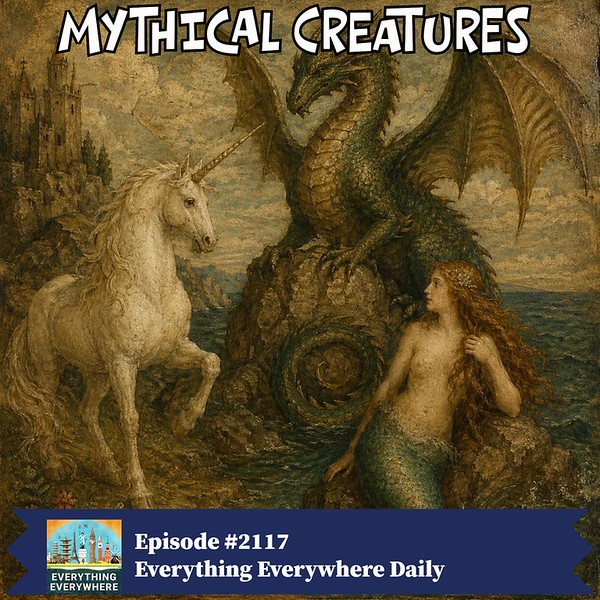
Episode – 2117 : Mythical Creatures: Unicorns, Dragons, and Mermaids
Podcast Transcript
Throughout history, people have believed in or told stories about fantastical creatures to teach lessons, explain the unknown, or entertain others.
Many of these stories originated from accounts by travelers, interpretations of discovered animal bones, or representations of remarkable natural phenomena.
Over time, these creatures transitioned from stories to mythological staples embraced by everyday people and are still shared today.
Learn about the origins of unicorns, dragons, and mermaids on this episode of Everything Everywhere Daily.
Let’s start with one of the most iconic and beloved legendary creatures: the Unicorn.
Unicorns are usually depicted as stunning white horses with a spiral horn sticking out of their foreheads.
The earliest historical connection to unicorns might date to the Indus Valley Civilization between 3000 and 1300 BC. The connection remains uncertain, as seals used by elites depict an animal resembling a horse with a single horn, though scholars question whether this truly represents a unicorn.
Though the animal depicted on clay seals appears similar to a unicorn, there is debate over whether it represents the ancient aurochs.
The animal appeared on many elite and merchant seals, suggesting cultural importance.
The earliest written evidence of what we would consider a unicorn comes from the Ancient Greeks in the 4th century BC. This account comes from the writer Ctesias in his book “Indika” (India).
In the book, he describes seeing wild horses of various colors running swiftly and with large horns. Despite this description, he is likely referring to a type of antelope, which he later describes in a similar way.
The etymology of the word Unicorn comes from Pliny the Elder, a Roman author in the 1st century. Pliny is best known for writing the ‘Naturalis Historia,’ which is one of the world’s earliest and largest encyclopedias. In this work, he compiled knowledge of botany, zoology, medicine, and other fields, making him one of the main scientific authorities for centuries despite his questionable accuracy.
In the ‘Naturalis Historia,’ Pliny writes about unicorns, which he calls ‘monokeros’ or one horn. The words used to describe a unicorn are very different from how we view the creatures today, with Pliny stating that the creature had the head of a stag, tail of a boar, feet of an elephant, the rest of the body looking like a horse, with, of course, one horn.
Pliny is also credited with describing the personality traits of unicorns. Pliny portrays the creature as ferocious, a trait that made it almost impossible for anyone to catch. The unicorn was believed to live in India and became part of the Roman world’s legend about the faraway region.
Mentions of Unicorns were also found in early Christian writings. This version of the unicorn more closely resembles the creature as we perceive it today.
Unicorns in Christianity can be traced back to a misinterpretation: the Hebrew word for Ox was read as “monokeros” (unicorn) in Greek.
A Greek Christian text published in the 2nd century, known as the Physiologus, helped formulate the modern perception and mythos behind the unicorn.
In this work, the idea of the unicorn as a fierce and powerful creature was established, and it was added that the animal could be calmed by a maiden. This presented the creature as being more loving and docile to beings they deemed “pure.”
The idea of “purity” could be manifest in several ways. The horn was considered to “purify” water, recalling the idea of holy water purifying sin. This characteristic led to the unicorn being associated with Jesus Christ himself, with unicorns depicted alongside him in paintings.
The perception of docility and grace was further perpetuated in medieval Europe. Unicorns were often put in tales of chivalry, where heroes and their lovers were compared with virgins and unicorns.
During the Renaissance, unicorns symbolized loyalty, purity, and chastity.
Belief in unicorns lasted into the 18th century, with much of their mythology continuing to revolve around them as untamable, pure creatures. They were portrayed as powerful beings and appeared in political spaces.
As exploration expanded and unicorns were not found, scientific consensus confirmed their nonexistence. Still, the unicorn’s mythology and popularity persist.
Another well-known fantasy creature seen in numerous cultures is the dragon.
It remains uncertain why so many cultures imagined large, scaly lizard creatures, though each culture developed their own unique characteristics and mythologies for their variation of the dragon.
Because so many civilizations held beliefs about dragons, the idea that these creatures once existed persists amongst some people today. However, scientific explanations offer insight into how dragon legends may have originated.
The most common explanation for why so many cultures believed in dragons is the presence of dinosaur fossils. In Ancient Times, people likely stumbled across the bones of giant, lizard-like creatures with skulls that resembled their idea of dragons.
The origins of dragon myths may also stem from impactful events, such as volcanic eruptions, comets, or violence, which sparked stories about powerful creatures.
Dragon-like creatures were first popularized in the Middle East and Mesopotamia. The most prominent dragon imagery was the muš?uššu.
The muš?uššu was considered to be a strong protector if the creature was on your side, it could be a considerable foe. It was described as resembling a snake, with a long tongue, scales, and a venomous, serpent-like head. However, it deviated from snakes in that the creature was described as having four legs.
The muš?uššu was depicted in religious contexts, often alongside the god Marduk, who was the god of justice and the supreme patron deity of Babylon. Because muš?uššu is often depicted alongside Marduk, it is thought that Mesopotamian cultures viewed the creature as a protector.
Dragons and dragon-like creatures appeared throughout Persian history. Known as Aždah?, the creature was said to live on land, in the air, or in the sea, have wings, and spew fire from their mouths.
Dragons have also been depicted in Chinese culture and mythology for the past 4,000 years.
The Chinese viewed dragons positively, believing they brought luck and fortune to the region and symbolized legitimacy in leadership.
Dragon bones in Chinese medical texts were perceived as natural objects that could cure various ailments. Scientists and historians are unsure what these bones actually were, but the most likely explanation is that they were using fossilized remains of other creatures.
The theory about the dragon bones was given credence following the excavation of a Dragon Bone Collection Site in Beijing. When archaeologists reached the site, they found that the bones present belonged to Homo erectus, not dragons.
In the case of China, it is widely believed that its dragon tales were inspired by fossilized dinosaur bones. Fossils resembling traditional Chinese dragons have been found on the continent, supporting this theory.
In Europe, they also had stories that involved dragons. Dragon adjacent creatures were mentioned in European culture from ancient Greek and Roman times.
The story of Saint George slaying a dragon is one that developed over time, beginning around the 9th to 11th centuries. Saint George himself died in the year 303.
One of the best examples of the belief in dragons in Europe comes from Austria in the 13th century. The story behind this revolved around the city of Klagenfurt.
In the tale, knights defeated a dragon that lived near Klagenfurt. This dragon had the head of a wolf, the tail of a snake, and the body of a bird. The story seemed credible when townspeople discovered a giant skull near the city.
The uncovering of the massive skull seemed to confirm the local dragon myth. This subsequently influenced the depiction of the creature, leading to statues that align more closely with contemporary representations of dragons.
The skull was later examined and found to belong to the extinct woolly rhinoceros, but it served to perpetuate the existence of dragons for centuries.
Not to be left out, the Americas also had dragon-related creatures. The Mayan, Aztec, and Toltec civilizations all believed that a feathered serpent god created the world. Though this is fundamentally different from the previous examples, it is interesting that these societies also believed in a dragon-like creature.
The final mythical creature I’ll be covering today is the mermaid. Mermaids are described as human-fish hybrids, often depicted with a human torso and a fish tail.
The earliest recorded fish-human hybrid creature appeared around 5,000 BC, once again in Babylonian mythology. This was depicted in the god Oannes, who had the body of both man and fish.
The earliest actual mermaid story comes from Assyria. The Assyrian deity was called Atargatis, a goddess of fertility and protector of the people.
In the myth, Atargatis fell in love and married a shepherd. However, she was accidentally responsible for causing his death. In her sorrow, Atargatis fled to a lake to either reunite herself with him through drowning, or take the form of a fish to forget about him.
However, Atargatis was so beautiful that she was unable to complete either task. Instead, she was transformed into having a fish-like tail from the waist down.
Much of our modern mythology about Mermaids comes from the Ancient Greeks, from creatures they called Sirens. Part of the mythology behind the Siren is that they lure men to their death through their voices. This was typically told as a warning to sailors and other people to avoid temptation.
Though modern Sirens are depicted similarly to mermaids, having the same half-fish, half-human figure, their original form looked far different. In Greek mythology, they were portrayed as half-human, half-bird creatures. Modern accounts paint them as gorgeous, alluring women.
How the mythology behind Sirens and Mermaids melded isn’t certain, but it is likely that the tales were mixed and combined with other stories of sea creatures over the years. The combination of different alluring female creatures at sea likely led to a change in how we view sirens’ physical descriptions.
Irish stories of mermaid-like creatures likely helped shape the existing mytholog. The Irish told stories of sea faeries who lived in the water. Though the male sea faeries were depicted far differently from our version of mermaids, the female counterpart is quite similar.
The female sea faeries are portrayed as beautiful women with fish tails. However, the female sea faeries share some commonality with sirens, as they were disgusted by their male counterparts and so used their voices to lure human men to them.
The Celtic Isles likely helped shift perceptions of mermaids toward the positive. Another mercreature the Celtics had was a selkie, a seal that came out of the water to shed its skin and turned human on shore. Selkies were portrayed as docile and sweet, a sharp contrast from the previously murderous fish-folk.
Belief in fish-human hybrids was prevalent across cultures worldwide, and it would be impossible to name and describe every creature that contributed to the modern mythos. However, there were reasons as to why so many societies came to this conclusion.
To start, sailors perpetuated the myth. Sailors who were at sea for long periods of time would look over the side of their ship and likely saw glimpses of creatures that could resemble humans in the water.
Potentially drunk or extremely lonely, they imagined the creature, which was likely a manatee or similar creature, swimming gracefully in the water. Between the murky waters, lonely feelings, and potential inebriation, they have convinced themselves that the creature was a beautiful woman rather than a sea mammal.
Accounts of mermaids have come from notable sailors like Christopher Columbus and Blackbeard, but many believe they were just manatees.
For as long as humans have told stories, we have filled the edges of the known world with mythical creatures. Unicorns symbolized purity, dragons embodied power, and mermaids represented the mystery of the sea.
None of these creatures may have actually existed, yet all have lived quite real lives in our imagination, shaping art, legends, and belief across centuries. In the end, these creatures tell us less about the world we inhabited, and far more about the world we wanted to live in.This episode can be found at: https://everything-everywhere.com/mythical-creatures-unicorns-dragons-and-mermaids/