
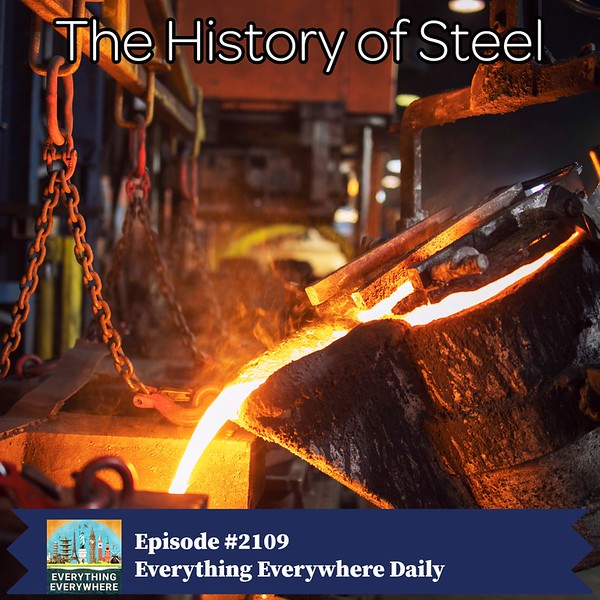
Episode – 2109 : Steel: The Metal That Made the Modern World
Podcast Transcript
For over 2000 years, steel has been known and used by humans. It slowly became more important to humanity and eventually became the central material of modern society.
It built railroads, bridges, battleships, skyscrapers, cars, and countless everyday tools.
Yet steel wasn’t discovered all at once. It was refined over centuries through trial and error and scientific breakthroughs.
Learn more about steel and how it changed the world on this episode of Everything Everywhere Daily.
Unlike other discoveries and inventions, steel has no particular person, place, or time that we can point to for its origin. The only thing we can be sure of is that its discovery was ancient and almost certainly accidental.
True iron smelting, achieved by heating iron ore in a charcoal fire hot enough to reduce it to a spongy metalite mass called a bloom, emerged around 1200 BC in Anatolia and the eastern Mediterranean.
The bloomery process produced wrought iron, which is nearly pure iron and thus soft. It would also occasionally contain accidental amounts of a harder, higher-carbon material whenever conditions were just right.
That higher quality material was steel.
Early metalworkers learned that they could significantly harden iron through a process now known as carburization. This involved a repetitive cycle of heating the metal over charcoal fires and hammering it, gradually infusing carbon into the metal’s surface. This breakthrough represented the first intentional method for producing steel.
As early as 300 BC, metallurgists in the Indian subcontinent pioneered the creation of crucible steel, also known as wootz. This sophisticated process involved sealing iron, charcoal, and organic materials within clay crucibles.
When heated, the iron absorbed a precise concentration of carbon, resulting in high-carbon steel renowned for its exceptional hardness and the unique, banded look that it takes on when polished.
Exported across the Persian, Arabian, and Roman world, wootz became the raw material for blades later known in the West as Damascus steel. It was famous for its flowing water-patterned surface and its ability to hold a razor edge, which confounded European metallurgists for centuries.
Damascus steel swords became the subject of legends and were said to be sharper, stronger, and able to cut lesser blades in two. In reality, its reputation likely came from the high-quality crucible steel used, combined with expert Middle Eastern forging techniques, which produce blades that were genuinely excellent, though not supernatural.
In East Asia, Chinese smiths were producing cast iron by 500 BC, centuries before Europe, owing to the higher furnace temperatures they achieved. They also pioneered decarburization, the deliberate removal of carbon from cast iron by prolonged heating in air, which produced a form of steel they called “hundred-refined iron.”
Chinese and later Japanese smiths developed techniques for folding and welding steels of different carbon levels, creating complex composite blades.
Representing perhaps the peak of pre-industrial metallurgy, Japanese tamahagane steel was produced by smelting iron sand in charcoal-fired furnaces. This refined process involved folding the steel and applying a strategic clay coating for differential hardening prior to quenching.
Throughout the medieval period, European steel production was an art rather than a science. The cementation process, widely practiced in the sixteenth and seventeenth centuries, involved packing bars of wrought iron into stone chests with charcoal powder and heating them for days at a time.
Carbon slowly diffused into the iron from the surface inward, producing what was called blister steel, identifiable by the blistered surface that formed as carbon bubbles were released. Blister steel was hard but uneven, with a carbon-rich shell and a softer core.
This was basically the state of steel entering the 18th century. It had been known for almost 2,000 years, but production was highly inconsistent, it was difficult to work with, and reserved for special items such as swords.
The great leap forward in steel production came in the 1740s when a clockmaker from Sheffield, England, named Benjamin Huntsman, frustrated with the inconsistent spring steel available for his clock mechanisms, began experimenting in secret with a new approach.
He melted blister steel in sealed clay crucibles heated to temperatures far higher than any English furnace had previously reached, discovering that the molten metal, on cooling, formed an entirely homogeneous ingot of uniform composition.
It was harder, tougher, and more consistent than any steel previously made. Sheffield became the steel capital of the world for over a century on the strength of this single innovation. Huntsman’s process spread slowly, partly because he tried to keep it secret, but it eventually transformed cutlery, tools, and spring manufacture throughout industrial Europe.
The eighteenth century’s great contribution to steel was indirect: it transformed the fuel that drove the furnaces. Before Abraham Darby’s experiments at Coalbrookdale in 1709, iron smelting depended entirely on charcoal, which required enormous quantities of wood.
Darby succeeded in smelting iron commercially with coke, unlocking a fuel supply effectively unlimited compared with charcoal. Coke is coal partially burned to drive off sulfur and other impurities. Coke-fueled blast furnaces could be built far larger and run hotter, producing cast iron in quantities previously unimaginable.
New processes of puddling and rolling iron made wrought iron cheap enough to build bridges, and the early nineteenth century saw iron used for a host of structural purposes. Steel itself remained expensive, limited to cutting tools, springs, and specialty uses.
Throughout the 18th and first half of the 19th centuries, the industrial world was desperate for something better than wrought iron. The problem was that steel was still too costly to produce in volume.
The answer came in the 1850s. Henry Bessemer, an English inventor with no formal metallurgical training, discovered in 1856 that blowing cold air through a bath of molten pig iron caused spectacular combustion: the excess carbon, silicon, and manganese in the iron burned away in a shower of sparks, converting the pig iron to steel in under twenty minutes without any extra fuel at all. The latent heat of the molten pig iron was sufficient.
The impact of the Bessemer process on steel production is difficult to overstate. Steel that had previously taken days to produce in small batches could now be produced by the ton in minutes.
The price of steel rails in Britain fell by roughly ninety percent between 1870 and 1900. Railroads expanded exponentially across North America and Europe. Structural steel made the skyscraper possible.
The first true steel-framed building, the Home Insurance Building in Chicago, was constructed in 1885. The Brooklyn Bridge, completed in 1883, used steel wire for its cables, a choice that made Bessemer-era steel engineering internationally famous.
The Bessemer process had limitations, however. It could not handle iron ore high in phosphorus, which was common across much of continental Europe.
The Gilchrist-Thomas process, which was patented in 1878, solved this by lining the Bessemer converter with dolomite, which is similar to limestone, that absorbed phosphorus in the slag. This made vast European iron ore reserves available for steelmaking.
Meanwhile, the Siemens-Martin open-hearth furnace, developed through the 1860s, offered an alternative: a slower process that could use scrap iron as well as pig iron and allowed more control over composition, making it better suited to the production of consistent steel. By 1900, open-hearth furnaces were producing more steel than Bessemer converters.
The first half of the twentieth century saw steel become the defining material of industrial civilization. It was central to two world wars, the construction of modern cities, and the rise of mass-market manufacturing.
Metallurgists of the late nineteenth and early twentieth centuries discovered that adding small quantities of other elements, including chromium, nickel, manganese, vanadium, and tungsten, transformed steel’s properties in highly specific ways.
In 1913, Harry Brearley made an accidental breakthrough in Sheffield while researching erosion-resistant steel for gun barrels. He observed that alloys with high chromium content were resistant to rust, a discovery that established the entirely new category of stainless steel.
Additionally, industrial manufacturing was transformed by the advent of tungsten carbide steels. This innovation enabled the machining of other metallic materials at velocities once considered impossible.
Both world wars drove enormous expansion in steel capacity and accelerated the development of specialty grades, including armor plate steel, high-temperature steels for turbine blades, spring steels for artillery, and bearing steels for machinery.
The United States became the world’s dominant steel producer, and Pittsburgh, with its proximity to coal and Great Lakes iron ore, became the symbolic center of industrial steelmaking. By 1945, the United States was producing roughly half of the world’s steel.
The postwar period brought the most significant process innovation since the Bessemer process. The basic oxygen steelmaking process (BOS) was developed in Austria at the Linz-Donawitz steel works in the early 1950s. It blew pure oxygen into the molten pig iron from above rather than air.
Because pure oxygen reacts far more vigorously than air, a BOS converter could process 300 tonnes of steel in under an hour, with better temperature control and less nitrogen pickup than Bessemer converters had allowed. BOS furnaces spread globally through the 1960s and 1970s and remain the dominant method of steelmaking today.
Simultaneously, the electric arc furnace, which melts steel scrap using enormous graphite electrodes, matured from a specialty tool for alloy steels into a mainstream production method.
The electric arc furnaces required neither a blast furnace nor a coke plant. It needed only scrap and electricity. This allowed a new type of producer, the mini-mill, to enter the market with far lower capital requirements than an integrated steelworks.
During the 1970s, Nucor Corporation championed the mini-mill in the United States. By initially utilizing scrap to produce low-grade reinforcing steel bar, the company eventually transitioned to higher-value offerings. This evolution was supported by the advancement of continuous casting, a process that boosted industry-wide consistency and productivity by pouring steel into a moving strand rather than in separate ingots.
The period from the 1980s through the 2000s was characterized by the globalization of the steel industry and the proliferation of specialty grades engineered for specific applications.
However, the most significant shift during this era was geographic rather than technological. Following massive investments in production capacity beginning in 1990, China overtook the United States as the world’s leading steel producer in 1996 and passed Japan in 2000.
By 2020, China’s output accounted for over half of the world’s total steel production, manufacturing roughly 1.06 billion tonnes of the 1.9 billion tonnes produced globally.
This transformation reshaped global trade, drove down prices, forced the mass closure of traditional steelworks in Europe and North America, and shifted the industry’s center of gravity.
What makes the history of steel remarkable is that it is not a story of one invention. It is a chain of thousands of improvements stretching from ancient accidental steel to modern AI-controlled mills.
Every age believed it had mastered steel only for the next age to discover a better method of steelmaking. Steel helped build the modern world, and despite competition from aluminum, composites, and ceramics, it remains one of the most adaptable and indispensable materials humanity has ever created.This episode can be found at: https://everything-everywhere.com/steel-the-metal-that-made-the-modern-world/