
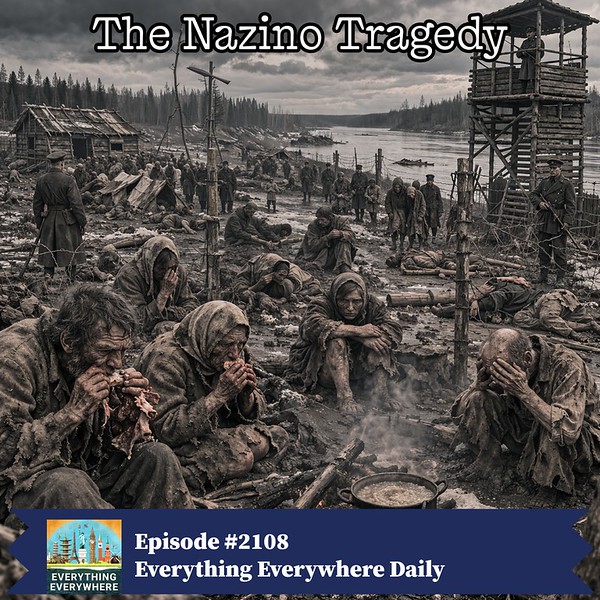
Episode – 2108 : Nazino Tragedy: The Shocking Story of Stalin’s Prison Island
Podcast Transcript
In 1933, deep in Siberia, thousands of people were dumped on a remote island with almost nothing to survive.
They had no shelter, no tools, and barely any food. What followed was chaos, starvation, and a descent into one of the darkest episodes of the Soviet era.
It wasn’t just a humanitarian disaster; it was the result of a system that treated human beings as expendable.
Learn about the Nazino Tragedy and why it still stands as a warning about the consequences of unchecked power on this episode of Everything Everywhere Daily.
To understand the Nazino tragedy, it has to be placed within the broader context of the early 1930s under Joseph Stalin. The Soviet Union was in the midst of forced collectivization, rapid industrialization, and widespread famine.
In early 1933, Soviet officials, including security chief Genrikh Yagoda and Gulag administrator Matvei Berman, proposed an ambitious plan to deport up to a million kulaks, or wealthy farmers, to Siberia and Kazakhstan, where they would establish “special settlements” and become self-sufficient agricultural laborers.
Previously, Berman and Yagoda had deported two million kulaks and agricultural workers to the same regions, with relative success. The difference between the first and second attempts at settlement was that the resources for the second were much less due to a famine that the Soviets were facing.
While the plan was originally to take kulaks from agricultural areas in the western this fell through. Instead of taking kulaks, the Soviets ended up deporting ordinary citizens from major cities like Moscow and Leningrad.
The regime was attempting to reshape society by removing what it considered “socially harmful elements.” These included not just criminals, but also vagrants, former merchants, peasants fleeing famine, and even ordinary urban residents who lacked proper internal passports, a system introduced in 1932 to control population movement.
These people were not necessarily political dissidents; they were simply socially undesirable individuals whom Stalin wanted removed.
The execution of this plan quickly descended into chaos. Thousands of people were arrested, within days of the program’s approval, and deported with minimal preparation. Many had no agricultural experience whatsoever.
Those rounded up were first sent to transit camps in cities like Tomsk, Omsk, and Achinsk, and from there, prisoners were transported by barge.
In May 1933, approximately 6,000 to 6,700 deportees were delivered to a small, swampy island on the Ob River known as Nazino. While the original plan called for roughly 25,000 detainees to be moved, only a small portion of that figure was actually sent.
There was a small group of native people living in the Nazino, a group known as the Ostyak. However, there were very few of them, and for all intents and purposes, the region was completely isolated.
They arrived on the island with almost no supplies. Despite the goal of making the group self-sufficient through cultivating the land, the deportees were provided with little food, clothing, tools, or materials for shelter. These barebone preparations were insufficient to survive in the brutal Siberian wilderness.
The first group to arrive on the island was ill and malnourished from their voyage. Already, dozens had died, and a third of the group was unable to stand when arriving on the island. These conditions only got worse.
The weather in Nazino was horrific in May. The island was plagued by snow, frost, and freezing rain, which caused many to succumb to exposure. In desperate attempts to stay warm, some individuals fell asleep too close to their bonfires and perished from burns during the night.
The prisoners looked at Nazino Island and the swampy terrain and knew there was zero chance of cultivating the land, as they had next to no supplies and only 20 tons of flour for the over 6,000 people sent to the island. To put that in perspective, that’s about 9 pounds (4 kilograms) per person.
Order on the island broke down almost instantly, with gangs being formed and fights breaking out over how the scarce amount of flour would be split.
For those who did manage to get their hands on the limited flour supply, they still suffered. Many did not take measures to prepare the flour; instead, they ate it dry or mixed it with water.
This led to two dangerous outcomes. For those who ate the flour dry, they often suffocated; if they mixed it with water, it was common for them to die of dysentery. Starvation, disease, and desperation quickly set in, and people began to grow even more desperate.
People began to try to escape from the island, but this was not easy. Despite the guards being completely inexperienced, most being fresh recruits without shoes or uniforms, they did their best to create an atmosphere of fear and danger around leaving the camp.
Those who managed to sneak past the guards tried to make rafts to escape the island. However, these rafts were primitive. Many collapsed, causing hundreds of bodies to wash onto the shore of the island.
If the escapees’ rafts managed to cross the river, the guards sadistically hunted them down for sport. If they managed to survive the hunt, the escapees would need to survive the taiga, which is an incredibly harsh environment. For this reason, any escapees who did not drown in the river and were not hunted for sport were presumed to have died from the elements.
As for the people who remained on the island, conditions grew increasingly desperate. Those left on Nazino were mainly from the city, meaning they had no farming experience and therefore had no idea how to properly clear and cultivate the land.
Gangs, which were already present due to the flour debacle, began to terrorize weaker people on the island, murdering people for money and food. After killing, their bodies would be looted for their gold tooth fillings, crowns, and other valuables.
The goal of the gangs with these killings was to engage in trade to get resources like food and cigarettes.
The guards did not help this situation; instead, they acted apathetically towards the gangs, choosing to enforce their own reign of terror. They would extort people on the island and execute people for the most minor of offenses to maintain order.
Their order by fear led to professionals who were sent to the island, like doctors, being fearful for their own lives despite being promised protection.
As for the prisoners, the food situation worsened significantly. For many, the only option for food was the people around them. Violent mobs would work together to hunt and kill the weak to ensure they’d have food and fresh meat. Murder for them was not for loo, but rather for the sole purpose of not starving to death.
By late May, cannibalism was widespread across the island. Eyewitnesses on the island recalled seeing people tied to trees and having their body parts cut away and cooked. Despite the carnage occurring on the island, the gulag’s guards did nothing to prevent the onslaught.
One of the nearby indigenous Ostyak settlements, reported that a female escapee from Nazino Island had arrived at their home. They reported the women who fled the island had part of their calves cut off and told horrific tales about the “island of death.”
Survivors who were interviewed after the events reported targeting victims who were just clinging to life. They weren’t quite dead, but weren’t necessarily alive either.
To keep some semblance of humanity, people reported only eating the heart or liver to avoid technically consuming human meat. They reported taking the body parts, placing them on sticks that served as skewers, and roasting the pieces over a campfire.
They justified the killings as mercy, for the victims were going to die anyway.
Once again, the guards did nothing. Instead, they seemed amused by the barbaric measures people took to survive. The guards were reported to throw pieces of bread at the prisoners, watching them fight over the scraps. They did arrest a few people for the crime, but all in all, they were powerless to stop it.
Now you may be asking, why did the Soviet government allow this to happen?
One reason is that they simply didn’t care. Another reason is that Nazino was so far away from power centers and so remote that no one really had a clue what was happening.
Vasily Velichko, a Soviet official and Communist Party propagandist, visited the island independently. As a figure regarded as a reliable source, he sought to investigate the situation on his own initiative.
Upon reaching the island, Velichko conducted interviews with inhabitants who provided accounts of the violence. He also witnessed the presence of partially consumed remains, which served as undeniable proof of the widespread cannibalism and devastation that had taken place.
Velichko sent his report to Stalin and the political bureau, prompting the camp to be closed immediately. However, it was decided that the report would remain classified because it revealed a humiliating failure for the internal passport program, the Soviet government, and, most importantly, Joesph Stalin.
The Nazino Island gulag closed in June of 1933, just two months after the camp opened. Of the 6,700 people sent there, only 2,200 survived. Those who lived were sent to other camps. Many did not survive the transfer, and those who did survive also suffered an extremely high mortality rate due to being in no condition to work in another camp.
The incident did have some limited consequences within the Soviet system. A Communist Party commission investigated the affair, and some local officials and guards were punished, receiving light prison sentences.
More importantly, the Nazino disaster exposed fundamental flaws in the “special settlement” program. It contributed to the abandonment of large-scale deportation schemes using untrained urban populations and reinforced the shift toward the more controlled, institutionalized Gulag camp system.
The truth about what happened in Nazino was only uncovered in 1988, roughly 5 decades after the tragedy. This was because of a human rights organization known as Memorial, which engaged in an investigation into the classified documents.
Memorial completed investigations and interviews surrounding the event and brought the island’s attention to the public. However, the documents surrounding Nazino weren’t officially declassified until 1994, three years after the Soviet Union collapsed.
Despite being uncovered, the general public was not especially aware of the tragedy until 2002, which was the same year a memorial for the victims of Nazino was constructed. Publications about the memorial helped bring the tragedy to the public’s attention, where it has remained since.
The story of Nazino is unsettling not just because of what happened on that island, but because of how easily it happened. It wasn’t the result of a natural disaster or a sudden breakdown, but of deliberate policies carried out with indifference to those affected.This episode can be found at: https://everything-everywhere.com/the-nazino-tragedy-the-shocking-story-of-stalins-prison-island/