
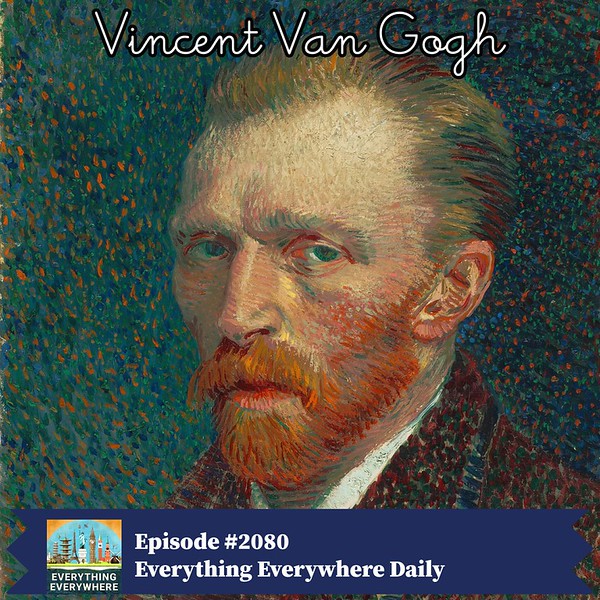
Episode – 2080 : Vincent Van Gogh
Podcast Transcript
Few artists’ works are as instantly recognizable as Vincent van Gogh’s.
In just a single decade, he created some of the most famous paintings in history, filled with bold color, swirling movement, and raw emotion.
Yet during his lifetime, he sold almost nothing and struggled with poverty and mental illness.
Today, his works hang in the world’s greatest museums and inspire millions. How did a little-known painter become one of the most influential artists of all time?
Learn more about van Gogh and his extraordinary legacy on this episode of Everything Everywhere Daily
Before I begin, let me address something that I know many of you are going to make an issue out of. The pronunciation of the name of the subject of the show.
In the United States, the common pronunciation is Van-Go. In British English, it is common to pronounce it, Van-Goff.
However, neither of these pronunciations is correct in the original Dutch. In Dutch, it is pronounced Van-Hoch.
Given that I speak American English, as do most listeners of this show, I will use the pronunciation Van-Go for the duration of this episode. However, I acknowledge that it is pronounced differently elsewhere. Apologies to my Dutch listeners.
Vincent Willem van Gogh was born in Groot-Zundert, province of the Netherlands, on March 30, 1853. He was the oldest living child of his parents, Theodorus van Gogh and Anna Cornelius Carbentus.
His parents gave Vincent the same name as his elder brother, who had died at birth the year before, continuing a family name from Van Gogh’s grandfather.
Vincent Van Gogh’s father was a minister who worked at the Dutch Reformed Church. However, the family had many ties to the art world, with Vincent’s grandfather and three of his six sons being art dealers, and a fourth being a sculptor.
Vincent’s mother, Anna, came from a well-off family in The Hague.
Growing up, Van Gogh’s family lived comfortably, with a church-supplied house, two cooks, a maid, a gardener, and a horse-drawn carriage.
As a child, Van Gogh was serious and thoughtful. Educated first by his mother and a governess, he later attended a village school from 1860 to 1864.
In 1864, Vincent’s family placed him in a boarding school. He did not welcome this change, reportedly feeling abandoned, and campaigned to return home.
His parents instead sent him to middle school in Tilburg in 1866, where he remained, reportedly unhappy.
As a child, Vincent became interested in art, encouraged by his mother to draw. His early drawings were considered expressive but lacked the intensity of his later works.
While in Middle School, Vincent’s art became more formal. At Tilburg, one of his teachers was Constant Cornelis Huijsmans, a successful artist in Paris. Huijsmans taught his artistic philosophy to the students.
Part of Huijsman’s philosophy was to reject artistic technique and instead focus on capturing impressions of different things, typically using objects and nature as examples.
However, despite learning this technique, Van Gogh paid little attention in class. His depression overshadowed the lessons he was meant to learn.
Van Gogh returned home from school in March 1868. The following year, Vincent’s uncle arranged a position for him with the art dealers Goupil and Cie in The Hague.
Van Gogh trained under the art dealers until 1873. Then, he was transferred to a different branch in London. Van Gogh considered his life at this time to be very happy. He was 20 and had a successful job. He also became infatuated with his landlady’s daughter, Eugénie Loyer.
However, this happiness did not last. After he confessed his feelings to Loyer, she rejected him. Van Gogh isolated himself and became more passionate about religion.
As Van Gogh’s mental health declined, his father and uncle moved him to Paris in 1875. The move made van Gogh resent his profession, especially how art dealers commodified art. His resentment grew, and his employer let him go.
In 1876, Van Gogh decided to return to England. During his time in England, he reimmersed himself in his faith and desired to become a pastor.
After working as a minister’s assistant, Van Gogh moved back to Amsterdam in 1877 or 1878. There, he studied for the theology entrance exam for the University of Amsterdam, which he failed.
He continued to do church-related positions until 1880. This was not a good time for Van Gogh, as he was ridiculed and dismissed by the church. His parents asked him to return home, and he did. Around this time, Van Gogh’s father became increasingly worried and suggested that Vincent be committed to a lunatic asylum.
When he returned home, Van Gogh’s interest in art picked up. He had previously only made doodles, not serious art. However, Van Gogh became more intrigued by the people and scenes around him.
He decided to record these scenes in drawings and ultimately committed himself to art. After making this choice, Van Gogh moved to Brussels in 1880 and began his career as a painter.
Despite his hatred of formal art schools, Van Gogh attended the Académie Royale des Beaux-Arts. There, he studied the standard rules of modeling, perspective, and anatomy.
In 1881, Van Gogh returned home for an extended period. During this time, he tried to sell some of his art. He also reconnected with his second cousin, Anton Mauve, who was successful artist. Mauve gave Van Gogh advice to work with pastel colors as well as charcoal, advice which Vincent adopted.
Also around this time, Van Gogh pursued another one-sided love interest: his widowed cousin, Cornelia “Kee” Vos-Stricker. Because Kee was seven years older and had a child, his declaration of love shocked everyone, including her. Kee refused him, saying, “No, Nay Never.”
Kee continued to reject Van Gogh despite his repeated attempts to see her. Her family also intervened, stating that his persistence with her was disgusting.
Van Gogh did not cope well mentally with this rejection. He reportedly put his left hand into a lamp’s flame, begging to see Kee for as long as he could keep his hand in the fire. Van Gogh had little memory of doing this and it didn’t work.
Despite his mental instability, Anton Mauve continued to teach Van Gogh about art. Mauve introduced him to watercolor and later to oil painting. He also lent Van Gogh money to set up his own studio.
After receiving the loan, Van Gogh and Mauve fell out over an argument, likely about the viability of drawing from plaster casts. Mauve also reportedly disapproved of Van Gogh hiring people from the street as models.
In June 1882, Van Gogh spent a few weeks in the hospital after he suffered from gonorrhoea. When he left the hospital, he started painting more in oils. He reportedly enjoyed spreading, layering, and scraping the medium on the canvas.
Van Gogh moved to Nuenen, a town in the Netherlands, in 1883. While there, he primarily focused on art, creating numerous drawings and paintings.
Van Gogh typically worked outdoors at a rapid pace, capturing cottages and weavers in his paintings and drawings. During this period, he also painted The Parsonage Garden at Nuenen.
Van Gogh spent two years in Nuenen. During this time, he painted many still lifes, watercolors, and drawings. He also completed almost 200 oil paintings. These works convey a more melancholic tone and use earthier colors than the vibrant work for which he later became known.
After being accused of forcing himself upon a peasant model, Van Gogh moved to Antwerp. He lived in poverty and spent what little money he had on art supplies such as paints, brushes, and models.
While living in Antwerp, Van Gogh studied the work of other artists, most notably Peter Paul Rubens. He focused on broadening his color palette to include more vibrant shades. He also studied color theory.
While expanding his artistic background, Van Gogh’s personal life continued to declined. He had another health scare, likely syphilis, and needed to be hospitalized. At the same time, he began drinking heavily. His teeth became loose and brittle, and he reportedly ate very little, surviving mostly on cigarettes.
After his hospitalization, Van Gogh enrolled at the Academy of Fine Arts in Antwerp. He struggled at the school and argued repeatedly with his instructor over their differing styles. Ultimately, the school expelled him.
Van Gogh moved back to Paris in 1886 and lived with his brother. In Paris, he studied art, befriended fellow artists, and mainly painted portraits, landscapes, and still lifes. He also adopted a brighter color palette and bolder style.
After a few arguments, Van Gogh moved out of his brother’s house, though they later made up. He stayed in Paris and adopted a new artistic style called “Pointillism.”
Pointillism is a painting technique in which small, distinct dots of pure color are applied in patterns so they visually blend together when viewed from a distance.
In late 1887, Van Gogh exhibited his work in Paris with several art friends. Contemporaries praised his work as ahead of anything else seen in Paris. By 1888, Van Gogh had grown tired of Paris and moved to the coastal city of Arles in southern France.
Arles offered Van Gogh an interesting place to live. In many ways, it fueled his drinking. Van Gogh arrived in the city as an alcoholic with poor lungs from smoking. Arles tempted him with many vices, such as alcohol and brothels, and embraced a much more open atmosphere.
During his time in Arles, Van Gogh’s work took on a vibrant quality, using colors like yellow, mauve, and deep blues to capture the countryside. He made 200 paintings during this time, along with 100 watercolors and drawings.
In 1888, Van Gogh began using the “Yellow House” as a gallery. The house was meant to be his home, but it needed renovation, and his art was meant to be displayed throughout the house for others to see.
Also in 1888, the most famous thing that most people know about Van Gogh occurred. He lost his ear.
The exact circumstances around how he lost his ear are unknown. What we do know is that one of Van Gogh’s friends, Paul Gauguin, was visiting, and the two got into a heated argument, possibly over finances.
It is believed that after Gauguin left the Yellow House, Van Gogh may have heard voices, leading him to use a razor to cut his ear off. He then bandaged the wound, sent the unattached ear to a prostitute, and fell unconscious. Reportedly, Van Gogh had no memory of this event.
Van Gogh was hospitalized for his cut-off ear, where he was diagnosed with “acute mania and generalized delirium.”
Throughout 1889, Van Gogh spent his time between the hospital and his house, facing delusions and hallucinations. He eventually voluntarily put himself into Saint-Paul-de-Mausole asylum, where his mood was said to dramatically fluctuate.
While in the asylum, Van Gogh was often seen painting the garden and the clinic. Perhaps his most famous work, Starry Night, was painted during this period. As shown in Starry Night, one of the main artistic features of works from this period was the use of swirls.
In early 1890, Van Gogh finally began to receive more praise from the art community. His work was praised by Albert Aurier in a French magazine; he was invited to a painters’ expo called Les XX in Brussels, where his work was presented. He also saw his work displayed at the Society of Independent Artists.
Van Gogh left the asylum in May of 1890. Upon leaving, he revisited and completed a few other paintings, including Wheatfield with Crows, a piece commonly associated by artists with his feelings of depression and loneliness.
On July 27, 1890, Vincent Van Gogh died by self-inflicted gunshot wound after years of depression and mental illness. He was just 37 years old.
Vincent Van Gogh clearly suffered from severe mental illness during his life. Even though he devoted himself to his art, he was mostly unknown, sold only a few paintings, and lived in poverty.
The dramatic rise in appreciation for his work was largely due to the efforts of his sister-in-law, Johanna, the widow of his brother Theo. After Theo’s death, shortly after Vincent’s, Johanna inherited hundreds of paintings and letters and began carefully promoting his work.
She organized exhibitions across Europe, loaned paintings to galleries, and published Vincent’s letters, which helped create the image of the passionate, misunderstood artist.
At the same time, artistic tastes shifted in the early 20th century. Movements such as Expressionism embraced intense color, emotional expression, and visible brushwork, qualities that Van Gogh had pioneered.
As younger artists and critics recognized the revolutionary nature of his style, his reputation grew rapidly.
Paintings by Vincent van Gogh have become some of the most valuable artworks ever sold at auction. Beginning in the mid-20th century, as modern art gained prestige and wealthy collectors competed for masterpieces, Van Gogh’s rare works drove prices rapidly upward.
The most famous example occurred in 1990 when his painting Portrait of Dr. Gachet sold at auction for $82.5 million, at the time the highest price ever paid for a painting. Since then, other Van Gogh works have sold privately or at auction for well over $100 million, reflecting his status as one of the most sought-after artists in the world.
Today, Van Gogh has completed his transformation from an obscure painter into one of the most celebrated artists in history.This episode can be found at: https://everything-everywhere.com/the-life-of-vince-van-gogh/