
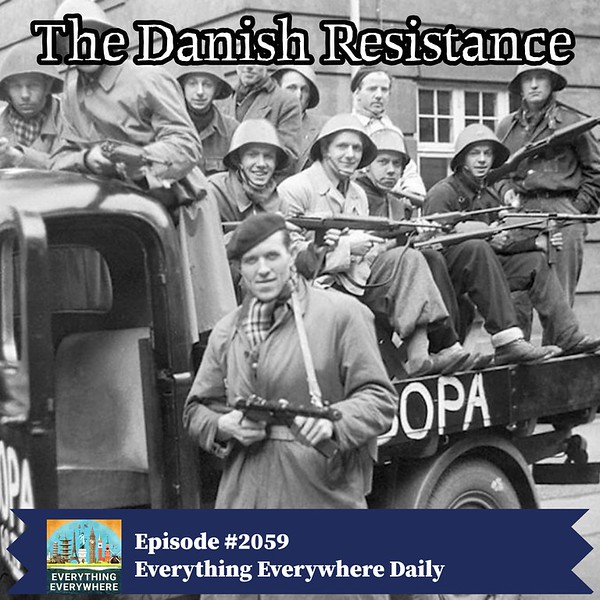
Episode – 2059 : The Danish Resistance
Podcast Transcript
As Germany conquered countries in WWII, in many nations, they found willing volunteers to help them identify Jews to send to concentration camps.
However, not every country did. Finland, Bulgaria, and Albania engaged in a spirited defense of their Jewish population in the face of Nazi oppression.
However, no country did more to save its Jewish population than Denmark.
Learn more about Denmark’s Great Escape and its resistance to Nazi Germany on this episode of Everything Everywhere Daily.
Denmark has a long history of accepting and accommodating Europe’s Jewish population.
During the chaos of the Thirty Years’ War, the Danish monarchy, eager to bring much-needed capital for taxation and investment, invited Jewish migrants into the nation.
During the 18th century, while many European nations adopted the long-standing tradition of forcing Jewish people to live in “ghettos”, the Danish refused the practice.
In fact, Denmark emerged as a citadel of religious tolerance when it ratified the 1814 Decree, which granted Jewish Danes equal rights and sponsored the construction of synagogues across the nation.
While many European nations endorsed policies limiting the rights of Jewish people, Denmark became an exemplar for religious pluralism. This principle was enshrined in the Danish constitution of 1849.
Hitler’s plan to establish a new European Order, motivated and organized on racial principles, ran in direct contradiction to long-held Danish values.
These values were on full display in 1933, when the Danish King Christian X attended the 100th anniversary of the Great Copenhagen Synagogue.
The historic relationship of Germany and Denmark proved inconvenient to Hitler. Denmark’s position in Hitler’s Europe was unique and played an important role in Denmark’s resistance.
Denmark and Germany share a border and have many other cultural and historical ties. Their proximity and long economic history reflect centuries of cultural exchange.
They had economic and commercial connections through the Hanseatic League, and before Christianity, they shared significant religious and mythological traditions.
Hitler’s rise to power challenged the strength of this historic alliance. Hitler was motivated by the establishment of a Pan-Germanic empire with Aryan roots. At the center of this network were the Nordic countries of Denmark, Norway, and Sweden.
Nazi racial philosophers identified the people of these countries as the blood equals of Germans. As such, the German engagement with Denmark was very different from their other European conquests in France, Czechoslovakia, and Poland.
On April 9th, 1940, Germany invaded Denmark.
The German conquest of Denmark was one of the fastest in history. Operation Weserübung Süd lasted six hours. The Germans and Danes reached a quick agreement after a series of short, sporadic military skirmishes.
The Danes knew that resistance to the German military machine was futile and hoped to spare Copenhagen from Luftwaffe bombardment.
While Germany did occupy Denmark, they maintained a very different sort of control. Hitler’s Germany labeled Denmark as a “model protectorate.” This protectorate status and their quick surrender preserved portions of Danish sovereignty.
Danish leaders had hoped to preserve as much Danish life as possible. Part of that preservation was maintaining the standards of religious and social tolerance in Denmark, particularly toward the Jewish community.
The hope was that Denmark could leverage its long-standing relationship with Germany to avoid the experience of occupation that the rest of Europe endured. The Danish government insisted in its surrender agreement that there be no legal changes for its Jewish population.
While the Germans unleashed a campaign of social ostracism towards Jews across Europe, Denmark resisted it.
One of the most prominent features of this campaign was the identification of the Jewish population by wearing a yellow Star of David. The Nazis intended the star to mark the Jewish population for visibility and humiliate them on the streets.
Denmark was the only European country that did not legally require its Jewish citizens to wear yellow stars.
Legends even held that the Danish King Christian X wore a yellow star in protest of this treatment, or that the majority of the Danish people wore one in solidarity. Neither of these actually happened, and they didn’t need to happen, as the Danes stood in unity with their Jewish brethren by refusing to bow to such laws.
In addition, Denmark never passed any of the other laws that destroyed Jewish life across Europe. They never lost their right to participate in public life; they were never forced to register their businesses; Synagogues were not closed; and they did not lose their homes or properties.
Across Denmark in the early 1940s, life for Danish Jews remained largely unchanged.
In 1942, the German leadership began insisting that the full weight of the Nuremberg laws be brought to bear in Denmark.
In response, the Danish government threatened to resign. Normally, the mass resignation of the government would have been something the Nazi’s would have welcomed. In this case, that was viewed as a disaster.
By transforming Denmark into a ‘Model Protectorate,’ the Nazis hoped to send a clear message to neutral Sweden and a defiant Norway that German oversight didn’t have to mean the end of civilization. It was a calculated attempt to show that if a fellow “Aryan” nation cooperated, they could keep their King, their Parliament, and their way of life.
For the Nazis, a stable, functioning Denmark was far more valuable than one under a pile of rubble. The Danes knew they were in a very strong position when it came to resisting the expansion of Nazi ideology.
The cracks in the Danish-German relationship appeared in September of 1941 when the Danes were outraged that the Nazi’s forced them to sign the anti-Comintern Pact against the Soviet Union.
The relationship worsened the following year at the Nazi’s Wannsee Conference, which outlined the continental-wide protocols for the implementation of the Final Solution.
German-occupied lands were expected to participate in the Final Solution, yet Denmark did not comply. Denmark was specifically cited at the Wannsee conference as a problem, given the autonomy Hitler had granted them as part of his broader Nordic plans.
Hitler was so insistent on treating Denmark with kid gloves that he allowed them the freedom to hold Parliamentary elections in 1943. The decision backfired as the Danes had record voter turnouts, which saw the complete defeat of all Nazi-affiliated parties.
Hitler had underestimated the passion that the Nordic countries held for their values of tolerance and community and overestimated their affinity for the Nazis.
Consider the words of Kaj Munk, a Lutheran minister who was later murdered by the gestapo: When here in this country pogroms have been started against a special group of our fellow countrymen, only because they belong to a special race, then the church has a right to cry out. This is breaking the constitution of Christ’s kingdom and is abominable to the Nordic way of thinking.
As the tide began to turn against the Germans in 1943, Danish resistance to Nazism grew increasingly bold. The summer of 1943 brought a nationwide campaign of strikes and coordinated sabotage against Nazi interests.
The Germans unsuccessfully ordered the Danish government to force the workers back into the shipyards and to punish sabotage with death. The Danish government refused to comply and resigned.
The resignation brought about martial law. The crisis effectively ended the legal shield that had protected Denmark’s Jewish population. The state of emergency allowed the Nazi’s to seize the state’s security apparatus, and arrests occurred in large numbers, making what was about to happen seem all the more heroic.
By the fall of 1943, the Nazi’s had formalized plans to round up Danish Jews and force them into camps. To stay ahead of the German SS, Denmark had to respond with extraordinary speed and resolve.
The Rescue of the Danish Jews was a plan to evacuate the entire Danish Jewish population to safety in neutral Sweden. Sweden had opened its borders to anyone during the crisis.
By chance, word of the Nazi plan was leaked to Danish leaders by a German military official named Georg Ferdinand Duckwitz.
Word spread quickly. Rabbis across the country warned their congregations, emphasizing that there was no time to delay. In his sermon on September 29, 1943, at the Great Synagogue of Copenhagen, Rabbi Marcus Melchior said, “We have no time to continue prayers. You must leave at once and go into hiding.”
The Danish Nation roared into action. A network of countless citizens contributed to the heroic hiding of the Danish Jews. Danes hid more than 7,000 Jews in forests, attics, hospitals, and churches.
Danish police refused to allow German forces to enter Jewish homes, they looked the other way when they found someone, and they helped hide those who had yet to be hidden.
Danish boats ferried more than 7000 people to safety in Sweden.
The voyage was inherently perilous due to the treacherous sea conditions, characterized by high winds and freezing temperatures. Undertaking the journey at night, concealed by darkness, introduced an additional layer of danger, making the avoidance of German patrols absolutely critical.
In fact, the captains who sailed the ships usually preferred bad weather. Heavy fog reduced visibility for German ships and shore-based spotlights, while storm threats kept German vessels in port.
The journey was typical of the Danish resolve displayed throughout the entire time period. Like the strikes and uprising of the previous year, this effort was a grassroots campaign that used regular family-style or small commercial fishing boats to make the journey. Photographs of the period often show people in groups of 4-10, perhaps two families at a time, boarding small craft.
The Danish sailors were also not alone in their courage; it was common for vessels to wait in the middle of the strait for Swedish ships to take on passengers and carry them the rest of the way.
Leo Goldberger, a survivor of the journey, recalled the risk the captains took: “I remember how poor [the fishermen] were and how dangerous it was for them; if we were caught on the water, they would have been arrested and sent to a concentration camp themselves.”
Sweden gladly took in the Danish Jewish.
Goldberg recalled the Swedish government creating schools for them so they could continue their education. He said, “Within a week, I was in a Swedish school, wearing a Swedish hat.”
Despite the remarkable success of the campaign, there were some Jews who did not escape the Nazi’s. Early in the campaign, Nazi forces captured 470 Jews and deported them to the Theresienstadt ghetto in Czechoslovakia.
In a manner consistent with the spirit of the Danish resistance, the Danish government insisted that the captured Jews be placed in a concentration camp and not an extermination camp. They also demanded the ability to communicate with all 470 and to share care packages with them as part of their correspondence.
While several dozen of those sent to the Theresienstadt died, the overwhelming majority returned home after the war.
Upon their return, they found their homes and businesses intact as they left them; their Danish neighbors had refused to allow any looting or destruction of Jewish property in their absence.
Today, at the Yad Vashem Holocaust Memorial, there is an ‘Avenue of the Righteous Among the Nations.’ There you will find individual trees planted in honor of heroes like Oskar Schindler and Irena Sendler.
Denmark’s tribute stands apart. Instead of honoring a single person, a solitary tree is planted in honor of the entire Danish Resistance. This serves as a powerful tribute to the only nation in occupied Europe that collectively refused to cooperate with the Nazis.This episode can be found at: https://everything-everywhere.com/the-danish-resistance-in-wwii/