
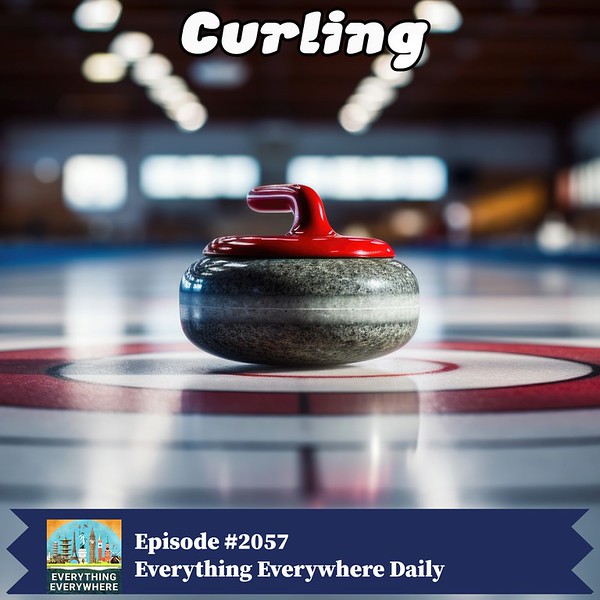
Episode – 2057 : Curling
Podcast Transcript
Every four years, we are captivated by the remarkable athletes who compete at the Olympics.
But while most Olympic events inspire a sort of awe because of their athleticism, curling feels different. It feels accessible, something that anyone could do, even if you’ve been drinking.
From its medieval origins on the frozen marshes of Scotland to its spread across the globe through centuries of migration, curling has built a rich, storied history.
Learn more about curling and how pushing rocks on ice became an Olympic sport on this episode of Everything Everywhere Daily.
The objective of the modern game of curling is for two competing teams of four players to slide a 44-pound granite stone down a sheet of manicured ice towards a bullseye target called the house. The goal is to have your stones closer to the center of the house, called the button, than your opponents.
Tracing the origins of curling poses challenges given the scarcity of written accounts of the early sport. The Stirling Stone is the oldest artifact associated with curling and comes from Dunblane, Scotland, and is housed at the MacFarlane Museum.
This Stirling Stone is sort of the Rosetta Stone of curling. The stone has a carved handhold on the top and “Stirling 1511” carved adjacent to it. Workers discovered the 26-pound basalt stone at the bottom of a drained bog.
Scotland is an unsurprising location for the sport to have begun, given the abundant water and frigid winters.
Five centuries ago, the first curling stones were nothing more than water eroded boulders, pulled from the beds of Scottish rivers and thrown across the ice in their raw, rugged state. As with modern curling stones, the stones used in early curling had to be smooth, and riverbeds were ideal places to find stones smoothed by the river over time.
The Stirling Stone is unmistakable proof of the sport’s origins in Scotland. The Scottish Curling Association is emphatic in its support of Scottish origins to curling, and dismisses the notion that the game began elsewhere.
Another potential origin for the sport is the Low Countries, specifically the Netherlands. The Dutch master Pieter Bruegel the Elder illustrated what appears to be curling in his 1565 painting Hunters in the Snow.
A version of the game also appears in the 1631 painting Winter Landscape With a Bird Trap by the Elder’s son, the Dutch artist Pieter Bruegel the Younger.
While the Dutch paintings are a compelling example of the sport existing in the Low Countries, to the Scots, there is no disputing the sport’s birthplace. The Scottish Curling Association insists that the Low Countries could not have created the sport:
“The Low Countries are spectacularly deficient in that necessary raw material, hard igneous rock, from which alone the peculiar implement of the game, the curling stone, is made.”
While evidence is scarce about the early origins of curling, a clear picture starts to emerge in the 16th century. The earliest written artifact associated with the game is a notarized 1541 challenge between a monk and a monastery official in Paisley, Scotland.
The challenge centered on a contest of throwing stones across the ice at a target.
After the 17th century, the historical window on curling begins to open wider. We find more documented evidence of its existence, even documents outlining its rules.
Scottish poetry of the time provides further evidence, as it is filled with references to curling.
Scottish poet Robert Burns made this connection in his 1785 poem, The Vision when he noted:
The sun had closed the winter day,
The Curlers quat their roaring play…
Curling has always been called the roaring game, for when the heavy granite stone slides across the natural ice of a Scottish Loch, it creates a constant, low, dull vibration.
Before the creation of indoor curling facilities, the ice of a frozen stream or marsh had tiny natural bumps and ridges; as the stone passed over them, the sound was like a dull roar. In the early history of the sport, sweepers cleared the ice of debris and reduced imperfections.
Scotland clarified the rules of the sport throughout the 18th and 19th centuries as Scottish clubs, such as the Duddingston Curling Society of Edinburgh, began to publish house rules. The rules varied slightly from one club to another, but curlers had clarified them by Victorian era.
Perhaps Scotland’s greatest claim to curling’s origins is the stone. Early stones were called loofies and could fit in the palm of your hand, but as the rules were standardized, the stones needed to be more consistent.
The standardization of the stone was essential as the sport became more competitive, with league- and championship-level play across Scotland. During the 19th century, Scottish artisans began creating stones of a common weight and material.
The stones, usually of granite, were crafted in a circular shape with a wooden top handle. The handle allowed the curler more control over the release of the stone. With it, the stone could now be “curled” or rotated on release to adapt to ice conditions and allow for unique angles to hit other stones.
Perhaps the greatest development in the sport, and one that solidified Scotland’s legacy as the torch-bearer of the sport, was the creation of the modern Olympic-level stone. The modern stones, which represent a blend of beauty and purposeful design, are one of curling’s greatest stories.
All of the stones used in high-level competitions, such as the Olympics, are made of granite from a single location, Ailsa Craig, a small uninhabited Island off the coast of Scotland.
As competitive curling became increasingly popular across Europe and throughout the northern Hemisphere where Scottish people migrated, the athletes faced one persistent problem, cracking stones.
The Scots realized that not all granite is created equal. A more porous stone will absorb water as it slides across the ice. This absorption can cause damage to the stones when they collide. To avoid this, the granite required must have a closed structure that repels all water.
The granite on Ailsa Craig possesses the perfect molecular composition to meet that challenge. Artisans have quarried granite here since the 19th century, but the industry took off with the formation of the Ailsa Craig Quarrying Company in 1907.
The company began harvesting granite from the island with very specific rules and regulations. These rules and regulations limit mining to a single company for the sole purpose of creating curling stones.
Mathematicians have calculated how long the granite will last, given the island’s small size. Assuming current mining rates and the strict protections the island enjoys, the granite on Ailsa Craig may be depleted in just…. 32,000 years.
Rules and regulations are in place to preserve the resource. Gathering granite is allowed only once every 5-10 years to protect the island’s wildlife. A typical harvest yields about 2,000 tons or enough granite to make stones for a decade.
While Ailsa Craig is famous for its granite, it is also an uninhabited wildlife sanctuary. It has one very famous resident that is the subject of pride and adoration in Scotland, the puffin.
After being nearly wiped out by rats introduced during the Industrial Revolution, the island’s puffin population has made a remarkable comeback in recent years, thanks to a massive effort to eradicate the invasive rodents.
When crews harvest the granite, they do so only in October to minimize disruption to the puffin’s nesting and birthing habits, and they are forbidden from using blasting.
There are two types of granite from Ailsa Craig that are used to make the stones. The body of the stone is a green granite, renowned for its toughness and ability to withstand the impact of two stones colliding on the ice.
The second type, the rarer of the two, is the blue hone granite. Blue hone is used to form the ring at the bottom of the stone that has contact with the ice.
Since its founding in 1851, the company Kays of Scotland has held a virtual monopoly on the world’s competitive stones. Their process involves highly specialized engineering, fusing the impact-resistant Common Green granite body with the water-resistant Blue Hone granite running band, all polished to elite specifications before the final handle is bolted on.
An Olympic-quality Ailsa Craig curling stone is a very expensive item; a Kay stone costs about $1,000 per stone and $16,000 for a complete set.
The design of the stone is crucial to the physics of successful curling. The bottom of the stone is concave, which limits the surface area in contact with the ice.
The Blue Hone granite on the bottom provides the perfect contact point. Blue hone’s dense, closed-quarter structure makes it impervious to water, enabling it to glide across the watery surface of the ice.
The bottom ring of the stone must be smooth to interact with the ice surface; any chips or dings in the bottom ring will slow the stone or cause irregular movement.
When curlers release the stone, they impart a slight clockwise or counterclockwise spin. The rotation helps the stone move across the ridges and bumps on the ice. Without that rotation, the heavy stone would be at the mercy of all of the bumps on the ice.
The physics of this is still a matter of scientific contention. Most spinning objects drift away from their rotation, but a curling stone does the opposite; it follows its spin. This ‘friction-induced’ steering is what allows a player to navigate the stone around obstacles.
Jennifer Vail, the author of Friction: A Biography, recently outlined the scientific community’s perspective to the BBC by noting:
“The scientific community hasn’t come to a consensus on the physics of curling, although it’s not through a lack of effort. It’s been over 100 years since researchers started trying to understand it, but the mechanisms behind the curling of the stone remain unsolved.
Small bumps and ridges on the ice surface require the use of sweepers. Like the stone itself, the curling brush has undergone a radical scientific evolution. The earliest sweepers on the Scottish marshes used simple brooms made of straw or birch twigs.
But today, those simple tools have been replaced by carbon-fiber instruments designed to manipulate the very laws of physics. The sweepers apply friction to the ice surface to generate heat and melt the surface, allowing them to manipulate the stone’s speed, direction, and distance.
The sweepers orchestrate the movement of the pieces on the chessboard as they vigorously apply friction to the bubbled surface of the ice, slowing down stones by not sweeping and speeding a stone up by sweeping with great intensity.
A Kay-manufactured stone on a proper surface with effective brooming can generate an additional 10-15 feet; that’s the difference between a stone that sails through the house and one that lands perfectly on the button.
Every four years during the Winter Olympics, the world reignites its curiosity and fascination with curling.Curling first appeared unofficially at the 1924 Winter Games in Chamonix, France, but it was later retroactively recognized and then disappeared from the Olympic program for decades.
It returned intermittently as a demonstration sport in 1932, 1988, and 1992, largely driven by Canadian and European advocacy and a growing international organization.
The formation and expansion of the World Curling Federation helped standardize rules and broaden participation, strengthening the case for inclusion. Ultimately, curling was officially reinstated as a full medal sport at the Winter Olympics in 1998 in Nagano, where it quickly proved popular with television audiences. Mixed doubles curling was added in 2018.Curling has developed a devoted following thanks to its accessibility and the social aspect of its countless clubs worldwide. This popularity is what made it an Olympic sport.
….which is not too bad for something that began with a bunch of Scotsmen tossing stones on the ice.
The Executive Producer of Everything Everywhere Daily is Charles Daniel. The Associate Producers are Austin Oetken and Cameron Kieffer.
Research and writing for this episode was provided by Joel Hermansen.
Today’s review comes from listener Jared1979 on Apple Podcasts in Canada. They write:
Completionist Club Achieved
This podcast keeps my kids and myself entertained while travelling around on the north shore of Lake Superior, where everything is hours away. Keep up the great work, and where would one find the Lake Superior chapter of the completionist club?
Thanks, Jared! You can always stop by the Thunder Bay chapter if you’re in town, or the lodge inside Pukaskwa National Park. The reports are that they make a mean Caesar.
Remember, if you leave a review on any of the major podcast apps, you too can have it read on the show.This episode can be found at: https://everything-everywhere.com/all-about-curling/