
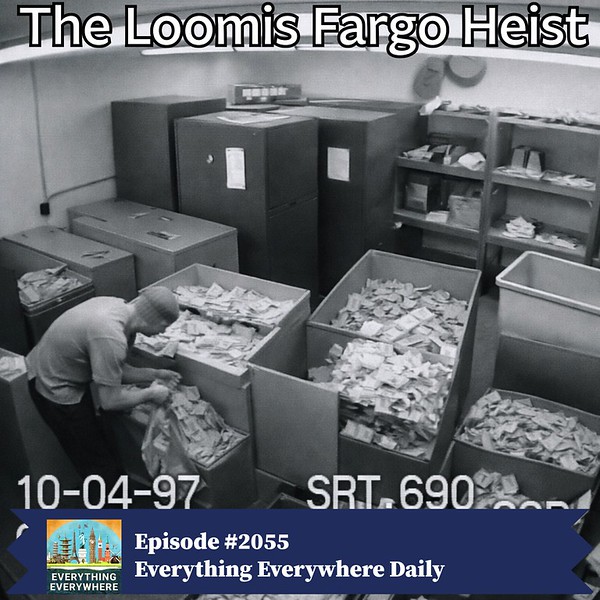
Episode – 2055 : The Loomis Fargo Heist
Podcast Transcript
On the evening of October 4, 1997, a large cash haul of about $17.3 million was stolen from the Loomis Fargo & Company vault in Charlotte, North Carolina.
It was one of the largest cash robberies in history.
Unfortunately, it wasn’t the work of criminal masterminds. The plot was quickly discovered, and the perpetrators were quickly apprehended because they made absolutely no attempt to hide their sudden newfound wealth.
Learn about the Loomis Fargo Heist, aka the “Hillbilly Heist,” on this episode of Everything Everywhere Daily.
The Loomis Fargo company traces its roots to the mid-19th century, when Henry Wells and William G. Fargo founded Wells Fargo in 1852 as an express and banking company serving the American West during the Gold Rush, transporting gold, mail, and valuables across vast distances.
Over time, the express and armored transport functions evolved separately from the banking division, and in the 20th century, these security operations became part of Loomis, a Swedish cash-handling firm founded in 1852 that expanded internationally.
In the United States, Loomis acquired Wells Fargo Armored Service in 1997, briefly operating under the combined name Loomis Fargo before later rebranding simply as Loomis following further global consolidation.
The 1997 consolidation led to the creation of new roles within the new corporation, which ultimately employed 8,500 people. These employees were responsible for armored transportation, cash management, and ATM servicing.
The company’s core mission was handling enormous amounts of cash.
Cold hard cash. Moolah. Deniero. Bucks. Dough. Wampum. Greenbacks. Bills. Federal Reserve Notes. Scratch. Loot. Bread. Clams. Cheddar. Cabbage. Benjamins. Dead presidents.
The Loomis Fargo Heist was masterminded by David Ghantt, Kelly Campbell, and Steven Chambers.
David Ghantt was an employee of Loomis Fargo, serving as a vault supervisor. He had been feeling increasingly underappreciated and frustrated because he was underpaid. In his anger, he began to conspire to rob his employers to get the money he felt he rightfully deserved.
Before committing the robbery, Ghantt was a Veteran who had served in the Gulf War. He had never been in trouble with the law before and, by all accounts, was a normal law abiding citizen, living with his wife and making an honest living.
Despite being married, Ghantt struck up a relationship with his co-worker, Kelly Campbell. Although they deny that the relationship was ever romantic, the FBI has stated that it was. She left the company before the heist, but both she and Ghantt maintained their relationship after her employment.
Campbell was the point of contact between Ghantt and Steven Chambers.
Chambers was the other major player in the case and was an old friend of Campbell. He had a past as a petty criminal and had brought up the idea of robbing Loomis Fargo to Campbell.
Intrigued by the idea of a major heist, Campbell shared the concept with Ghantt. She suggested that Chambers could assist Ghantt in carrying out a massive robbery of a Loomis Fargo Vault.
Ghantt, who again was frustrated with the company, decided he wanted to make a drastic change and agreed to participate. Together, Ghantt, Chambers, and Campbell would plan the heist.
Chambers looped in his friend Scott Grant to help with the robbery. Eric Payne was also recruited to help transport the money.
The plan was for Ghantt to do the work in the vault and then flee to Mexico. Chambers was to get a false passport so that Ghantt could leave the country.
Before Ghantt left the country, he was supposed to hand over most of the cash to Chambers. This is because there was a limit of $50,000 at that time that could be taken across borders legally without reporting.
While in Mexico, Chambers would wire money to Ghantt to meet his basic financial needs. Once the attention on the robbery had died down, Ghantt would re-enter the US, and the money was to be split among the co-conspirators.
If the idea of conducting a robbery, giving someone else the money, leaving the country, and trusting them to send you money sounds stupid…..you are not wrong.
October 4, 1997 the date of the heist.
Ghantt began his plan at 6:40 pm. During the day, he had been training another young man. He told the trainee to go home early and quickly went to work.
Over the next hour, Ghantt loaded over 1.5 tons of cash from a vault into a company van, most of it in the form of $20 bills. The total amount of cash in the van was approximately $17,300,000.
In addition, he also stole security footage from the facilities to help protect his identity. He removed the tapes from two of the three cameras, unaware that there was a third.
After securing the cash, Ghantt moved to leave the premises, but was caught by a locked rear gate. After panicking, Ghantt moved to the front gate and escaped.
Ghantt then met up with his co-conspirators at a printing business in northwest Charlotte. While at the business, the group split the cash into personal vehicles.
This process took much longer than expected. Ghantt had directed his co-conspirators to hide the gun he had taken for the robbery and the security tapes he had stolen from the premises.
In their panic, the group stashed as much cash as possible in their private vehicles. However, because of the amount stolen, not all of it could be packed away. The group ended up leaving $3 million of cash behind in the van, as well as the gun and security tapes they were meant to dispose of.
Meanwhile, after handing over most of the cash to his conspirators, Ghantt took $50,000 and traveled with Campbell in Campbell’s pickup truck to the airport. He successfully made it to Mexico with his money.
The following morning, employees at Loomis Fargo arrived at work, found they were unable to open the vault, and called the police.
The police then brought in the FBI because the majority of the money stored at the facility belonged to banks, not Loomis Fargo. This meant that the heist was technically a bank robbery, even though it didn’t occur at a bank, which is a federal offense.
The FBI suspected David Ghantt immediately. This was for two reasons:
He had not shown up for work that morning, making him the only unaccounted-for employee.
There was a third security tape, something Ghantt had failed to steal the night prior. This meant there was video footage of him committing the heist.
It took the FBI two days to locate the Loomis Fargo armored van used to carry the cash. In the van, they found the approximately $3 million left behind, along with Ghantt’s pickup truck, which was left at the warehouse.
An FBI investigation uncovered a link between Ghantt and Kelly Campbell, both former Loomis Fargo employees, leading to suspicion regarding Campbell.
Campbell’s acquisition of a new Toyota minivan, paid entirely in $20 bills, solidified the suspicion. Although this was her only major expenditure, it drew the attention of the FBI, leading to an interrogation.
While being questioned by the FBI, she lied about her role in the heist. She was also wiretapped by the FBI, which allowed them to identify who else was involved.
It was much more difficult to connect Ghantt and Chambers.
Chambers failed to heed the agreement to keep a low profile with the stolen money for a year or two, instead immediately beginning to live extravagantly. This suspicious activity prompted the FBI to receive tips about him.
Steven Chambers and his wife, Michelle, began spending excessively, using large amounts of cash, primarily in $20 bills, for their purchases. They replaced their trailer home with a luxurious mansion and acquired expensive items like cars, jewelry, and furniture.
The large amount of spending was not the only suspicious activity conducted by Chambers and his wife. Michelle had gone to the bank shortly after the heist to deposit some of the money from the robbery. When doing so, she reportedly asked the bank teller how much money she could deposit before the amount was reported to authorities.
After being told the amount was $10,000, Michelle reportedly pulled out $9,500 in $20 bills from her bag. This action raised the bank teller’s suspicions, leading them to report the transaction to the authorities.
Chambers enlisted friends and family to help distribute the stolen funds, paying them tens of thousands of dollars. This tactic ultimately failed, when several of those same disgruntled individuals robbed one of his money storage caches.
This pushed Chambers to move the money to new locations, including leaving bags of cash with his attorney, buying a discount furniture outlet, and turning it into a high-end store to hide and launder the money.
While Chambers was drowning in his money, Ghantt was living his best life in Mexico, living in resorts and clubs. He spent his money on luxury experiences, and when he was running low, he called Cambell and Chambers to send more over.
The FBI became concerned for Ghantt’s safety after they established a connection between him and Chambers. This crucial link was only discovered through an intercepted phone call between the two.
The FBI discovered that Chambers, unhappy with the money transfer to Mexico, was conspiring with a hitman, Michael McKinney, to murder Ghantt.
Due to the number of people involved, many of whom were spending well above their means, it was fairly easy for the FBI to track down the conspirators.
Interpol agents arrested Ghantt in Mexico on March 1, 1998, following a request from the FBI. The day after his arrest, Chambers, Campbell, and four other individuals were also taken into custody.
A grand jury indicted eight additional potential conspirators in the weeks that followed. They faced charges of bank larceny and money laundering, the latter stemming from how the defendants spent the stolen funds.
Later, nine more people were charged with crimes related to the heist. These were relatives and friends of the robbers and were charged once again with money laundering.
The justification was that they were cosigners on safe deposit boxes used to store some of the stolen money. The prosecution charged them because it was thought that they knew they were helping store illegally obtained money. Four other people were later charged for the same reason.
In the end, all but one defendant pleaded guilty.
Steve Chambers received the longest sentence of 11 years and 3 months in federal prison for his involvement. While some perpetrators received prison time, those who were safe deposit box buyers were only placed on probation.
The only person to plead not guilty was Steve Chambers’s attorney, Jeff Guller. He was charged with helping launder the stolen money and sentenced to eight years in prison.
Oddly enough, the person who actually conducted the heist, David Ghantt, received only a seven-year prison sentence and was fined only $26,000 for his part.
The defendants became the butt of jokes across the country, being dubbed the “hillbilly heist.” This nickname came from the fact that the vast majority of the co-conspirators were from small towns near Charlotte, North Carolina, and because of how they obviously spent their money after the robbery.
With the heist solved and the conspirators charged, one question remains: what happened to the money? The FBI managed to track down and account for the majority of the missing money; however, 12% or over $2 million is still unaccounted for today.
The Loomis Fargo heist ultimately led to charges against twenty-four individuals. All those involved in the conspiracy have since been released from prison, and many are working to reconstruct their lives.
If there is one lesson we can learn from the Loomis Fargo heist, it is that crime doesn’t pay.
…..and if there are two lessons we can learn, the second would be don’t purchase a mansion with $20 bills days after millions of dollars in $20 bills were stolen in your community.
The Executive Producer of Everything Everywhere Daily is Charles Daniel. The Associate Producers are Austin Oetken and Cameron Kieffer.I have a bunch of short reviews for you today.Rowan W C on Apple Podcasts in the US writes
Awesome job Gary Arndt!
This show is the absolute best. I love listening to it while I walk or
drive anywhere.
Fun with two emoji smiley faces writes:
Love the show, informative and quick. I had no idea how much I didn’t
Know.Klee7822 from France writes:
Interesting and informative
Short, easily digestible bites of fun facts, told in an interesting
Manner.Rhhrrhgedg from Canada writes:
Nova Scotia competitionest club achieved. Can you make an episode about the HMCS Haida?Fredrick 243 from the United States writes:Finally I’m so happy you’ve finally made an episode on Star Wars Thank you all for your reviews. Every review, no matter how short or long is appreciated.Remember, if you leave a review on any of the major podcast apps, you can have it read on the show.This episode can be found at: https://everything-everywhere.com/the-loomis-fargo-heist/