
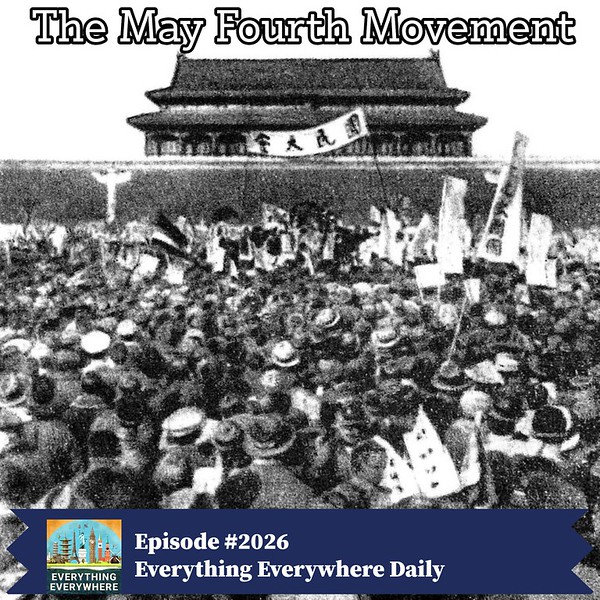
Episode – 2026 : The May Fourth Movement
Podcast Transcript
Few dates in China are as significant as May Fourth, which marks two distinct revolutionary periods in modern Chinese history.
On May 4th, 1919, student protests erupted in China in response to the country’s outrage over being ignored at the Paris Peace Conference. This event became known as the May 4th Movement.
Seventy years later, in 1989, a resurgence of movement inspired the Tiananmen Square student protests.
Learn more about the May Fourth Movement and its lasting impact on Chinese society on this episode of Everything Everywhere Daily.
To understand what sparked the May Fourth Movement, we need to look back at the events that brought down the Qing dynasty.
As we’ve covered in previous episodes, the 19th century was disastrous for China. It suffered foreign invasions, the Opium trade, wars, and unfair treaties. The reactions to these humiliations, such as the Taiping and Boxer Rebellions, failed to save China from decline, and arguably made things worse.
After the dynasty’s collapse in 1911, Qing leaders lost the Mandate of Heaven, ending 4,000 years of Imperial dynastic rule.
In the wake of this collapse, China became unstable.
This instability set the stage for a brief republic, a dictatorship, and an era of warlord rule, reflecting the chaos that defined this period.
Amid these challenges, World War I appeared to many in China as a potential turning point, offering a chance for change through international participation. China sent nearly 150,000 workers to Europe to support the war effort.
Although fighting in Western Europe was not realistic for China, their workers could dig trenches, build roads, and help with communication on the Western Front.
Chinese nationalism grew from their participation in the war.
Many Chinese believed supporting the Allies would bring rewards after the war. However, when the Paris Peace Conference was announced, this expectation was shattered, intensifying disillusionment and protest.
The Chinese delegation believed they had earned a place at the table and anticipated enjoying the fruits of victory.
The treaty brought enormous gains to the allies. The Germans faced heavy military restrictions and also had to pay 33 billion dollars to the victors.
Moreover, Germany was forced to give up key colonial holdings.
Confident, the Chinese delegation arrived at Versailles seeking the return of the Shandong region, which Germany had occupied.
Events, however, took an unexpected turn.
The Chinese delegation was disrespected. China was excluded from the Treaty of Versailles and actually lost key territories to its main Asian rival. A prized Shandong coastal area where the Yellow River meets the sea was given to Japan.
The Japanese had claimed Shandong in 1914, seizing upon Germany’s preoccupation in Europe. They would hold these lands until the end of WWII.
Japan’s takeover of Shandong became a rallying point for China’s educated class, highlighting Japan’s successful modernization through the Meiji Restoration in contrast to China’s struggles with Western influence and the humiliation it suffered in the 19th century.
Losing Shandong and being ignored heightened anger among young, educated Chinese, especially in major cities and college campuses. Protestors strongly condemned Chinese officials for accepting unfair conditions.
Later, when it became public that Chinese leaders had secretly agreed to cede Shandong to Japan before the Paris Peace Conference even started, without informing their own team attending the conference, public outrage intensified, further fueling the growing protest movement.
Protestors accused officials of letting foreign powers control Chinese land, which culminated in demonstrations on May 4, 1919.
Around 3,000 students marched in Tiananmen Square, demanding change, sparked by China’s treatment at the Paris Peace Conference.
Confucian tradition often promotes order over protest, yet its philosophy also gives citizens the right to criticize leaders who fail morally.
To the protesting students, China’s leaders had failed their duty. The warlord government, fractured and weak, risked returning China to the dominance of foreign powers, a status akin to the previous century’s pseudo-colonialism and national humiliation.
On May 4, 1919, students took to the streets with a new vision; one without foreign subjugation.
After May 4th, the student protestors continued their protests by joining organizations seeking political and social change in China.
Chen Duxiu had been a student of architecture at Beijing University. Chen founded the New Youth, a movement that protested foreign imperialism, the warlord government in China, and the continued conservative practices in Chinese culture.
The public challenge to the government initiated by New Youth was a remarkably bold move for the Chinese of that era.
Beyond protest, New Youth students used violence and intimidation against those with pro-Japanese leanings, including beating one official and burning another’s home.
Despite violence, the movement was mostly philosophical. New Youth urged students to seek Western inspiration, echoing Meiji Japan’s earlier path.
Hu Shi, an intellectual leader of the New Youth Movement, wrote:
At? present? the? most? unfounded? and? more? harmful? distortion? is? to? ridicule? Western? civilization? as? materialistic? and? worship? Eastern? civilization? as? spiritual.? …? The? modern? civilization? of? the? West, ?built ?on ?the ?foundation? of? the?search ?for ?human? happiness,? not ?only ?has? definitely? increased? material? enjoyment? to? no? small? degree,? but? can? also? satisfy? the? spiritual? needs? of? mankind.?…
Driven by intellectuals such as Hu Shi, the demonstrators called for an end to Confucian dominance in China and for the opening of the country to Western ideas, believing that only a fundamental transformation could secure China’s future.
The students of the May 4th movement had a clear goal: transforming China into a Western-style liberal democracy.
This idea seemed unimaginable in a country with no experience of democratic government or pluralism.
On their signs, in their writings, and in their speeches, the students of Beijing’s 13 universities openly ridiculed the archaic ways of Confucianism, believing it had kept China in a dogmatic cycle of stagnation for centuries.
The students in Beijing viewed Confucianism as limiting their freedom, given its emphasis on compliance within the family structure; these ideas ran counter to their goal of participating in government as citizens with the right to vote and to freely disagree with the government.
Among the most significant aims of the group was the call for a constitution, with a clear set of rules and structures.
Many in the movement had conflicting thoughts on the topic of Japan. On the one hand, their seizure of Shandong had brought the students together. Japan faced boycotts, protests, and condemnation over its land claims in China.
Yet they were eager to amplify, in the loudest possible terms, the success of Japanese modernization efforts under the Meiji Restoration by putting forward their own platform for change.
The Japanese served as an example of what a traditional East Asian culture could achieve through modernization.
Japan had been able to avoid European involvement in its affairs by adopting European political practices, industrial methods, and approach to modernization.
They hoped to bring the same attitude to update the rigid Chinese system.
Unfortunately for the students of China, democratic elections, civil liberties, and technology were meaningless in a China governed by a small group of warlords.
The students protesting received a hard lesson in why they were far from their goals, as one of the protestors was badly beaten by police officers and died as a result of his wounds.
It had become clear to many that their methods were too passive to meet their goals.
Parliamentary practices would not have been able to generate the sheer depth of change required to institute land reform, educational reform, and social reforms for women.
Many of the student leaders started to believe that Vladimir Lenin, the leader of the Communist Revolution in Russia, had been right when he said that imperialism was the final stage of capitalism.
Many students began to believe that an alternative Western philosophy holds the key to greater change: Communism.
Many of the student leaders in the May Fourth Movement went on to become the foundation of the Chinese Communist Party.The May 4th movement, which had begun as a nationalist movement that advocated western democracy, evolved into something totally different.
The impact of Russia’s transition to Communism in 1917 was not lost on the May Fourth students. The legacy of the May Fourth Movement, carried by these leaders, set China on a path that would change it decades later.
In fact, there is a straight line from the leadership of the New Youth movement to the foundation of the Chinese Communist Party.
In fact, the first general secretary of the party was none other than Chen Duxiu.
One of the May Fourth protestors who wrote against Confucian practices and their effects on women was Mao Zedong.
The Paris Peace Conference and the Treaty of Versailles had illustrated to this generation that the deck was stacked against China, and the best path forward was to attack the Western system.
The students of the May Fourth Movement went on to become leaders of movements against the nationalist government of Chiang Kai-shek in the Chinese Civil War.
They protested against the Japanese occupation of China after 1931 and the appalling atrocities they committed against the Chinese in Nanjing during WWII.
The students of the May Fourth movement were not initially interested in Communism, but their interests eventually aligned as both movements focused on anti-Western imperialism.
The ideas of democratic liberalism were not aligned with the intense anti-imperialism on China’s college campuses, and Communism was the compromise between the status quo in China and their rage at their treatment by the Japanese.
The May Fourth celebration is not only welcomed by the Chinese Communist Party today but is integrated into its platform. The day is lauded as providing the philosophical foundation that ultimately led to China’s transformation into a Communist state.
However, there is a very ironic twist to the story.
Seventy years after the events of 1919, students in 1989 took inspiration from their activities to protest the very Communist government that came out of the original May Fourth Movement.
Like the students of 1919, the demonstrators in 1989 framed themselves as the moral conscience of the nation, acting when the state had failed to live up to its own ideals.
They invoked May Fourth’s emphasis on nationalism, civic responsibility, and the duty of educated youth to speak out against corruption and injustice.
Protesters frequently referenced May Fourth slogans and symbols, presenting their movement as part of a continuous struggle for reform, accountability, and political modernization.
By gathering in Tiananmen Square, the 1989 protesters placed themselves at the political heart of the nation, where earlier generations, seventy years before, had also challenged authority.
Just as the May Fourth movement combined calls for national renewal with demands for cultural and political change, the 1989 movement blended patriotism with appeals for transparency, free expression, and reform within the Chinese Communist system.
In both cases, students believed that public protest rooted in moral legitimacy could pressure the state to correct its course.
Despite being inspired by the student who came before them, the 1989 protests were crushed mercilessly by the same communist party that was created by students seventy years earlier.
The May Fourth Movement has the unique distinction of inspiring both the party in power in China and its dissidents and opponents.
This means that no matter what happens in China’s future, the May Fourth Movement is likely to be held in high regard.
The Executive Producer of Everything Everywhere Daily is Charles Daniel. The Associate Producers are Austin Oetken and Cameron Kieffer.
Research and writing for this episode were provided by Joel Hermensen
My big thanks go out to everyone who supports the show on Patreon. Your support helps make this podcast possible.I also want to remind everyone about the community groups on Facebook and Discord. This is where everything happens outside the podcast.
As always, if you leave a review on any major podcast app or on the above community groups, you too can have it read on the show.This episode can be found at: https://everything-everywhere.com/the-may-fourth-movement/