
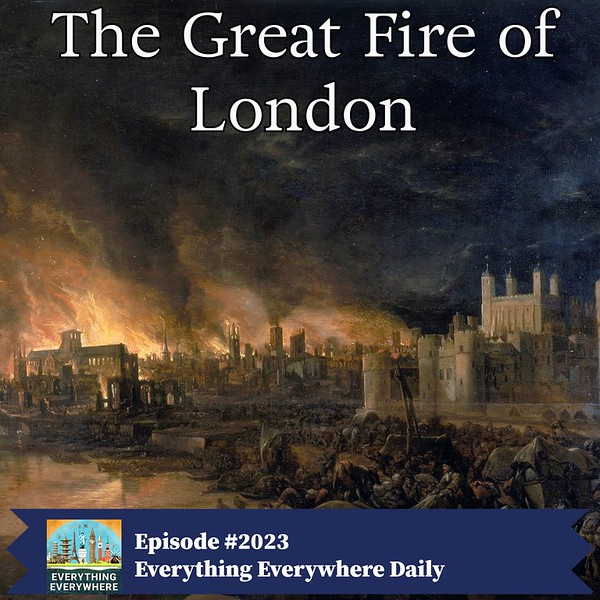
Episode – 2023 : The Great London Fire of 1666
Podcast Transcript
From September 2 to September 5, 1666, one of the largest urban fires in history took place.
The Great Fire of London swept mercilessly through the city, reducing roughly 80% of its buildings to smoldering ruins, possibly killing thousands of people.
In the ashes of the inferno, the city reinvented itself, determined to ensure such widespread destruction would never happen again. It also laid the foundation for the London that exists today.
Learn about the Great Fire of London on this episode of Everything Everywhere Daily.
1660’s London was one of the world’s largest cities, with an estimated 350,000 people living in close proximity to one another. This closeness was in large part due to the city’s massive walls.
Residents living within the city walls and along the River Thames were part of the “city proper.” This region covered only 700 acres, and this close proximity led to a poor quality of life. Heavy traffic choked the streets, filth and unsanitary conditions were everywhere, and disease thrived in this environment.
In addition to epidemics, another great risk for the city was fire. There had been a few large fires in the decades leading up to the Great Fire. This was largely due to the close proximity of the buildings and the materials used to build them.
Most of the homes in London were built with oak timber and were clustered tightly together. This was a deadly combination of combustibility and conditions that allowed fire to spread rapidly.
These fire risks were made worse by the weather. The summer of 1666 had been incredibly hot, windy, and unusually dry. This meant the wooden homes and buildings were essentially bone dry and perfect for burning.
The lack of water also contributed in other ways, as many of the city’s water sources dried up. This, together with the absence of any organized firefighting force, made it extremely difficult to fight the fires because there was little water available to put them out.
The windy conditions just made everything worse. Strong wind can literally “fan the flames,” providing oxygen to the fire as well as causing hot embers to travel to other rooftops.
The Great Fire of London began in the early hours of Sunday, September 2, 1666. A fire started at Thomas Farriner’s bakery on Pudding Lane. The fire quickly engulfed the house. The family managed to escape, except for the maidservant. The rest of the family fled to a neighbor’s home, where they tried to put out the flames.
After an hour of trying to quell the flames, the local parish constable arrived at the scene and decided to destroy the remaining homes in the area to stop the fire from spreading further.
Obviously, the people living in the nearby homes were unhappy with this arrangement and refused to accept it. This led to the parish constable summoning London’s Lord Mayor, Sir Thomas Bloodforth, to the scene to give permission to knock the homes down.
When Bloodforth was awakened, he reportedly showed no concern. In fairness to him, fires were fairly common in London at the time. But his cavalier response to the fire likely initially led to the situation escalating into the disaster it became.
Bloodforth arrived at the scene as the fire was already spreading to nearby homes, allowing it to move closer to flammable warehouses and stores along the riverfront.
The more experienced firemen at the scene were yelling for Bloodforth to grant permission to demolish the nearby homes so the fire would not spread, but Bloodforth refused.
Reports indicate that Bloodforth refused to demolish the buildings because many of the homes in the area were rented. Since authorities could not locate the owners of the rented properties, he declined to demolish the buildings.
After denying the firefighters’ requests, Bloodforth reportedly said, “Pish! A woman might piss it out!” and left the area.
Many contemporaries believe that Bloodforth was ill-equipped to be mayor and was appointed to be a “yes man,” rather than because he was capable for the job. As a result, when an emergency occurred, he panicked.
Later that morning, according to Samuel Pepys, a writer and politician,, the fire had burnt down about 300 homes. The flames traveled toward the riverfront. People desperately tried to remove their goods and put them on boats, or to toss them into the river to save them.
Pepys’ account continued to describe the rest of Sunday, reporting that by then, efforts to extinguish the fire had diminished and that people were fleeing the area. The fire was spreading rapidly due to high winds, and there was little that could be done.
Word reached the King, Charles II, from Pepys that the fire was dangerous and that if he did not command that buildings be knocked down, the fire would destroy the city.
King Charles II ordered Mayor Bloodforth to begin demolishing buildings and sent Pepys to deliver the order.
Pepys went to the fire zone and described the situation getting worse. As people fled, crowds formed a human wall. It was almost impossible for firefighters or carriages to enter the area.
Pepys then described Bloodforth’s actions throughout the day. When arriving at the scene of the fire, Pepys describes finding Bloodforth “acting like a fainting woman” while trying to direct the firefighting efforts. Pepys reported that Bloodforth was whining that he was trying to follow the King’s orders to demolish buildings to prevent the fire from spreading, but that the flames were moving too quickly.
Pepys then says that when Bloodworth was offered more soldiers to help prevent the fires from spreading, he refused, desperate to hold onto his authority, and went to bed.
Many historians blame Bloodworth for the fire; however, it is unfair to completely scapegoat him. Bloodworth could not demolish homes without being personally held responsible for the cost of rebuilding them. However, this does not excuse his inaction.
Later, King Charles sailed down the river on his boat to inspect the scene and saw that buildings were not being demolished to help quell the fire. So, he overrode Bloodforth’s authority, ordering that demolitions occur to the West of the fire to prevent further spreading.
However, at this point, the fire had taken on a life of its own. It had become a “firestorm,” meaning the flames generated and sustained their own wind system. This pushed the fire towards the city center.
On September 3, the fire continued to blaze. The flames spread rapidly to the northern and western portions of London. Fortunately for the Southern Portion, the River Thames mostly prevented the flames from spreading, but there was still fear that the fire could cross the London Bridge.
By September 4, roughly half of London was in flames. The situation was dire. People worked tirelessly to try to stop the fire, with little success. Even the King was on the front lines, passing buckets of water to the firefighters.
In a desperate attempt to stop the fire, officials ordered the use of gunpowder to blow up buildings in its path. This attempt failed and only worsened the problem.
Many of London’s affected citizens ran to Saint Paul’s Cathedral, which was presumed to be safe due to the empty plaza and the stone walls surrounding it. The Cathedral was filled to the brim with refugees, goods, and other important items.
However, the Cathedral’s assumed safety was false. Due to ongoing renovations, the building was covered in wooden scaffolding. As such, the church caught fire and was destroyed.
On the evening of September 4th, luck finally broke in London’s favor. The wind began to die down, slowing the flames.
On September 5, the fire breaks that had been made finally began to work, helping make the fire more controllable. While there were still smaller flames that needed to be put out, the great inferno that had been moving through the city had ended.
In total, roughly 80% of London was destroyed in the Great Fire. Though the death count estimates vary from the single digits to the thousands, the impact on people’s lives and the sheer amount of damage inflicted on the city were significant.
The homeless were placed in temporary buildings. These buildings were poorly built and ill-equipped to handle that many people. Illnesses spread, and people were exposed to the harsh winter that followed. This led to numerous deaths from disease in addition to those killed by the fire.
Additionally, the financial costs of the fire were disastrous for the city. With 13,200 houses, nearly 100 Parish Churches, the city Guildhall, the Royal Exchange, and St Paul’s Cathedral destroyed or damaged, the city had to pay an estimated 10 million pounds to repair everything, which was an astronomical amount for the time.
Fire prevention and urban regulation became far more organized. London developed organized fire-fighting measures, including parish fire engines, water supplies, and later insurance-backed private fire brigades.
The creation of these fire insurance programs laid the ground work the establishment of a larger insurance industry centered in London, which to this day remains the world’s largest.
Building inspection, street cleaning, and waste control improved, reflecting a growing belief that the city could and should be managed through rules and planning rather than tradition alone.
The rebuilding of London was planned by Sir Christopher Wren and carried out over 30 years. In many ways, the fire was viewed as an opportunity to rebuild the city in a more logical, safer way.
Prior to the Great Fire, London was considered to be a filthy city. There was little infrastructure or sanitation measures due to the dense layout, which allowed for disease to spread.
The city’s weaknesses had been recognized before the fire, but little could be done about the cramped, flammable, unsanitary conditions.
The fire created a perfect situation to address these problems. Suddenly, the tightly packed space was empty, allowing the builders to put new measures in place to improve the city’s infrastructure and safety.
The new buildings were built with materials like brick and stone, which are much less flammable than wood. Measures were passed, such as banning protruding signs and other objects that could spread fire, and different building classes were enacted to help widen the streets.
Additionally, new public health measures were passed to help sanitize the city. These actions helped prevent further outbreaks of plague in London.
Economically and administratively, the rebuilding accelerated modernization. New taxes on coal helped fund reconstruction, property records were clarified, and surveying became more precise.
The rebuilding process stimulated trades such as brickmaking, stone masonry, and architecture, helping London emerge as a more professionalized and commercially driven capital.
The new St Paul’s Cathedral, with its great dome, became a defining symbol of London and marked a shift away from medieval Gothic architecture toward Baroque and classical forms.
In sum, the Great Fire did not turn London into a perfectly planned city, but it decisively ended the medieval timber city. It produced a safer, more regulated, more monumental London whose materials, architecture, and governance set the pattern for the modern metropolis.
While the Great Fire didn’t immediately give birth to modern London, the London that we know today probably wouldn’t exist in its current form without it.This episode can be found at: https://everything-everywhere.com/the-great-london-fire-of-1666/