
Episode – 2022 : The Grateful Dead
Podcast Transcript
One of the most popular music groups over the last half-century is also one of the most unlikely.
They were seldom played on the radio, almost never appeared on network television, and had only one song ever make the Billboard Top 100.
Yet they have more Top 40 albums than any other group in history and are among the best-selling live acts of all time.
Learn more about the Grateful Dead’s unique legacy and how it cemented its place in American culture on this episode of Everything Everywhere Daily.
This podcast often covers topics such as empires, world leaders, and civilization-changing technologies.
So you might be wondering, why am I doing an episode about a bunch of old hippies?
I’m not a Grateful Dead fan, but I am interested in subcultures, cultural phenomena, and innovative businesses, and the Grateful Dead has all of those in spades. The Grateful Dead formed in 1965 in the San Francisco Bay Area, emerging from the folk and jug-band scene surrounding Jerry Garcia, Bob Weir, Ron “Pigpen” McKernan, Phil Lesh, and Bill Kreutzmann.
Several members had played together in Mother McCree’s Uptown Jug Champions before deciding to go electric, initially performing under the name the Warlocks before adopting the name Grateful Dead. They had to change the name because another band called The Warlocks already existed.
The phrase “grateful dead” has its origins in folklore and mythology rather than in modern music. In many European and Near Eastern folk tales, a traveler helps pay the burial expenses or proper rites for a dead person who was denied them.
Later in the story, the spirit of that deceased person returns to help the traveler in a moment of danger or need, revealing itself as the “grateful dead.” The idea reflects a belief that the dead retain moral agency and can show gratitude when treated with dignity.
When members of the Grateful Dead were searching for a new name in 1965, Jerry Garcia reportedly encountered the phrase while flipping through a dictionary of folklore references.
The band adopted it because of its mysterious, archaic meaning and its implication of reciprocity between the living and the dead, a theme that fit well with their interest in myth and improvisation.
The band was an eclectic mix of musicians. Jerry Garcia was a bluegrass musician; Bob Weir was a folk guitarist who appreciated cowboy songs; Phil Lesh was a classically trained trumpeter with perfect pitch… who never played bass guitar until Garcia insisted he learn it.
The band actually had two drummers. Bill Kreutzmann, a jazz drummer, and Mickey Hart, a marching band enthusiast.
The keyboardist position was known for its short tenure due to the early deaths of some members. Some of the keyboardists included Pigpen McKernan, Keith Godchaux, Brent Mydland, Vince Welnick, and solo artist Bruce Hornsby. In the late 1960s, the Grateful Dead became one of the defining bands of the psychedelic era. Their early albums, including The Grateful Dead and Anthem of the Sun, blended blues, folk, and rock with experimental studio techniques that attempted to replicate the spontaneity of their live performances.
However, unlike many groups of that era, the band quickly realized that their true strength lay on stage rather than in the studio.
This is where the Grateful Dead began to take a different path from most other recording artists.
Their shows weren’t concerts so much as events.Many of the Grateful Dead’s shows ran nearly 5 hours, establishing a stunning precedent that few musicians have ever matched.
The first set of each show featured standard-length Dead songs, usually 7-10 minutes long, like Bertha, Althea, Sugaree, and Jack Straw.
The second set was when things truly stretched out. Songs would jam into each other, often running 40 minutes. The emphasis on touring and long improvisations is a big reason why the band never received much radio play or had the hit singles that other popular bands of the period did.
They went through several eras, often tied to their changing keyboardist. Songs performed during different periods are difficult to recognize from one iteration to the next.
The band formed a strong following among musicians, including Elvis Costello, Paul McCartney, John Mayer, and Jimmy Buffett.The Grateful Dead would go on to reproduce an incredible number of tunes from the deepest reaches of American folk music, whilst adding their own take on these often short and lost-to-history tunes.
Iconic Dead classics such as “Cold Rain and Snow”, “Deep Elem Blues”, “Morning Dew” and “Peggy-O” were reformed folk takes from the archives of global music and would go on to form some of the most intricate Grateful Dead performances.
The late 1970s and early 1980s were marked by both creative resilience and personal struggles, particularly for Garcia, whose drug addiction affected his health and consistency. Even so, the band continued to perform hundreds of shows each year, and live albums such as Europe ’72 became definitive documents of their performances.
In 1987, the unlikely happened when the song “Touch of Grey” became a major hit, reaching the Top 10 on the Billboard Hot 100 and introducing the Grateful Dead to a broader mainstream audience. It was their first and only hit song.
During their final decade, the Grateful Dead became one of the most successful touring acts in history, regularly filling stadiums and arenas. Their concerts functioned as temporary communities, complete with informal marketplaces and rituals that extended far beyond the music itself.
Despite declining health among several members, particularly Garcia, the band maintained their commitment to live improvisation and audience connection.
Jerry Garcia’s death in 1995 effectively ended the Grateful Dead as a performing band, though the surviving members chose not to formally disband, acknowledging the music’s continuation through other forms.
After 1995, the Grateful Dead’s legacy continued through numerous successor projects, archival releases, and a still passionate fan base. Bands such as Dead and Company and various member-led ensembles carried the music to new generations.
Various incarnations of the Grateful Dead continue to perform up to the present day.
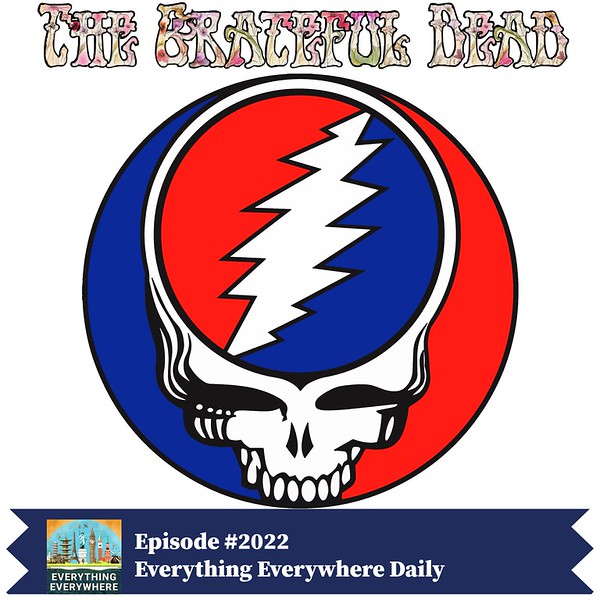
So, why did the Grateful Dead make such a cultural impact?First, the band had powerful symbolism and iconography. The most famous image, the skull with a lightning bolt known as “Steal Your Face,” originated from the band’s sound crew as a way to mark equipment and came to symbolize the raw electricity of live performance. It was officially used as the cover of their 1976 album, Steal Your Face.Dancing Bears and skeletons were also used as imagery on merchandise and as a way for other fans to recognize each other.
The thing that really cemented the band’s popularity with their fans was their touring schedule. The Grateful Dead probably performed more live shows than any other major band in the world during the 30 years they toured.
Over a 30-year period, they performed 2,318 live concerts. Fans of the group would often follow the band from city to city on tour and began to refer to themselves as Deadheads.Deadheads would set up small, temporary communities around each show, including marketplaces and opportunities to meet other fans.
The biggest thing, however, that really set the Grateful Dead apart was that they allowed their fans to record their concerts.The band accommodated tapers by permitting audience recording as long as tapes were traded noncommercially. By the early 1980s, they even designated official “taper sections” near the soundboard where fans could set up microphones without obstructing others.
Tapers used increasingly sophisticated equipment, often capturing remarkably high-quality recordings for the era. The only firm rule was that recordings could not be sold, a norm largely enforced by the community itself. It was legal and legitimized bootlegging.
As a result, the Grateful Dead became one of the most extensively documented live acts in history. Of their 2,318 concerts, well over 2,000 survive in recorded form, many in multiple versions.
These include both audience recordings and soundboard tapes made by the band’s crew. Today, tens of thousands of individual tape sources circulate, and the Dead’s live archive is among the largest and most complete musical archives ever assembled.
Every college dorm room in the United States either had someone who traded tapes or knew someone trading tapes. I remember a guy in college who had hundreds of tapes of live shows back in the 1980s, when tape trading required trading physical tapes in person, buying blank tapes, and taking the time to copy them.
Today, everything is available online.There are some who argue that the origins of the internet can be traced in part to the trading of Grateful Dead recordings.
Online file sharing was, in part, developed to share Grateful Dead recordings legally, and in some small way, was a key part of the foundations of the modern internet.
The band released over 200 albums, the vast majority of which were live performances.
The sheer volume of their output is the reason why they have more top 40 albums than any other group. This is despite the fact that, in a technical sense, they were a one-hit wonder because they only had one single ever reach the top 100.
Grateful Dead fans play a game on Sirius XM Radio where they listen to the nonstop stream of music and try to guess, not the name of the song, but the year each song was recorded in concert.
Beyond these musical achievements, the Grateful Dead had a broader cultural impact. Their story occupies a unique place in America’s cultural landscape, with its roots in the Bay Area of the 1960s.
The band arrived on the scene at a remarkable time in American cultural history. San Francisco of the 1960s was the epicenter of the counterculture movement.
The Grateful Dead and their unique partnerships with Ken Kesey and the Merry Pranksters, the Hells Angels, and the Beatniks produced a cultural footprint that can still be felt throughout the entire Bay Area.
The Dead’s live shows, which often lacked even the structure of a set list, were a perfect companion to the free-wheeling 1960s.
They often dedicated their talents to supporting businesses they believed in, such as the inaugural opening of the first North Face store in San Francisco in 1966.
One of their most famous shows was held in Veneta, Oregon, on a scorching summer day in 1972, in support of Springfield Creamery, a financially troubled dairy in the Hood River Valley. Today, sixty years after the band was formed, there are deadheads everywhere. Grateful Dead music can still be heard in college dorm rooms and in corporate boardrooms. The remaining band members are still playing, people are still showing up to see them, and they are recording their concerts.
There are multiple generations of fans who weren’t even born when the band was formed.
Much of this is due to the band’s innovative approach to business and marketing. The community they built through touring, the permissible recording policies, and the decades-long trading of tapes all helped build a fanatical fan base.
There are other bands from the 60s, like the Rolling Stones, that still occasionally perform, but no one has been able to consistently entertain and keep an audience for so long like the Grateful Dead.
Given how long they’ve been going and how unique their approach to business and music has been, it gives a whole new meaning to their lyric, “what a long, strange trip it’s been.”
The Executive Producer of Everything Everywhere Daily is Charles Daniel. The Associate Producers are Austin Oetken and Cameron Kieffer.
Research and writing for this episode were provided by Joel Hermensen
Today’s review comes from listener triumvirate2 from Apple Podcasts in the United States. They write:
Grass 1830 episodes, 27,450 minutes, 1372 lawns mowed, 31 weeks of mowing, that’s what it took over 1 1/2 summers. I made it! Finally, in the completionist club. Thank you, Gary, for all I have learned. I use it more than I thought I ever would. Just asking where the clubhouse is in Merrill. And if there is sun, drop in glass bottles. Sorry, I couldn’t make it to the 5th anniversary party!Thanks, Triumvirate! Always nice to see another Wisconsinite in the completionist club. Yes we have Sundrop in glass bottles as well as a fine selection of DuPont cheese curds in our Wisconsin clubhouse.
Remember, if you leave a review of the podcast on any of the major podcast apps, you can have it read on the show.This episode can be found at: https://everything-everywhere.com/the-grateful-dead/