
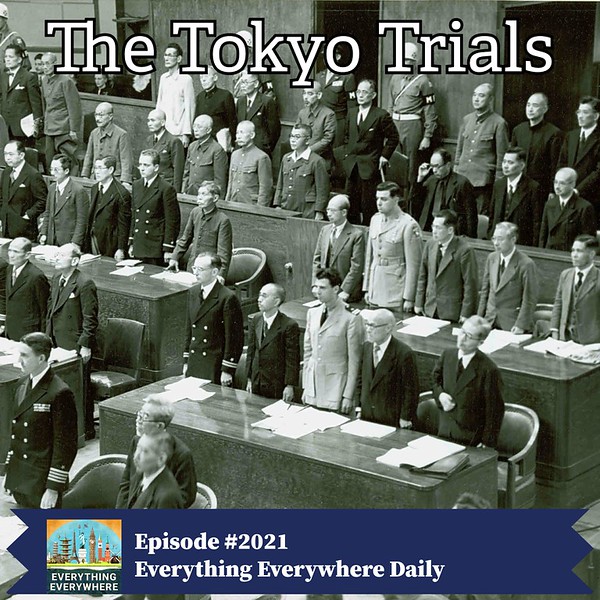
Episode – 2021 : The Tokyo Trials
Podcast Transcript
Following the conclusion of World War II, decisions needed to be made about how to handle the defeated Axis Powers.
Due to the vast scale of atrocities committed, it was not feasible to punish everyone involved. Instead, the Allies chose to put key members of the leadership on trial.
In the Eastern Theater, it was decided that trials in Tokyo would be held to determine the fate of those in high-ranking political and military positions for war crimes.
Learn about the Tokyo Trials, why they were held, the controversies surrounding them, and why they were considered to be necessary on this episode of Everything Everywhere Daily.
The Second World War was far and away the most horrific war in terms of loss of life in human history. Tens of millions of people died, and millions more were subject to horrible conditions, injury, and illness.
The most well-known atrocities occurred in the European theater of the war, but there were many equally horrific events that took place in the Pacific theater.
The Empire of Japan committed numerous war crimes, which, at the completion of the war, demanded some sort of justice on the part of the victors.
While it is not possible to list all of these war crimes committed by the Japanese, there were several major ones that are worth mentioning.
The Rape of Nanking began on December 13, 1937, and lasted for six weeks. The Imperial Japanese Army marched into the Chinese city, Nanjing, and murdered hundreds of thousands of Chinese civilians and soldiers, and raped tens of thousands of young girls and women.
At the time, Nanjing was the capital of Nationalist China, though officials had already abandoned the city before the attack. Despite this, when the Japanese arrived at the city, they attacked with pure brutality.
Entire families were murdered, including infants and the elderly; bodies lined the street for literally months after the attack, and one third of Nanjing’s buildings were looted and burnt to the ground.
According to eye-witnesses, roughly twenty to eighty thousand women and young girls were tortured and raped. A massive portion of these women were mutilated and killed after being assaulted.
Another war crime attributed to the Japanese during World War II was the attack on Pearl Harbor on December 7, 1941. This attack is notable because it was launched without a prior declaration of war against a neutral country, which is the reason it has been regarded as a war crime.
The Japanese had hoped that by attacking Pearl Harbor, they would cripple the American Pacific Fleet, allowing them to conquer more territory. They managed to cripple or destroy 20 different ships and roughly 300 planes, and most crucially, 2,000 Americans lost their lives.
A final example of War crimes committed by the Japanese was the Bataan Death March, which I covered in a previous episode. It took place on the Bataan Peninsula just west of Manila, and saw roughly 78,000 prisoners of war, 66,000 Filipinos, and 10,000 American, march 66 miles or 106 kilometers across the island of Luzon.
The march began on April 9, 1942, after US and Filipino soldiers were forced to surrender after months of fighting. The Japanese were unprepared for the number of prisoners they now had. This led to the first of the atrocities to occur, when hundreds of Filipino officers were executed.
Afterward, the prisoners were forced to march. Along the way, the Japanese troops beat men to either move them along or for sport. They limited the amount of food and water given to the prisoners, and anyone who broke rank on the march was shot, beheaded, or stabbed.
Once the 66-mile walk was finished, the remaining prisoners were shoved into boxcars. These cars were small and built for 40 men, but often were filled with 100. Many died standing in these cars due to the extreme heat.
Anywhere from 5,000 to 18,000 Filipinos and 500 to 650 Americans died.
After the war, the Allies faced the critical task of holding Japanese officials accountable for their war crimes while recognizing the impossibility of prosecuting all offenders. The Tokyo Trials focused on the top Japanese leaders to ensure justice for many victims.
It was decided that top-ranking leadership in Japan would take responsibility for promoting and accepting the systematic violence occurring during the war.
Additionally, because the scale of the violence was essentially unheard of, new charges were created for the express purpose of these trials. There were ultimately three different charges that the defendants could be given, which were modeled after the Nuremberg Trials that were held against Nazi Leadership.
The first of these were “Class A” charges. These charges were based on crimes against peace, which basically means that they waged wars of aggression against other countries. The only people charged with Class A crimes were the top leaders of Japan who had planned and directed the war effort.
The “Class B” charge focused on war crimes. These are violations of international laws, known as the laws of war, which govern the acceptable limits of hostility a nation may direct toward others and define the level of hostility necessary to justify a declaration of war.
The final charge was “Class C,” which covered all crimes against humanity. This includes systematic violence, enslavement, and deportations of the civilian populations during wartime. The trials also prosecuted individuals for persecution based on race or political opinion. This was a crucial element, primarily to allow for the prosecution of Japan for atrocities committed against people who became subjects of the Japanese Empire, such as forcing Korean and Taiwanese women into labor or sexual slavery.
The court was created by a special proclamation issued on January 19, 1946, by US General Douglas MacArthur, who served as the military governor of Japan at the end of the war.
This proclamation established the International Military Tribunal of the Far East. This brought in justices from 11 different allied countries.
Twenty-eight individuals were tried in the Tokyo Trials.
Some of the top Japanese officials put on trial included Hideki Tojo, the wartime prime minister and former army general who was widely seen as the central figure in Japan’s war leadership: Koki Hirota, a former prime minister and foreign minister; Iwane Matsui, an army general associated with the Nanjing Massacre; and Kenji Doihara, a senior general and intelligence officer deeply involved in Japan’s expansion in Manchuria.
Other prominent defendants included Kiichiro Hiranuma, former prime minister and head of the Privy Council, and Heitaro Kimura, a senior commander in Southeast Asia.
They were indicted on crimes including contemplating and carrying out murder, maltreatment, and maiming of prisoners of war and civilians, enforcing inhumane labor conditions, the destruction of towns and cities beyond military necessity, and the perpetration of mass murder, rape, torture, and other forms of cruelty against civilian populations.
The trials officially began on May 3, 1946, with the prosecution’s case. The prosecution presented its case over 192 days, ending on January 24, 1947. Evidence for the trials was presented in 15 different phases.
The prosecution based its case on the doctrine of command responsibility, holding commanding and superior officers legally responsible for war crimes carried out by their subordinates.
To get a defendant convicted, the prosecution needed to prove three different things:
The crimes were widespread or systematic.
That the defendant knew their troops were committing atrocities.
That the defendant had the authority or power to stop these crimes and did not.
The court allowed any evidence deemed to have demonstrative value, meaning the standards for admitting evidence were considered rather low. Objects like documents and diaries without signatures were allowed to be admitted without signatures or proof of issuance.
Additionally, the defense was told to adhere to the “best evidence rule,” which means the original documents were considered the best evidence. This means that any copies of the document were not admissible in court if the original document still existed.
Finally, another key decision was that the Japanese Emperor, Hirohito, and his family members were not put on trial, as foreign powers like the United States believed that he was a crucial piece in maintaining order in post-war Japan.
This decision to exempt the Emperor was the subject of extensive internal debate amongst the allies.
The defense in the trial, comprising over 100 attorneys (with three-quarters being Japanese and the rest American), started its case on January 27, 1947. This presentation continued for over 225 days, concluding on September 9.
The main argument given by the defense was that the trials were never going to be free of substantial doubt, something a free and fair trial promises.
Another main argument presented by the defense was that the laws they were charged with did not exist at the time the offenses were committed; therefore, they weren’t technically breaking the law.
An additional argument was that individuals cannot be held accountable for crimes committed by the state. So, because of this, the defendants could not be responsible for committing war crimes.
The final main argument given by the defense was that the Allied powers also committed war crimes, so they themselves should be examined under international law, and that Japan was only acting in self-defense.
After the defense finished presenting, the Court spent fifteen months reaching its decision and writing its opinions. There was one reading of the judgment’s opinions. Despite this, five of the eleven judges wrote their own dissenting opinions, disagreeing with the court’s overall decision.
One of these dissents was issued by an Australian and a French judge, who argued that exempting Emperor Hirohito from the trial directly contradicted the evidence presented in court.
They believed that the emperor bore responsibility for the war crimes as Japan’s monarch who had launched the war. Despite the claim that the emperor felt forced to do so, he launched the war and should be held responsible.
Another dissent was issued by a Filipino judge, who found the trial’s punishments too lenient. He believed that the punishments meted out by the tribunal lacked the same gravity as the crimes committed and failed to provide any deterrence
Yet another dissent was presented by a Dutch judge, who argued that the trial was inherently biased because it was being held by the victors. He felt that the trial would’ve been more fair if neutral countries and Japan itself had representatives.
The final dissent was delivered by an Indian Judge, who also found the trial biased. He believed that every accused person should be found not guilty. He claimed the trials were “victor’s justice,” meaning that justice is unevenly distributed by the winners of the war, despite committing many of the same crimes.
He considers them to be punished simply for losing. Despite this, he still believed that the atrocities were committed, but rather questioned the legitimacy of the trial.
Of the 28 defendants, only one person, Sh?mei ?kawa, was deemed mentally unfit to stand trial.
?kawa had been charged with Class A crimes, having long promoted the idea of war between Japan and Western Countries. ?kawa was the one person accused in the Tokyo Trial who was not a military or political leader, and in many ways, can be considered to be the Japanese version of Joseph Goebells, who was the Nazi minister of propaganda.
Additionally, two more defendants never received a verdict because they died during the trial.
The remaining accused were all found guilty. Seven were sentenced to death, including Hideki Tojo, Koki Hirota, and Iwane Matsui.Of those sent to prison, three died while incarcerated, and the rest were granted parole between 1952 and 1958 after President Harry Truman issued Executive Order 10393, which established a Clemency and Parole Board for War Criminals.Emperor Hirohito remained the Emperor of Japan until his death in 1989 at the age of 87.
Following the end of the Tokyo Trials, smaller trials followed. Over 5,700 lower-ranking personnel were tried with more conventional war crimes. These charges included medical experimentation, rape and sexual slavery, prisoner abuse, torture, and executions without trials.
The postwar trials at Nuremberg and Tokyo were important because they established, for the first time, that national leaders could be held personally accountable under international law for waging aggressive war and committing mass atrocities, rather than hiding behind state authority or military orders.
Through the work of the International Military Tribunal for the Far East, the Allies affirmed principles such as individual criminal responsibility, the illegality of crimes against peace, and the rejection of “just following orders” as a legitimate defense.
The Executive Producer of Everything Everywhere Daily is Charles Daniel. The Associate Producers are Austin Oetken and Cameron Kieffer.
Research and writing for this episode were provided by THE… Olivia Ashe.
I wanted to give a shout-out to one of the show’s listeners, Andy Swanson, who has launched a new podcast, Sports History Daily.
The show has a similar format to this one, and every day you can hear a short bit of sports history.
Recent episodes include how Curt Flood opened the door to baseball free agency, the Green Light Letter sent by President Roosevelt that allowed baseball to continue during World War II, and Dwight Howard’s famous catch in the 1982 NFC Championship game.
If this sounds like your cup of tea, just check out Sports History Daily wherever you listen to this podcast.
That is Sports History Daily. This episode can be found at: https://everything-everywhere.com/the-tokyo-trials/