
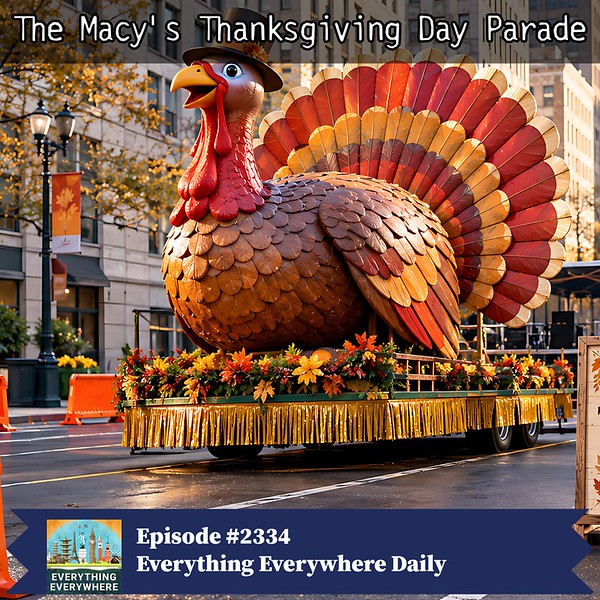
Episode – 2334 : The Macy's Thanksgiving Day Parade
This episode can be found at: https://everything-everywhere.com/the-macys-thanksgiving-day-parade/
Podcast Transcript
In 1924, one of America’s largest department stores came up with a novel way to kick off the Christmas shopping season.
What began as a relatively modest promotional event featuring store employees and animals from a zoo eventually became one of America’s most beloved holiday traditions.
Over the next century, it would feature technological innovations, enormous crowds, celebrity performances, and even a few spectacular accidents, becoming an annual event watched by tens of millions of people.
Learn more about the Macy’s Thanksgiving Day Parade and how it became an American institution on this episode of Everything Everywhere Daily.
In 1858, Rowland Hussey Macy opened a small dry goods store in New York City. Over time, Macy’s grew into one of America’s largest and most iconic department store chains, opening its famous Herald Square flagship location in 1902.
In the Roaring 1920s, Macy’s was thriving. It went public in 1922, giving the department store the capital to expand rapidly, acquire competing businesses, and open new locations.
In 1924, they decided to expand the Herald Square store to an entire city block. This made it the “World’s Largest Store,” covering a million square feet of retail floor space.
To celebrate, at the start of the holiday shopping season, Macy’s opted to throw a parade in New York on Thanksgiving morning.
The Macy’s Thanksgiving Day Parade was not the first Thanksgiving Day parade, nor is it the oldest. The oldest is actually the Philadelphia Thanksgiving Day Parade, which began in 1920 and was established by the Gimbels Department Store.
Gimbels was one of Macy’s main rivals, as it was the world’s largest department store chain by revenue in the 1930s. The Gimbel family, who ran the business, saw the parade as a good way to promote shopping at their stores.
The first Gimbels’ parade featured 50 people, a fireman dressed as Santa Claus, and 15 cars. When the Gimbels department store chain was liquidated in 1986, other companies took over sponsorship of the parade. Today, it is known as the 6abc Dunkin’ Thanksgiving Day Parade.
The other parade that competes with Macy’s for the title of oldest is America’s Thanksgiving Parade in Detroit, Michigan. Hudson’s Department Store historically organized the event, which included floats, marching bands, and people wearing papier-mâché heads.
Newspapers advertised the first Macy’s Parade as “a Marathon of Mirth.” Although it wasn’t the standard marathon length of 26.2 miles, it still stretched 6 miles from Harlem to Herald Square.
Interestingly, even though the parade took place on Thanksgiving, it was first known as the Macy’s Christmas Parade to help the store jump-start holiday sales.
In the early 1920s, many of Macy’s employees were first-generation European immigrants, and they wanted to celebrate American Thanksgiving with a European-style parade that combined their old culture with their new one.
Macy’s employees dressed in bright costumes, and the overall feel was more like a carnival on wheels. The attractions included marching bands, clowns, Mother Goose-themed floats, and animals on loan from the Central Park Zoo.
The parade ended with a float carrying Santa Claus, who sat in a reindeer-driven sleigh perched atop a mountain of ice.
250,000 people watched the parade along the route, with 10,000 waiting at Macy’s. Once Santa arrived, he blared a trumpet, and the Macy’s windows revealed their holiday displays.
Although the parade barely appeared in the following days’ newspapers, Macy’s was excited about the event. Because of the crowd size, Macy’s thought they had a hit on their hands. Macy’s decided to hold the parade the following Thanksgiving, and they announced it in the newspaper the next morning.
Some of the aspects of the parade changed over the following years.The biggest change came in 1927, when the parade stopped using animals. The animals were not exactly thrilled to walk the parade’s 6 miles on hard city streets. Also, the animals’ noise frightened many young spectators.
The parade turned to something much less scary: an animal-shaped, upside-down marionette. They inflated the marionette with air and carried it on sticks. The first of these was the cartoon character Felix the Cat.
This was the start of the parade’s most iconic feature: massive balloons.This first year, they were inflated with regular air, but the next year they began being filled with helium.
In 1927, the event was renamed the Macy’s Thanksgiving Day Parade to better align with the holiday and signal the start of the winter shopping rush.
Early in the parade’s history, organizers released balloons into the sky at the end of the route. The balloons had a return address, and people who returned them were offered a reward of up to $100. This made for a fun treasure hunt for those in the area.
This practice eventually ended in 1932 after a student named Annette Gibson attempted to catch a 60-foot-long balloon with her small aircraft. As she tried, the balloon became entangled with one of her plane’s wings. While Gibson and her flight instructor, who was also aboard, landed safely, the impact was enough to end the balloon-releasing practice.
Interestingly, the success of the Macy’s Thanksgiving Day Parade was so big that it reduced the popularity of another holiday: Ragamuffin Day. Ragamuffin Day was a version of children’s Thanksgiving, popularized from 1870 into the 1920s. This holiday primarily featured children going around and doing something similar to trick-or-treating.
Many adults disliked the holiday, and the backlash grew so severe in the 1930s that organizers promoted alternative events, including the Macy’s parade. This eventually overwhelmed Ragamuffin Day and caused it to die out.
Throughout the 1930s, the parade’s popularity continued to grow. Crowds of over 1 million people appeared starting in 1933 during the Great Depression. It was cheap entertainment.
To keep up with the event’s growing popularity, the balloons became more extravagant. Popular characters like Mickey Mouse were introduced, and they grew bigger and more elaborate to draw more attention.
Local radio stations broadcast the annual parade festivities across New York between 1932 and 1941.
The parade was suspended from 1942 through 1944 after America entered World War II. This was primarily because the war effort needed resources like rubber and helium. The balloons were deflated and donated, providing 650 pounds of scrapped rubber.
The film Miracle on 34th St. was released in 1947. The film featured footage from the 1946 parade, exposing it to audiences outside New York, turning the event into a nationwide phenomenon. The parade was first broadcast on national television in 1948. That year, the parade featured 17 floats, six different balloons, and several marching bands.
After it was televised, the parade’s popularity grew, and many of its traditions developed. For example, one of the parade’s cornerstone performances is the Radio City Music Hall’s Rockettes. They have performed in every parade since 1958 and are considered a cornerstone of the event.
Another major change came in 1958, when the parade began featuring celebrity performances, starting with the Benny Goodman Sextet. However, delivering live musical acts on moving stages presented significant technical and logistical challenges. To overcome these hurdles, the parade shifted to lip-synced performances in 1964.
Marching bands are selected through a competitive application process, often with applications submitted more than a year in advance. Macy’s parade officials evaluate audition videos, musical ability, marching precision, visual presentation, and previous performances. Bands are selected from high schools, universities, and other musical organizations across the country and occasionally from abroad.
Typically, 10 to 12 marching bands perform each year, with more than 100 bands competing for the opportunity. Since 2006, the parade has also featured Macy’s Great American Marching Band, consisting of more than 250 outstanding young musicians representing all 50 states.
Floats have been part of the Macy’s Thanksgiving Day Parade since its inception in 1924. In the late 1960s, designer Manfred Bass revolutionized float construction by developing elaborate, collapsible structures that could be transported through the Lincoln Tunnel from New Jersey and reassembled in Manhattan. This allowed floats to reach up to 40 feet tall and 28 feet wide, incorporating elaborate scenery, moving mechanical parts, and stages for celebrity performances.
Another major part of the parade, and something almost no other parade features, is Broadway cast performances. Most of the time, the performances come from shows that debuted that year and appear for promotional purposes.
Over the years, the parade has also undergone many safety changes. The primary concern during the event is that strong gusts of wind will cause the giant balloons to damage something.
On a few occasions, people have been injured. In 1993, a Sonic the Hedgehog balloon was pushed into a lamp post. This caused damage, and the top of the light post broke off inside the balloon. As a result, the balloon dragged down, injuring a child and a police officer.
A similar issue occurred during the 1997 parade. High winds pushed the cat in the hat balloon into a lamp. This led to debris that struck a parade-goer, fracturing her skull. The victim was in a coma for 24 days.
That same year, other balloons got out of control, leading the mayor at the time, Rudy Giuliani, to form a task force that imposed multiple safety regulations and removed lamppost arms along the parade route. It also required balloon handlers to complete physical training.
A key step was adding wind-measurement devices to alert parade organizers to unsafe conditions. Regulations also required keeping balloons closer to the ground when it was windy.
The balloons in the parade come in different varieties. Novelty balloons, the oldest class of balloons in the parade, are smaller inflatable figures that require 1 to 30 handlers and include oversized character heads, animals, and other decorative shapes.
The larger balloons you think of when you picture the parade are called character balloons. These balloons are primarily licensed characters from popular culture. These often require 90 people to handle.
As of 2024, the tallest Macy’s Thanksgiving Day parade balloon of all time appeared in 1986. The balloon was of Olive Oyl, holding her baby Swee’Pea. It stood 102 feet tall.
The Widest balloon was added to the parade in 2024. Known as the Gabby balloon, it was inspired by the children’s TV series Gabby’s Dollhouse. The balloon was 66.5 feet wide, or the equivalent of 10 taxi cabs.
The longest balloon in Thanksgiving Day Parade history is known as Old Man Dragon. The balloon appeared only in 1929, but reached 178 feet long.
The longest-running balloon in parade history is Snoopy. However, new designs of the balloon have been released several times. Nonetheless, Snoopy has appeared in 45 different parades in some form.
Today, the Macy’s Thanksgiving Day Parade route is significantly shorter, at only 2 1/2 miles.
Each year, over 44 million people watch the parade on television. It remains one of America’s most-watched events. In 2005, the parade telecast was one of the five most-watched television broadcasts that were not NFL games. The other four were national championships of other sports and the inauguration of the President of the United States.
NBC has been the official broadcaster of the parade since 1953. As of 2025, the program pays Macy’s $60 million per year to broadcast the parade and another Macy’s event, the Macy’s Fourth of July fireworks. In 2023, advertisements during the parade cost roughly $900,000 per 30-second commercial.
The earliest telecasts of the parade were only an hour long, but the broadcast has been four hours long since 2007.
What began in 1924 as a department-store promotional event has evolved into one of America’s most enduring holiday traditions. For generations of Americans, giant balloons floating through the streets of Manhattan and the arrival of Santa Claus have become as much a part of Thanksgiving as turkey and pumpkin pie.
Automatically extracted from this episode; not independently verified. Please report possible errors below.
Episode topics
- Culture
- Entertainment
- History
- Popular Culture