
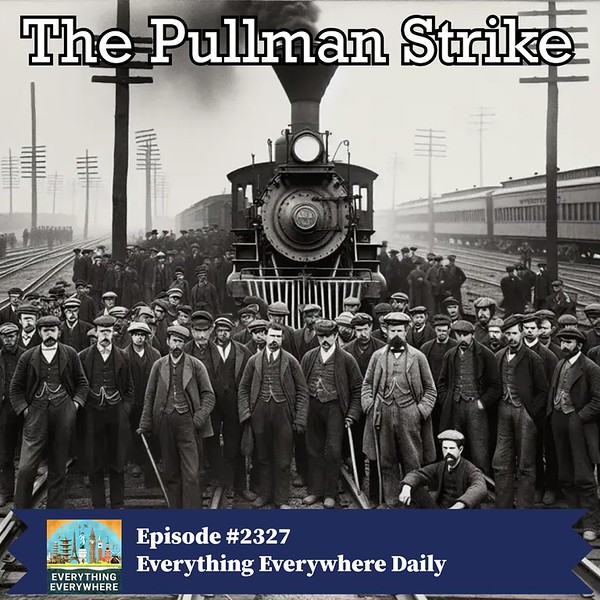
Episode – 2327 : The Pullman Strike of 1894
This episode can be found at: https://everything-everywhere.com/the-pullman-strike-of-1894/
Podcast Transcript
In the late 19th century, one American industrialist attempted to create the perfect town for his workers.
It was a carefully planned community where employees enjoyed modern conveniences, clean streets, and comfortable homes.
However, beneath the surface of this industrial utopia lay growing resentment, economic hardship, and a conflict that would eventually bring much of the nation’s railroad network to a screeching halt.
The confrontation would become one of the defining moments in American labor history.
Learn more about the Pullman Strike of 1894 and how it transformed American labor relations on this episode of Everything Everywhere Daily.
In the 19th century, American industry changed dramatically, and sdidre condition of American workers. One of the most visible changes was the establishment of mill and company towns across the United States.
One prominent example of an industrial mill town was Homestead, Pennsylvania, near Pittsburgh, where Andrew Carnegie’s steelworks attracted thousands of industrial laborers in the late 19th century. More than 8,000 people settled around the mill.
The mill’s surrounding area quickly became private residential lots, many rented to mill workers. The town’s life depended on the mill. Everything from housing affordability to availability depended on the factory.
The town soon became a network of overpopulated immigrant enclaves with people living in dirty, overcrowded dwelling. Industrialists bemoaned the conditions but chose not to intervene because a steady stream of workers kept coming. Also, controlling living conditions beyond the mill added complexity and cost they weren’t willing to accept.
Railroad magnate George Pullman was the exception. Pullman saw an advantage in doing things differently. Rather than having adjacent factory towns pop up, he saw an economic opportunity.
Pullman’s factory manufactured sleeping cars for the ever-expanding American rail industry. He was determined to remove his plant and the workers from the plight of Homestead-type urbanization, as he characterized it: The snares of the great city
Pullman acquired approximately 4,000 acres of prairie and marshland near Lake Calumet, south of Chicago, although the original factory and residential community occupied only a few hundred acres.
The city annexed the town in 1889, formally making it part of Chicago. Today, visitors can see the historic town at the Pullman National Historic Site on Chicago’s South Side, which I highly recommend if you’re in the area.
Pullman intended to build a model town to improve his workers’ lives, as he wrote: It was in the employer’s interest to see that his men were clean, contented, sober, educated, and happy.
When the first families moved in shortly after New Year’s Day 1881, they arrived in a town boasting a library, parks, artificial lakes, fountains, playgrounds, and an auditorium. Luxuries that were uncommon in Gilded Age America.
The town’s 1,800 residents also had plenty of places to spend their factory earnings, including men’s clubs, hotels, and shopping districts.
Despite its impressive amenities, Pullman’s town was missing one key element of urban life: a saloon. At its core, the community of Pullman was a grand experiment in social engineering and moral reform. Pullman prohibited saloons and the public sale of alcohol in his model town, although he made a notable exception for the upscale Hotel Florence, where visiting executives and other guests could purchase alcoholic beverages.
By creating a dry town, Pullman hoped to cultivate an industrious and orderly workforce and, more importantly, one free from unionization.
Pullman exercised complete authority over every aspect of life in his company town.. It basically ran as his personal fiefdom. No one could buy a home in the town. They all had to rent from Pullman, giving him complete license to evict anyone who ran afoul of his expectations.
While Pullman’s effort may have sounded noble, the economic realities of life in Pullmantown would eventually have dramatic effects on working conditions.
Despite his noble intentions, he also expected a significant financial return on his investment. Pullman’s rents ran much higher than those in surrounding communities and eventually created an unbreakable cycle of debt for workers at the Pullman factory.
The situation in the young town grew untenable as the nation was struck by one of the most devastating economic downturns in U.S. history: the Panic of 1893. By some measures, the Panic of 1893 rivaled the Great Depression, a topic which I covered in a previous episode.
While the Panic did not reach the same depths as the Great Depression, unemployment spiked in some urban areas to rates approaching 25%. More than 15,000 businesses and more than 500 banks closed, wiping out the wealth of large parts of the country.
Railroads were among the hardest-hit businesses, with more than 1 in 4 forced into merger or foreclosure. Plummeting demand for rail cars devastated Pullman workers.
As railroad car orders declined during the 1893 depression, Pullman repeatedly cut wages, and some workers had lost 25 to 40 percent of their wages.
This was bad, but a bigger problem was that rents in the town of Pullman stayed the same. Although workers’ wages were no longer subject to direct rent deductions after 1891, Pullman circumvented the restriction by issuing separate checks for rent and wages, ensuring the company received its rent even as workers struggled to survive.
Discontent was not unique to the Pullman Company. Workers across the country were angry about their conditions in the 1880s and 1890s. As historian Pauline Maier notes, nearly every town with a population greater than 20,000 in the Northeast and Midwest saw a strike in the late 1880s and early 1890s.
Americans were wary of strikes. The Great Railroad Strike of 1877 was still fresh in their memory as tens of thousands of workers struck, paralyzing the nation’s rail traffic and culminating in dozens being killed by workers and militias called in to put down the violence.
On May 4, 1886, a labor protest rally at Chicago’s Haymarket Square turned violent when an unidentified person hurled a bomb into the ranks of police officers attempting to disperse the crowd. Officers immediately opened fire on the crowd, killing several demonstrators and wounding many more, while the explosion and ensuing chaos also killed multiple police officers. The riot permanently linked the eight-hour workday movement with radical violence in public consciousness.
By 1894, Pullman workers felt trapped. They recognized that the nation’s attitudes toward labor unrest had grown acrimonious and that more than three million workers were out of work.
Despite these concerns, Pullman’s workers were too demoralized by declining wages and static rents. Yet, Pullman refused to yield, saying: The renting of the dwellings and the employment of workers at Pullman are in no way tied together.
The workers were further enraged by the continued payment of an 8% dividend to Pullman’s stockholders and a large corporate surplus of $25 million announced at the end of 1893.
In March 1894, the Pullman workers joined the American Railway Union. Labor leader Eugene V. Debs created the ARU, hoping to expand railway workers’ interests by unifying them into one large nationwide labor conglomerate.
Unlike traditional craft unions, which organized workers by trade or skill, Debs’s American Railway Union sought to unite railway workers from many occupations into a single powerful organization. However, the union excluded Black railway workers.
By uniting them, Debs hoped to use sheer numbers to the workers’ advantage.
George Pullman poorly received the news of the workers’ unionization and promptly fired the three prominent leaders the day after they protested a new round of wage cuts. On May 10, 1894, the workers voted to strike.
What began as a small strike ballooned to 90% of Pullman’s 3300 workers. Thomas Heathcote, a Pullman employee and chairman of the workers’ strike committee, summarized the conditions that led them to strike: “We do not know what the outcome will be, and in fact we do not much care.” We do know that we are working for less wages than will maintain ourselves and families in the necessities of life, and on that proposition we refuse to work any longer.
Interestingly, Debs was reluctant to have the American Railway Union support the strike, fearing that public opinion was now firmly against striking workers, particularly during a painful economic time. The striking workers received only Debs sympathy, as he knew the costs of a strike outweighed the potential benefits.
Debs’ call for discussion was disregarded as Pullman maintained his stance and refused arbitration. Despite Debs’s reservations, delegates at the American Railway Union’s June convention voted to support the Pullman workers by refusing to handle trains carrying Pullman sleeping cars. The boycott began on June 26, 1894, turning a local labor dispute into a full-blown national crisis.
Despite using replacement workers, the ARU gained momentum as the boycott soon spread to 27 states and disrupted traffic on more than a dozen railroads.
By early July, the nation’s rail traffic was at a standstill. Railroad executives saw this as an opportunity to crush the union. They fired switchmen who refused to follow orders and replaced them with men who would.
Although the original walkout at the Pullman factory remained largely peaceful, the expanding railway boycott became increasingly violent, particularly in Chicago, where crowds attacked railroad property, overturned railcars, and clashed with authorities. Not all of this violence was organized or directed by the union itself.
The Railroad General Managers Association realized that the workers had the upper hand and they needed to change the one thing they had left: public opinion.
Railroad executives fed loyal newspapers false or exaggerated headlines. The media campaign worked as the federal government stepped in on behalf of the railroads.
Attorney General Richard Olney, a former railroad lawyer, hired 3,200 “special deputies” to keep the trains running. Lawyers followed, filing an overwhelming number of lawsuits to curb the effects of the boycott.
The judges were often harsh in their opposition to the striking workers. A Federal District Judge and future President and later Chief Justice of the Supreme Court, William Howard Taft, lamented the lack of violence towards striking workers when he wrote in a letter to his wife: They have killed only six of the mob as yet. This is hardly enough to make an impression.
Injunctions against the workers came down in droves, including those that forbade Debs from speaking in public and an arrest warrant for anyone participating in the strike.
On July 3, 1894, President Grover Cleveland ordered federal troops into Chicago, ostensibly to protect the delivery of federal mail and ensure the continued operation of interstate railroads. Approximately 2,000 federal soldiers were eventually deployed, alongside thousands of state militia, deputy marshals, and local police.
The violence escalated rapidly, particularly in Chicago, where clashes involving protesters, police, and military forces left at least 13 people dead and dozens more wounded.
The strike eventually collapsed under the combined pressure of federal troops, court injunctions, arrests of union leaders, and the railroads’ use of replacement workers. By mid-July, the nationwide boycott was effectively broken, although the original Pullman workers did not return to work until August.
Debs was jailed for his role in the strike. His case eventually went to the Supreme Court, which upheld the charges against him, ensuring he would serve more time in jail and receive a heroic welcome when he was released.
While in prison, Debs became more radicalized and ran for president as the Socialist Party candidate in five elections, including once from jail in 1920.
The Pullman Strike of 1894 was ultimately unsuccessful for the Pullman workers, but its consequences extended far beyond the factory town south of Chicago. It exposed growing tensions between labor and management in an industrializing America and demonstrated the federal government’s enormous power to intervene in labor disputes. It also helped transform Eugene V. Debs into one of the most influential figures in American labor history.
Although the strike failed to achieve its immediate objectives, it helped fuel a broader movement for labor reform.
Automatically extracted from this episode; not independently verified. Please report possible errors below.
People mentioned in episode #2327
- George Pullman
- Andrew Carnegie
- Eugene V. Debs
- Thomas Heathcote
- Richard Olney
- William Howard Taft
- Pauline Maier
- Grover Cleveland
Places mentioned in episode #2327
- Pullman
- Chicago
- Homestead, Pennsylvania
- Lake Calumet
- Haymarket Square
Historical events in episode #2327
- May 4, 1886 — Haymarket Square Riot (impact 60/100)
- March 1894 — Pullman workers joined the American Railway Union (impact 60/100)
- May 10, 1894 — Pullman workers voted to strike (impact 70/100)
- June 26, 1894 — Boycott began (impact 40/100)
- July 3, 1894 — Federal troops ordered into Chicago (impact 40/100)
Episode topics
- Economics
- History
- Politics