
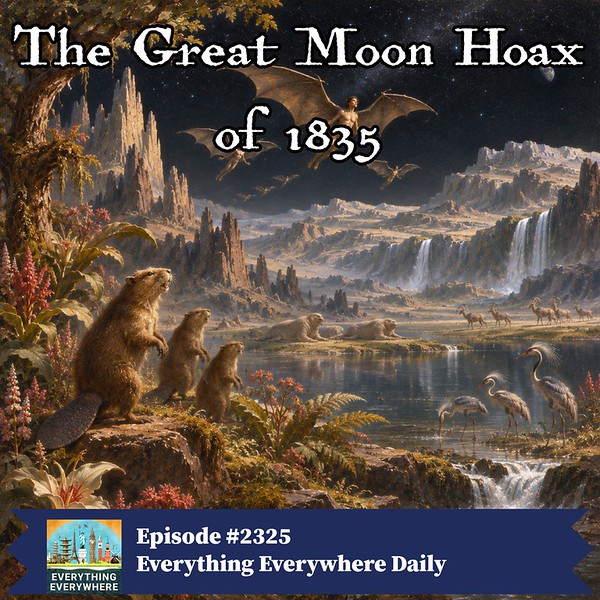
Episode – 2325 : The Great Moon Hoax of 1835
This episode can be found at: https://everything-everywhere.com/the-great-moon-hoax-of-1835/
Podcast Transcript
In 1835, a New York newspaper announced one of history’s most astonishing scientific discoveries.
A world-famous astronomer supposedly developed a revolutionary telescope that revealed things no human had ever seen.
Over six days, readers received increasingly extraordinary revelations that captured the public’s imagination and made headlines worldwide.
There was just one problem. None of it was true.
Learn more about the Great Moon Hoax of 1835 on this episode of Everything Everywhere Daily.
The events of this episode might seem absurd to someone in the 21st century. That is because it’s hard to imagine what it is like not to know something you know.
We know a lot about the moon. We’ve sent people to the moon. They’ve taken photos on the moon’s surface and brought back samples we’ve analyzed. Orbiting spacecraft have mapped the surface, and we even have a good idea of where we could find near-surface water.
200 years ago, that wasn’t the case.
By 1835, scientists had made considerable progress in understanding the solar system, but enormous gaps remained in their knowledge.
Astronomers understood that the Moon had mountains, craters, and vast dark plains. They knew its approximate distance from Earth and had developed increasingly accurate maps of its visible surface.
However, telescopes still had limited resolving power, and the lunar surface was poorly understood.
The possibility of life on the Moon was not necessarily considered absurd.
Since the seventeenth century, scientists, philosophers, and theologians had seriously considered the possibility that other celestial bodies might be inhabited.
Johannes Kepler imagined lunar inhabitants in his fictional work Somnium, published posthumously in 1634.
Christiaan Huygens explored the possibility of extraterrestrial life in his Cosmotheoros, published in 1698.
William Herschel, one of the most important astronomers of the eighteenth century, also speculated about inhabitants of other worlds.
By the nineteenth century, the idea that planets and moons might harbor life had become part of popular scientific discussion.
One particularly important figure was Thomas Dick, a Scottish minister and popular science author.
In his 1823 book The Christian Philosopher and later writings, Dick argued that the universe likely contained intelligent beings. He even attempted to calculate the populations of other worlds.
One estimate he assigned to the Moon was approximately 4.2 billion inhabitants, based largely on assumptions about population density and habitable surface area rather than observations.
Dick’s writings became popular in Britain and America, so many educated readers were familiar with the notion of a populated Moon before 1835.
The possibility of extraterrestrial life was also tied to religious discussions. Theological arguments tied to natural theology held that studying nature revealed God’s wisdom and power.
Some thinkers reasoned that a universe containing countless planets would be strangely wasteful if Earth were the only inhabited world. For them, discovering intelligent beings on the Moon would reinforce the idea of a universe filled with purposeful creation.
This was the rough state of both science and theology with respect to the Moon in 1835. We didn’t know a lot, and there was a lot of speculation as to what might be on the Moon.
The other major factor influencing the events of 1835 was the state of the media, which at the time meant newspapers.
In the early nineteenth century, most American newspapers were relatively expensive publications serving merchants, political organizations, and educated subscribers.
A typical New York newspaper could cost six cents per issue, a substantial expense for ordinary workers. This changed in September 1833, when Benjamin Day founded The Sun.
Day introduced a newspaper that sold for only one cent.
Instead of relying primarily on subscriptions or political patronage, the Sun sought a large audience and substantial advertising revenue.
The business model depended on selling as many copies as possible.
To do this, The Sun emphasized stories that interested ordinary readers, including crime, scandals, human-interest stories, unusual events, and sensational discoveries.
The introduction of steam-powered printing presses, combined with New York City’s growth, made large-scale newspaper distribution increasingly practical.
By 1835, The Sun was already distributing around 19,000 to 20,000 copies on a typical day, making it one of the most widely read newspapers in the United States.
This combination, a public that knew little about the moon yet welcomed speculation and a newspaper incentivized to sell copies at any cost, led to the Great Moon Hoax.
Enter Richard Adams Locke.
Locke was an English-born journalist who had moved to the United States and joined The Sun in 1835. He was well educated and familiar enough with contemporary scientific debates to convincingly imitate the language of astronomical research.
His motivation was probably more complicated than simply fooling newspaper readers. Locke was skeptical of the extraordinary claims made by writers who speculated about populated planets and other worlds without sufficient scientific evidence.
Thomas Dick’s writings were a particularly prominent target. Locke apparently wanted to satirize those speculative theories by taking them to absurd extremes.
If authors could confidently estimate billions of inhabitants on the Moon without having observed a single lunar creature, Locke would demonstrate the absurdity of such speculation by inventing observations of entire lunar civilizations.
However, and this is where the problem set in, he presented his satire as a convincing scientific report.
On Friday, August 21, 1835, The Sun published a short notice claiming that astronomer John Herschel had made remarkable astronomical discoveries using a powerful new telescope.
The notice was supposedly based on information from the Edinburgh Courant, a Scottish newspaper. It was essentially a teaser.
Four days later, on Tuesday, August 25, the newspaper began publishing a long serialized account under the headline:
GREAT ASTRONOMICAL DISCOVERIES LATELY MADE BY SIR JOHN HERSCHEL At the Cape of Good Hope
The first installment described Herschel’s supposed invention of an enormous new telescope in South Africa that would revolutionize astronomy.
It was claimed to have a primary optical element measuring 24 feet in diameter, far larger than the telescopes actually used at the time.
Its most remarkable feature was supposedly a device called a hydro-oxygen microscope, which would project and greatly enlarge telescopic images.
The narrative claimed that the instrument was powerful enough to view objects on the Moon as though they were only about 100 yards away. This fictional technology was the crucial piece on which the entire hoax depended.
Also, the fictitious report that the Sun was citing was supposedly published in the Edinburgh Journal of Science.
The second installment on Wednesday described Herschel’s first detailed observations of the Moon, supposedly made on January 10, 1835.
Instead of a barren landscape, he encountered a thriving environment. There were forests, flowers, enormous rock formations, grassy plains, and bodies of water.
Dark red flowers reportedly grew among basaltic rocks. Large animals resembling bison roamed across the landscape, along with blue-gray goat-like creatures, unusual birds, and bizarre amphibious animals.
The third installment on Thursday introduced even more vegetation and animals, including an extensive catalog of newly discovered lunar species.
The fourth installment on Friday delivered the most sensational discovery.
Herschel’s telescope supposedly revealed humanoid beings roughly four feet tall, standing upright, with humanlike faces and covered in copper-colored hair.
Most astonishingly, they possessed large wings similar to those of bats. The fictional scientists in the article classified them as Vespertilio-homo, meaning roughly “bat-man.”
After introducing intelligent lunar inhabitants, Locke needed another extraordinary discovery to keep the narrative moving. The fifth installment on Saturday described an apparently abandoned structure built from polished sapphire.
Its roof was covered in golden or yellow metallic ornamentation resembling flames surrounding a large sphere.
In the final installment, on Monday, August 31, Herschel supposedly discovered another group of winged humanoids living near the sapphire temple.
These creatures were described as more physically refined than those observed previously. Their behavior suggested a peaceful civilization without warfare or widespread violence.
Then disaster interrupted the observations. According to the report, the telescope had been left positioned so that sunlight passed through its optical system, concentrated into an intense beam, and set part of the observatory on fire.
One of the biggest problems with the story is that much of it was real.John Herschel was one of the world’s most respected astronomers. He was the son of William Herschel, who had discovered Uranus in 1781, and was himself an accomplished mathematician, chemist, and astronomer.
In 1834, John Herschel did travel to the Cape of Good Hope in South Africa to observe the southern sky.
The story provoked an enormous reaction, though it is difficult to establish how many people actually believed it.
New Yorkers debated the discoveries in coffeehouses, workplaces, and homes. Some accepted the reports as factual. Others were skeptical, and still others suspected that the entire narrative was an elaborate joke.
The story quickly escaped the pages of The Sun. Competing newspapers reprinted portions of the articles, extending their reach far beyond New York. Within days, newspapers in Philadelphia, Baltimore, Boston, and other American cities carried the supposed discoveries.
Within approximately two weeks, the reports had spread westward to Cincinnati, and by late September they were being discussed in Europe.
While some people bought the story hook, line, and sinker, others were skeptical, and the Great Moon Hoax began to unravel almost immediately.
The New York Journal of Commerce questioned the reports’ authenticity before the series had completed, comparing the narrative to fictional travel adventures such as Robinson Crusoe and Gulliver’s Travels.
However, the most aggressive critic was James Gordon Bennett Sr.. Bennett had founded the New York Herald in May 1835, making him a direct competitor of Benjamin Day.
His newspaper had temporarily stopped printing after a fire, but when publication resumed on August 31, Bennett attacked the lunar discoveries.
His article, titled The Astronomical Hoax Explained, identified a devastating factual problem. The Edinburgh Journal of Science, which supposedly published the findings, had ceased publication in 1833.
Bennett also publicly identified Richard Adams Locke as the probable author.
Within two weeks, pressure mounted on The Sun to admit the articles were a hoax; however, like a good professional wrestler, they stuck to the story.
The newspaper continued to claim that it could not determine the truth until reports arrived from Britain. The editors maintained the fiction that they had merely republished a document received from overseas, and Locke himself also resisted publicly admitting authorship.
In fact, supposedly, several Yale professors traveled to New York to inspect the original scientific journal containing the discoveries.
The newspaper staff supposedly sent the visitors from one office to another, claiming that the journal was at the printer’s office or had been divided among typesetters. Eventually, the scientists allegedly returned to Connecticut without obtaining the document.
The real John Herschel was thousands of miles away in South Africa, largely unaware of the commotion in New York. Because international communications were slow, they could not immediately check the story with him.
When he eventually learned what had been published in his name, Herschel reportedly responded with amusement rather than outrage. He recognized the article’s absurdity.
However, the matter also became inconvenient, as some correspondents apparently kept inquiring about his supposed lunar discoveries even after the hoax was exposed.
For several years, Richard Adams Locke avoided fully admitting his authorship.
Finally, on May 16, 1840, in a letter published in The New World, Locke maintained that his original purpose was satire.
One interesting side story to the hoax had to do with Edgar Allen Poe. Just two months before the hoax, Poe had published a story titled The Unparalleled Adventure of One Hans Pfaall, which describes a man who constructs an enormous balloon and uses it to travel to the Moon.
He initially believed that Locke might have borrowed elements of his story, although the two works differed considerably in their central premises. Poe was especially struck by the fact that his own fictional narrative had attracted relatively little attention, while Locke’s newspaper articles had become a major sensation.
Poe later wrote extensively about the Great Moon Hoax and its extraordinary public reception. He was fascinated by hoaxes and later produced several. One of his most famous was The Balloon-Hoax in 1844, a fictional account of a remarkable transatlantic balloon crossing that was also published in….The Sun.
The Great Moon Hoax of 1835 was more than just an elaborate practical joke. It demonstrated the power of emerging mass media and the public’s willingness to believe extraordinary claims when they came from seemingly authoritative sources.
Although the story of winged humans and lunar civilizations was eventually exposed as fiction, it revealed something very real about human nature.. A compelling story can travel around the world long before anyone takes the time to determine whether it is true.
Automatically extracted from this episode; not independently verified. Please report possible errors below.
People mentioned in episode #2325
- John Herschel
- William Herschel
- Richard Adams Locke
- Thomas Dick
- Benjamin Day
- James Gordon Bennett Sr.
Places mentioned in episode #2325
- New York
- Cape of Good Hope
- South Africa
- Edinburgh
Historical events in episode #2325
- August 21, 1835 — Publication of the first notice of the Great Moon Hoax (impact 20/100)
- August 25, 1835 — Beginning of serialized account in The Sun (impact 30/100)
- January 10, 1835 — Herschel's supposed observations of the Moon (impact 5/100)
- August 31, 1835 — Final installment of the Great Moon Hoax (impact 25/100)
- May 16, 1840 — Locke's admission of satire (impact 5/100)
Episode topics
- Astronomy
- History
- Media
- Popular Culture
- Science