
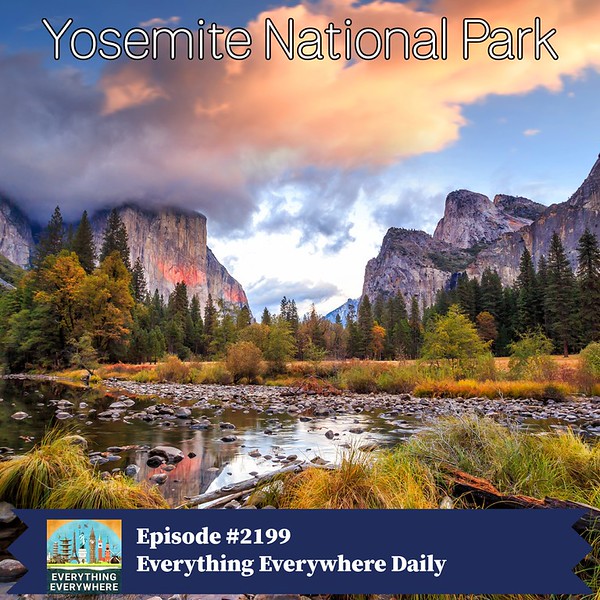
Episode – 2199 : The History of Yosemite National Park
Podcast Transcript
In the heart of California’s Sierra Nevada mountains lies a landscape of towering granite cliffs, ancient sequoias, cascading waterfalls, and deep valleys carved by ice.
It has inspired Indigenous peoples, explorers, artists, conservationists, and millions of visitors.
Its story also helped create the modern idea of protecting wild places for everyone.
Learn more about Yosemite National Park on this episode of Everything Everywhere Daily.
The United States has one of the world’s great national park systems. Among its most famous parks are Yellowstone, the Grand Canyon, and Yosemite. Yosemite’s landscape has been changing for hundreds of millions of years, and one of the things that makes it unique is the amount of granite exposed at the surface.
Granite is an igneous rock that forms when underground magma cools very slowly deep within the Earth. While granite is usually buried as basement rock, tectonic forces uplifted Yosemite’s formations thousands of feet. Water, weather, and glaciers later stripped away surface layers and carved the sheer walls visible in Yosemite Valley.
The result is a landscape dominated by granite and shaped into some of the most recognizable scenery in the world.
People have lived in the Yosemite region for more than 8,000 years. Several Native American peoples called the area home, most notably the Ahwahnechee. Their stories and traditions became central to the valley’s cultural history.
Ahwahnechee stories explain landmarks such as El Capitan, Half Dome, and the waterfalls, and describe the relationship between people, animals, and the land. One famous story tells of two bear cubs sleeping on a rock that rose into the sky. Their mother called on the animals to rescue them, and only a small measuring worm could climb the rock and create a path down.
The Ahwahnechee also shaped the valley through controlled burning. Frequent low-intensity fires preserved open meadows, recycled nutrients, encouraged black-oak growth, and reduced the buildup of fuel that could produce destructive wildfires. Later policies suppressed fire, allowing forest cover to expand and altering the valley’s ecology.
Ahwahnechee control of the region collapsed after the California Gold Rush. In 1851, the state-sanctioned Mariposa Battalion entered the valley, burned villages and food supplies, and forced Native residents from their homes. Settlers then claimed the land.
The valley was renamed Yosemite by members of the battalion. The name was intended to honor the people who had lived there, but it likely came from a misunderstood word that meant something closer to “they are killers,” possibly referring to bears or to the reputation of Chief Tenaya’s people.
After the conquest, settlers arrived seeking minerals, timber, and commercial opportunities. The landscape also attracted artists, writers, naturalists, and tourists. German-born painter Albert Bierstadt helped make Yosemite famous through dramatic paintings that commanded extraordinary prices in eastern markets.
Galen Clark became one of Yosemite’s earliest guardians. He described visitors standing speechless and tearful when first seeing the valley’s immense scale. His work helped prepare the way for the person most closely associated with Yosemite’s preservation: John Muir.
Muir was born in Scotland and raised in Wisconsin. He arrived in Yosemite after years of travel and became captivated by the mountains. He climbed peaks, studied plants and glaciers, drew maps, kept journals, and wrote passionately about the valley.
Muir described Yosemite as a temple of nature and became its most influential advocate. In 1892, he helped found the Sierra Club to build public and political support for protecting the Sierra Nevada.
Yosemite became a national park in 1890, but an earlier law created a complicated division of authority. In 1864, President Abraham Lincoln had granted Yosemite Valley and the Mariposa Grove of giant sequoias to the state of California. The surrounding high country later became a federal park, while the valley floor remained under state management.
Muir believed California was allowing logging, grazing, hotel construction, and commercial development to damage the valley. He sought a powerful ally who shared his enthusiasm for wilderness and found one in President Theodore Roosevelt.
In 1903, Roosevelt asked Muir to guide him through Yosemite. Roosevelt wanted to leave politics and attendants behind and camp in the open with Muir. The two spent several days together in the mountains, including a memorable night beneath giant sequoias.
The trip strengthened Roosevelt’s commitment to conservation. Three years later, Yosemite Valley and the Mariposa Grove were transferred from California to federal control, unifying the park.
Yosemite soon faced another major conflict. San Francisco wanted to dam the Tuolumne River in Hetch Hetchy Valley, north of Yosemite Valley, to provide water and hydroelectric power. Hetch Hetchy was often described as nearly equal to Yosemite Valley in beauty.
Muir and preservationists opposed the project, arguing that a national park should not be flooded for municipal development. Other conservationists, including Gifford Pinchot, believed natural resources could be used carefully for the greatest public benefit.
The debate revealed a lasting divide between preservation and conservation. Preservationists wanted extraordinary places left substantially untouched. Conservationists accepted development when resources could be managed for broad public use.
The 1906 San Francisco earthquake strengthened the city’s argument for a secure water supply. Roosevelt was sympathetic to Muir but also faced pressure from advisers and California officials. President William Howard Taft initially resisted the project, but the issue continued after his administration.
In 1913, Congress passed the Raker Act, and President Woodrow Wilson signed it, authorizing the Hetch Hetchy dam. Muir was deeply disappointed but wrote that the battle for conservation would continue endlessly. He died the following year. The valley was later flooded behind O’Shaughnessy Dam.
The Hetch Hetchy controversy became one of the most important environmental debates in American history. It helped define the modern preservation movement and remains a symbol of the tension between development and protection.
Yosemite is more than cliffs, waterfalls, and giant sequoias. It is a place where geology, ecology, Indigenous history, tourism, art, politics, and conservation meet. Its protection helped shape the national park movement and continues to influence how societies decide which landscapes should be preserved.
Yosemite remains one of the clearest examples of why extraordinary places are worth protecting for future generations.
This episode can be found at: https://everything-everywhere.com/the-history-of-yosemite-national-park/