
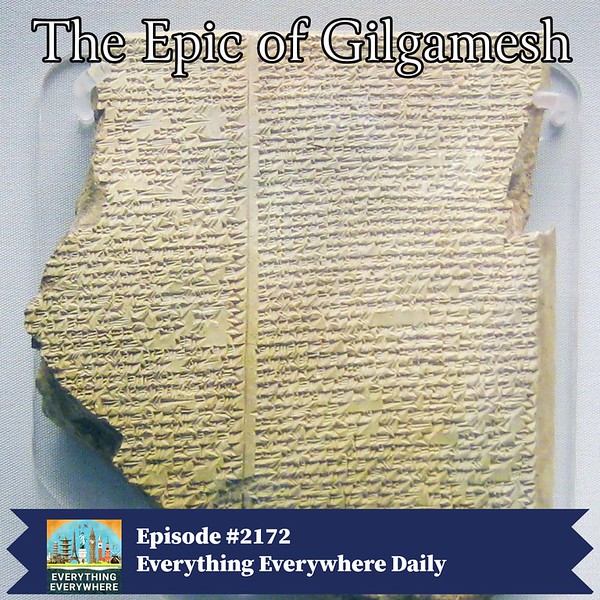
Episode – 2172 : The Epic of Gilgamesh
Podcast Transcript
Over 4,000 years ago, in the cities of ancient Mesopotamia, people told the story of a mighty king who sought fame, found friendship, faced devastating loss, and went searching for the secret of eternal life.
This story is one of the oldest written stories in the world, and many of its tropes are still a part of storytelling today.
And the character from this four-thousand-year-old story has even found a place in the Marvel Universe.
Learn more about the Epic of Gilgamesh, the world’s first written story, on this episode of Everything Everywhere Daily.
The Epic of Gilgamesh dates back to the Sumerian city-state of Uruk in modern-day Iraq. An oral version of the story almost certainly predates the earliest written copies, which are almost 5 thousand years old.
In ancient Sumeria, scribes used cuneiform, the earliest Near Eastern writing system, for accounting and agricultural records. Early Mesopotamian scribes would press symbols into wet clay using reeds harvested from the Tigris and Euphrates riverbeds.
The earliest writers chronicled mundane grain transactions and accounts of sheep herd growth, probably not anticipating that their script would later convey powerful messages about life, death, and the meaning of life.
The origin of the Epic of Gilgamesh lies between the rise of record-keeping and the emergence of narrative storytelling.
Like other legendary ancient texts, the Epic of Gilgamesh has no author. The story began its life as a song, likely sung by Sumerian storytellers called Gala. This oral tradition laid the groundwork for variations and retellings across generations.
Like Greek bards or African griots, the Sumerian Gala traveled from region to region sharing their songs for whatever people paid. The more exciting their songs were, the greater the demand for their talent. Gala often accompanied their lyrics by playing a three-stringed instrument called a gish-gu-di.
Gilgamesh was a popular song. In a Sumerian market called a karum, several Gala revelers would likely be found celebrating the heroics of Gilgamesh. The story was very likely a community tale, one told in competing variations by skilled Galas who committed the story to memory.
Most scholars credit a Babylonian poet named Sin-liqe-unninni (Seen-LAY-key-oon-NEEN-nee) with editing and compiling the definitive version of the story. Some Bronze Age writer then pressed a contemporary version of the Epic into the wet clay that has been the version told for thousands of years. This has become our standard version of the story, although there is little doubt that it has drifted and changed over millennia.
This standard story begins in a thriving Uruk, governed by the demigod Gilgamesh. He had many human weaknesses. He was anxious and arrogant, unwilling to accept limitations. His energy and ambition pushed Uruk’s people to work hard. They labored tirelessly to maintain the city.
His subjects tolerated the workload, but Gilgamesh’s sexual appetites presented an entirely different challenge. In the Epic, Gilgamesh takes any woman he desires, with a special preference for women on the eve of marriage.
The people of Uruk privately pray for Gilgamesh’s redemption and seek an end to the practice, but eventually his reign sparks hostility among his subjects. According to the Epic, their prayers were answered by Anu, the Sky-God.
Anu commissioned Aruru, the creator of humans, to create Enkidu, a rival to Gilgamesh. Enkidu possessed all of Gilgamesh’s physical traits; he matched his strength, stamina, and speed, while also possessing a keen intellect.
When a hunter stumbled upon Enkidu, he was living as a wild beast amongst the other animals. The people of Uruk sent Shamat, a prostitute, to civilize the beastly Enkidu. The plan succeeds; Enkidu abandons his wild ways and decides to challenge Gilgamesh.
The two demigods fought in Uruk for seven days, in a legendary battle. When the dust settled, the relationship between the two shifted dramatically as neither warrior could best the other.
The two decide that their true destiny lies in a heroic collaboration. Their first target is Humbaba, the monstrous, divine-appointed guardian of the Cedar Forest in nearby Lebanon.
Enkidu convinces Gilgamesh to behead Humbaba after an epic battle, helped by a rogue god. As Humbaba lies on the cusp of defeat, he places a curse on Enkidu.
Written in Akkadian, the language of Old Babylonia, the curse reads: May the pair of them not grow old, / apart from his friend Gilgamešh, may Enkidu have nobody to bury him!
Their situation worsens when the normally amorous Gilgamesh refuses Ishtar, the Goddess of Love, and her advances.
Unaccustomed to rejection and enraged, Ishtar sends the great beast, the Bull of Heaven, to destroy Gilgamesh and his city, Uruk. In a heated battle, Gilgamesh and Enkidu rise to the challenge and defeat the creature.
At the conclusion of the battle, Enkidu taunts Ishtar with her failure by throwing a leg from her prized bull at her. She demands that Enkidu be killed for his insolence, and he is.
With Enkidu’s death, Gilgamesh’s journey takes on a new focus, his search for immortality.
As Enkidu dies a painful, slow death, Gilgamesh doesn’t leave his side and is overcome with grief. As he enters death, Enkidu reveals what is our perception of the Mesopotamian attitude towards the afterlife.
The afterlife described by Enkidu is grim and hopeless. Everyone, regardless of status, lives in darkness and eats dust and clay. Enkidu’s death devastated his friend.
Gilgamesh’s experience is described by historian Yuval Harari: Gilgamesh sat by the body and observed it for many days, until he saw a worm dropping out of his friend’s nostril. At that moment, Gilgamesh was gripped by a terrible horror, and he resolved that he himself would never die. He would find a way to defeat death.
Gilgamesh embarks on a new quest: to find a way to evade death. To do so, he must learn the secrets of immortality.
Gilgamesh seeks out Utnapishtim, the mortal who was granted immortality. On his journey, Gilgamesh comes across the divine alewife, Siduri. Siduri tries to dissuade him from his quest, warning that it is fraught with failure and disappointment, and urges him to chart a new path and seek what truly matters.
She presents him with an important message: “Gilgamesh, where are you hurrying to? You will never find that life for which you are looking. When the gods created man, they allotted to him death, but life they retained in their own keeping. As for you, Gilgamesh, fill your belly with good things; day and night, night and day, dance and be merry, feast and rejoice.”
Her encouraging words fall on deaf ears, as he is committed to finding Utnapishtim, the man who was saved from a global flood by building a boat.
One of the most researched and debated components of the Epic of Gilgamesh is the flood story. This section links ancient Mesopotamian storytelling to familiar narratives in other cultural traditions.
Perhaps no part of the Bible is as well-known as the story of Noah, his ark, and the great flood. The stories of Noah and Utnapishtim are so similar that it seems difficult to believe they are not of common origin.
After being chosen for survival, both men build an ark and fill it with animal life to survive an extinction-level flood, only to be led to safety by a bird, with their boat ultimately resting on a mountain.
While it may seem peculiar that the flood myths are so similar, a closer look reveals that they shouldn’t. While Gilgamesh predates the Biblical flood story in Genesis, they share a common cultural and literary history in the Near East.
Historians are also quick to point out that flood myths are common around the world. There are flood myths among the Norse, Mayan, Hindu, Greek, and indigenous peoples of the Americas.
Perhaps the primary factor supporting their similarity is that the Hebrew writers of the Old Testament wrote it while in captivity in Babylon, the seat of Akkadian and Sumerian culture.
Gilgamesh reaches his final destination with the help of the boatman Urshanabi, who guides him across the waters of death. This encounter shifts the narrative from Gilgamesh’s search to his engagement with the realities of immortality.
Gilgamesh finds Utnapishtim, who politely refuses to provide Gilgamesh with immortality. He informs Gilgamesh that the gift of his immortality was a singular event, and not even his strength or guile can win it for him.
Gilgamesh refuses to accept this and demands that Utnapishtim present him with a worthy challenge to earn the ultimate prize. After failing the initial test, a challenge to stay awake for six days and seven nights, a horrified Gilgamesh pleads for another chance to prove his worth.
Utnapishtim unsuccessfully tries to remind Gilgamesh that his failure is inevitable, yet he relents and grants him another quest. Gilgamesh is to sail to the deepest part of the sea and obtain a plant that will grant him the gift of youth. While he won’t grant him immortality, as the Gods forbid it, he can at least have more time.
Gilgamesh ties stones to his ankles, sinks down, gathers the plant, and returns to the boat.
Rather than eat the plant immediately, Gilgamesh saves it. While Gilgamesh bathes before eating the plant, a serpent emerges and steals it.
The serpent mirror another bible story. In the Biblical version, a cunning serpent also appears, denying Adam and Eve immortality by deceiving them into eating the forbidden fruit, thereby ensuring their exile from Eden.
A despondent Gilgamesh is comforted by Utnapishtim, who reminds him that the only thing that is permanent is impermanence and that he was never going to be able to succeed.
He reminds him that his quest has been futile and that it has actually brought him closer to death. Utnapishtim finally reaches Gilgamesh after his last failure by reminding Gilgamesh that he can obtain the immortality he seeks, but perhaps not in the place where he is looking.
While he will never defeat death, he can ensure his permanence by returning to Uruk immediately and ensuring his legacy lives on through his leadership. The Gods may have kept everlasting life for themselves, but he can claim an everlasting reputation by your conduct.
In the end, what Gilgamesh learns is that what is truly remembered is kindness and a heart filled with joy for others. The hard-won lessons that Gilgamesh learned throughout his daunting quest still form the basis of modern morality nearly 5000 years later.
The Epic of Gilgamesh was reintroduced to the world in the summer of 1849, when British Archaeologist Austin Henry Layard was excavating the ruins of the famed Assyrian Library of Nineveh. He made one of the important discoveries in modern archaeology: the twelve tablets of the Epic of Gilgamesh.
Despite damage to the tablets, scholars managed to reconstruct them, and they were eventually housed in the British Museum.
In 1872, a regular visitor and self-taught Assyriologist, named George Smith, became so obsessed with the tablets that he taught himself to read the cuneiform script using partial translations from earlier attempts, and later announced that he had found a Mesopotamian flood story strikingly similar to the story of Noah in Genesis.
Smith was granted a fellowship to return to Nineveh and search for additional tablets, and his quest proved successful. He found other pieces of the tablets that filled in key parts of the flood story.
Oddly enough, George Smith managed to provide Giglamesh with what he had been looking for. By preserving the legend, he provided Gilgamesh immortality.
Thousands of years later, the Epic of Gilgamesh still reminds us that civilization is built not only with walls and monuments, but also with stories.
TThis episode can be found at: https://everything-everywhere.com/the-epic-of-gilgamesh/