
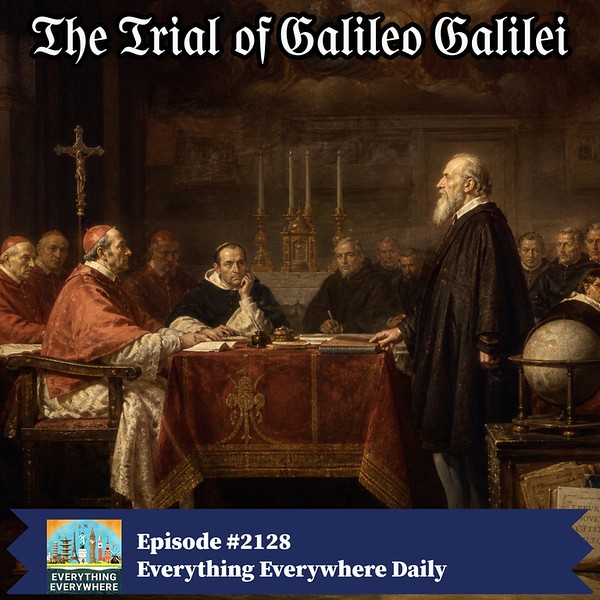
Episode – 2128 : The Trial of Galileo Galilei
Podcast Transcript
In 1633, one of the greatest minds in Europe stood before a tribunal, not for a crime of violence or treason, but for an idea.
Galileo Galilei had looked to the heavens and reached a conclusion that challenged centuries of accepted belief.
What followed was a confrontation between observation and authority, with consequences that would echo for centuries.
Learn more about the trial of Galileo Galilei and its legacy on this episode of Everything Everywhere Daily.
European thought and Catholic doctrine were dominated for hundreds of years by a geocentric model of the universe. Rooted in the works of Aristotle and Ptolemy, this framework posited that the Earth remained stationary at the center of the universe while all other celestial bodies revolved around it.
This perspective was viewed as being in complete harmony with both biblical scripture and established philosophical heritage.
In the 16th century, Europe began to recover from the slow pace of scientific discovery of the Middle Ages, and scientists began to realize that the model that had long been accepted was incorrect.
In 1542, the Polish priest Nicolas Copernicus published his revolutionary work, On the Revolutions of the Heavenly Spheres. Copernicus sparked controversy by placing the Sun at the center and making the Earth an orbiting satellite.
As a priest, Copernicus was well aware of the controversy his book would create. To avoid controversy, Copernicus chose to publish his findings only near the end of his life.
Hoping to avoid religious turmoil, dedicated his work to Pope Paul III. He wrote, The learned and unlearned alike may see that I shrink from no man’s criticism. It is to your Holiness rather than to anyone else that I have chosen to dedicate these studies of mine.
Copernicus was ultimately spared the controversy by passing away just as his book was being printed and distributed.
Danish astronomer Tycho Brahe and his student Johannes Kepler were among the scientists who picked up where Copernicus had left off. Brahe, lacking a telescope, relied on his naked eye for detailed observations of celestial movements.
Kepler used Brahe’s observations to develop models of planetary motion, and both adopted the Copernican model while living in Protestant strongholds.
Unlike Kepler and Brahe, the Italian scientist Galileo Galilei could not avoid the controversy with the Catholic Church, becasue it was in his backyard.
Galileo’s relationship with the Catholic Church ran very deep. At one point, he had planned to pursue a career in the priesthood, and later, two of his daughters had entered the convent. Given his ecclesiastical background, Galileo was well read, and he was a prime candidate to make scientific breakthroughs.
Galileo’s main early scientific contribution was the development of the experimental method. Early Greek scientists rarely experimented, preferring to base their hypotheses on observation and reason. Galileo’s approach emphasized forming a hypothesis and gathering evidence to support or refute it.
His earliest work focused on a more benign Aristotelian principle, the physics of inertia. Galileo contradicted Aristotle, asserting that objects remain in motion unless acted upon by an external force, a view later established by Isaac Newton. Though it opposed Church perspectives, this theory was less controversial than rewriting celestial models of the universe.
Aristotle claimed that the universe was composed of perfect spheres moving in circles around Earth.
For centuries, Church doctrine favored this cosmological model. By supporting Aristotle’s vision of a flawed, changing Earth contrasted with flawless celestial orbs, the Church maintained a worldview that linked the physical world and the heavens to the concept of a divine, perfect creation.
Galileo was concerned about contradicting Church doctrine. Unlike Kepler and Brahe, Galileo was a devout Catholic, creating an internal struggle over how far he should push the matter.
Galileo, like Copernicus, feared the Church’s reaction to dissenting views. In a letter to Kepler in 1597, Galileo shared his views with great clarity and concern when he wrote: Like you, I accepted the Copernican position several years ago…I have written up many of my reasons and refutations on the subject, but I have not dared until now to bring them into the open, being warned by the fortunes of Copernicus himself, our master…I would dare publish my thoughts if there were many like you; but, since there are not, I shall forbear….
Galileo used a telescope, invented in the Netherlands in 1608, for astronomical observation, discovering four moons of Jupiter, mountains on the moon, and stars that couldn’t be seen with the naked eye. In his book Sidereus Nuncius, or The Starry Messenger, published in 1610, Galileo challenged Aristotle’s cosmology.
By 1616, heliocentrism was under siege as the works of Kepler and Copernicus were placed on the “Index Librorum Prohibitorum”, the Index of Forbidden Books of the Catholic Church.
Galileo avoided the ban but received a stern warning from Cardinal Robert Bellarmine. Bellarmine warned that Galileo’s persistent contradiction of the Church’s teaching on the universe violated the Council of Trent and constituted heresy. The Council of Trent was the Catholic Church’s response to the Protestant Reformation.
The release of Galileo’s research came at a particularly sensitive time for the Church, as it coincided with the height of the Thirty Years’ War, the most violent phase of the ongoing religious struggle between Catholicism and Protestantism.
With war raging and Protestantism growing, the Church could not endure more controversy.
The Church launched an inquisition into Galileo’s exploration of the Copernican universe, and in 1616, they concluded that Heliocentrism was “foolish and absurd, philosophically false and formally heretical.”
For the Vatican, the issue was about survival, not just science. The Reformation had cost the Catholic Church millions of believers, and it could not allow any further defections. The Church feared the debate could spark challenges to other teachings.
Galileo disagreed and saw a way for the Church and science to work together. In a famous 1615 letter to Grand Duchess Christina, a member of the Medici family, Galileo hoped for a shared scientific consensus with the Church.
In fact, Galileo believed that God intended scientific inquiry. He wrote: I do not feel obliged to believe that the same God who has endowed us with senses, reason, and intellect has intended us to forgo their use and by some other means to give us knowledge which we can attain by them.
The letter gained notoriety and was widely circulated, eventually falling into the hands of Vatican officials.
Galileo recognized that, like Icarus, he had soared too close to the sun, and decided to obey Vatican orders and curtail the open expression of his views. Galileo continued his scientific inquiries in silence until 1623.
Galileo had consistently found himself in the crosshairs of Papal authorities under Popes Paul V and Gregory XV. However, the ascension of Cardinal Maffeo Barberini as Pope Urban VIII in 1623 was exactly what Galileo hoped for.
Galileo had a long relationship with the Barberini family, including patronage for his scientific studies. As Cardinal, Barberini even wrote a long Latin poem in honor of Galileo’s work. quote:
or at the attendants of Jupiter, or of Saturn (his father),
that were discovered by your glass, learned Galileo!
Galileo could not have been more excited with Barberini’s election as Pope; in fact, according to Papal records, he had met with the Pope 6 times by 1624. Having an admirer and confidant as Pope unlocked Galileo’s opportunity to write and lecture on a grander scale.
In fact, Galileo made a monumental decision: he would begin writing in Italian instead of Latin. Latin had been the traditional language of science, limiting the audience to those who were educated. By writing in Italian, Galileo hoped to reach a wider audience.
In 1632, he secured the Church’s approval for his opus, Dialogue Concerning the Two Chief World Systems. In addition to writing in Italian, Galileo wrote his “Dialogue” as a narrative conversation between three people.
One of the characters in the narrative was “Simplicio” or Simpleton. In the narrative, the Simpleton is cast as a dim-witted Aristotelian who refuses to budge from dogma despite mounting evidence to the contrary.
The book was published across Europe and became a sensation.
As it turns out, the book’s censors didn’t properly scrutinize the book, in part because Italy was dealing with an outbreak of plague at the time. Regardless, the damage was done.
The Vatican was outraged by the portrayal of those who held to Aristotle’s traditional beliefs. Galileo had misjudged the situation, particularly regarding his relationship with the Pope.
Urban VIII’s views were complex; while he held Galileo in reverence as a scientist, he viewed the matter as evolving scientifically. The book that the Church thought they were approving was supposed to be a hypothetical, mathematical treatise on heliocentrism, not a biting, sarcastic narrative about the non-believers of the theory.
The goodwill between Pope Urban VIII and Galileo evaporated, and the Church called for an inquisition in 1633. That was a crucial year as it marked the midpoint of the Thirty Years’ War.
Catholic and Protestant armies were sowing devastation across Europe, and Galileo had to be made an example of as the Church could not afford any further dissent.
The trial began in April of 1633.
Galileo clearly understood what was at stake for him personally. He could be excommunicated, and it was possible he could be tortured and even executed. It is also important to remember that Galileo was still a devout Catholic and in his ideal world, his discoveries would be viewed as confirmation of God’s brilliance, as he had come to understand the natural laws God created.
The trial lasted just two months.
Realizing that his case was doomed, Galileo reached an agreement with Papal officials: if he renounced his teachings, he would avoid torture, prison, and death.
Galileo was 67 at the time, and his health was failing; recanting was the only way that he could end the affair and continue to work.
On June 22, 1633, Galileo offered the following to the tribunal: I abjure, curse, and detest the said errors and heresies.
According to legend, after recanting, Galileo uttered under his breath, “Eppur si muove”, or “yet it moves”. Their story is almost certainly apocryphal, as there was no mention of it for a century after his death.
The lead Inquisitor, Father Vicenzo da Firenzuola, was also eager to end the affair, as Galileo had many powerful supporters, including the Medici family.
Urban VIII was also eager for a quick resolution. Although he was angry about the powerful insults in Galileo’s book, he was not interested in executing his former friend, a renowned public figure.
This was the most viable off-ramp for everyone involved.
Galileo was forced to pledge that he would abstain from further work on heliocentrism and would spend the remainder of his life under house arrest.
During his incarceration, Galileo didn’t focus on heliocentrism, but he didn’t sit idle. He had his work smuggled out of Italy to Holland, where his treatise on physics, The Two New Sciences, was published.
Galileo died under house arrest in 1642 at the age of 77.
Isaac Newton credited the work of Galileo when he said, If I have seen further, it is by standing on the shoulders of Giants.
Galileo’s quest for vindication from the Vatican didn’t come until 1992, when Pope John Paul II acknowledged the Church’s mistakes in prosecuting Galileo for his scientific inquiry into heliocentrism.
The life of Galileo Galilei reminds us that truth does not depend on permission. Confronted by the authority of his time, he bent when he had to for survival, but his discoveries could not be unlearned.
His work carried forward into the scientific revolution, reshaping how we see the cosmos and ourselves. In the end, the trial that sought to limit his ideas only served to amplify them.This episode can be found at: https://everything-everywhere.com/the-trial-of-galileo-galilei/