
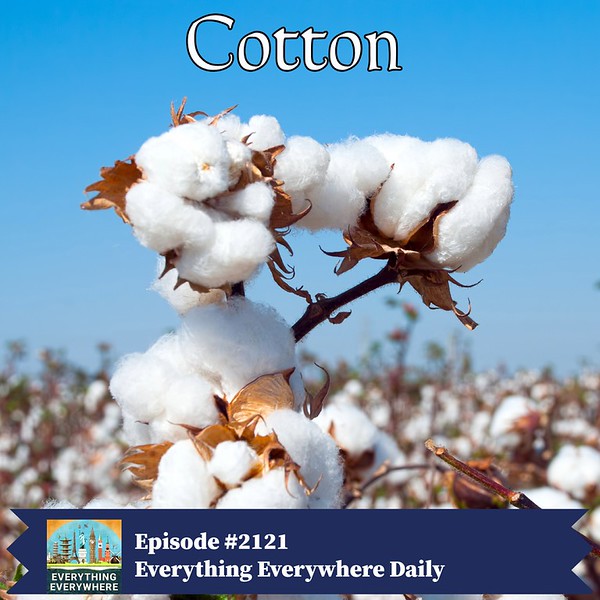
Episode – 2121 : Cotton: How It Helped Build The Modern World
Podcast Transcript
It is soft, common, and something most people wear almost every day. Yet behind this humble fabric lies one of the most dramatic stories in human history.
Cotton connected ancient civilizations, built global trade networks, fueled the Industrial Revolution, enriched empires, and helped sustain slavery.
Few plants have had a greater impact on the modern world. From fields in India and Peru to factories in Britain and plantations in America, cotton changed everything it touched.
Learn more about the remarkable history of cotton on this episode of Everything Everywhere Daily.
Cotton comes from plants in the genus Gossypium, a group of shrubs native to tropical and subtropical regions.
Cotton fibers grow around the seeds of the plant. Once cleaned, spun, and woven, they create cloth that is soft, breathable, washable, and comfortable in warm climates. Compared with wool, cotton was lighter and cooler. Compared with linen, it was often easier to weave into a variety of fabrics. It could also be dyed readily.
Unlike crops with a single center of domestication, cotton was domesticated independently in multiple parts of the world.
At least four species were domesticated by humans. In the Old World, Gossypium arboreum was domesticated in South Asia, likely in the Indus region, and Gossypium herbaceum in Africa or Arabia. In the New World, Gossypium hirsutum was domesticated in Mesoamerica, probably in Mexico, and Gossypium barbadense along the Pacific coast of South America, especially Peru.
Cotton fibers have been found in Peru dating as far back as 6000 BC and in Mexico 2000 years later. The Indus Valley was not only growing cotton by 3000 BC, but also weaving it into specific textiles.
African communities were using cotton in the Nile delta as early as 5000 BC, a full two millennia before the rise of Egyptian civilization.
Before the rise of cotton, people wore fabrics depending on the region they lived in. Wool from sheep was quite popular in Europe and Central Asia, particularly in colder climates. In the Middle Ages, the woolen trade was the backbone of the European economy, particularly in Northern Europe.
In East Asia, silk production was widespread, though it was more readily available to the elite, leaving commoners to wear linen.
Linen from the flax plant was the primary textile for clothing, even in areas where cotton was available, as cotton required far more intensive care and advanced irrigation.
The weavers of ancient communities in modern-day India and Pakistan gained regional fame for their technical mastery of cotton fabrics. The demand for the elaborate “calicos” of South Asian weavers was high, as they were found in trade markets as far away as Egypt and the Mediterranean world.
The attributes of cotton didn’t escape the Greek historian Herodotus, who noted: “In India, trees are growing wild, which produce a kind of wool better than sheep’s wool in beauty and quality, which the Indians use for making their clothes.”
India’s mastery of spinning and dying made it the center of the world’s cotton industry. Indian cotton became a crucial part of the evolving Indian Ocean trade networks, which treated it as a prized commodity, often traded for African gold and spices from the Spice Islands of Indonesia.
Indian weavers achieved complete mastery of cotton production with the development of muslin. Muslin was a remarkably light, airy-textured cotton developed in Dhaka, in what is today Bangladesh.
The BBC noted the importance of cotton muslin, stating: “Made via an elaborate, 16-step process with a rare cotton that only grew along the banks of the holy Meghna river, the cloth was considered one of the great treasures of the age.“
Muslin became even more prized than the most elaborate silk fabrics from China.
Once believed to be extinct, the cotton species Phuti Karpas was the source for Dhaka muslin, a fabric so fine the Romans nicknamed it “woven wind.”
Researchers and scientists scoured the region around the Meghna and Brahmaputra rivers in modern-day Bangladesh to find a rogue plant of the extinct species. The search relied solely on historical evidence, including where the plant once grew, and fossilized leaves preserved at the Royal Botanical Gardens in London.
Researchers were excited to have found several plants near the river in 2014 that were a perfect genetic match, and they have begun a restoration campaign to grow the formerly extinct cotton species.
In the early 18th century, in an effort to help the British wool industry, Parliament banned the importation of Indian cotton goods. England’s swift industrialization, combined with this prohibition, spelled the end for the Indian muslin industry. Consequently, the British East India Company overwhelmed South Asian markets with inexpensive, tariff-free British textiles.
The muslin producers were forced into service by the British East India Company at rates well below market, effectively ending the industry. A major challenge has been finding the families of the former weavers to gather any family legacy stories about their techniques.
The Silk Road was a key to the introduction of cotton into China, as cotton is not indigenous to East Asia. Cotton was slow to gain a foothold in China, as it was viewed as a “Southern” innovation and panned by Chinese elites, who preferred silk for themselves and hemp clothing for the common people.
Cotton did not enjoy widespread acceptance in China until its conquest by the Mongols, as they showed no interest in traditional Chinese conventions. The Mongols knew they could layer cotton, and they found quilted cotton, lined with skins or silk, a very valuable asset in the inhospitable climates of Central Asia.
The arrival of Europeans did not introduce cotton to the Americas, as it was already present, but it did introduce new economies. After the massive European migration to the Americas and the establishment of British colonies, the cotton belt emerged.
Being a tropical and semitropical plant, cotton requires a frost-free environment, which rules out most of North America above 37 degrees latitude.
The areas below Kansas, Missouri, and Kentucky were well suited to cotton cultivation, and as British industrialization expanded after the introduction of the water frame and, later, the steam engine, these regions ramped up production and shifted away from tobacco.
The evolution of cotton production in North America coincided with the introduction of slave labor to the southern colonies.
In the early 1790s, the American South faced a pivotal moment. Tobacco, long the region’s primary cash crop, had depleted the soil, leaving planters to struggle with cotton production, which remained a costly and inefficient venture.
The primary obstacle was the inherent physical constraints of manual processing. An enslaved worker could spend an entire day cleaning only a single pound of cotton. This was due to the specific type of cotton native to North America, short-staple upland cotton, which contains remarkably sticky seeds that are notoriously difficult to detach from the fibers.
The plantation system seemed destined to become a historical footnote due to exorbitant labor costs and restrictive British mercantile tariffs on raw imports; however, a singular technological breakthrough fundamentally altered the economic landscape.
In 1793, Eli Whitney invented the cotton gin, a simple machine that used combs to separate seeds from fibers. After the invention of the gin, a slave working an entire day would now be producing 50 lbs of cotton.
The cotton gin actually entrenched slavery by allowing cotton production to explode in the South. Before the invention of the gin, the cotton belt produced 3000 bales of cotton for export.
In 1800, just seven years after the development of the gin, the region produced 73,000 bales, a more than 2300% increase in just seven years. The cotton belt became the “cotton kingdom,” feeding British textile factories.
Before American Civil War, the American South accounted for an estimated 75% of the cotton used in British factories.
The seat of the English industrial revolution, fueled by cotton, was Manchester, England, also known as Cottonopolis. Weavers in the cottage industry here produced textiles before machines dominated the local industry.
Cotton fueled the transition to machines such as the Spinning Jenny and the Spinning Mule. Between 1750 and 1850, Manchester grew from a city of 18,000 to more than 300,000, a growth rate of over 1,500%. That growth came to a grinding halt in 1861 with the outbreak of the American Civil War.
Manchester suffered greatly when the Union’s naval blockade cut off the supply of southern cotton. Unable to secure the raw material essential for their machiner, the city’s mills faced a crisis further exacerbated by global supply chain disruptions, including India’s struggle for independence.
The Lancashire Cotton Famine, which followed the collapse of the cotton supply chain, wreaked havoc on the British economy. As the largest city in Lancashire County, Manchester felt the swift effects: within four months, mills ran out of cotton, leading to widespread job loss, poverty, and even famine among the workers.
Although the cotton shortage caused significant distress throughout Lancashire, the region’s laborers remained steadfast. At a meeting held in Manchester on December 31, 1862, textile workers resolved to back the Union’s campaign to abolish slavery, choosing to prioritize the cause of human liberty over their own economic survival.
By the 20th century, the technology that had driven the English textile industry had spread across Europe into North America. The Industrial Revolution in textiles, which England had previously monopolized, had now spread globally, leading to the expansion of cotton production worldwide.
One of the biggest ecological disasters of the 20th century was directly related to the production of cotton: the disappearance of the Aral Sea.
The Aral Sea was once the world’s fourth-largest lake, but the Soviet Union’s attempts to establish a cotton kingdom in an area incapable of supporting such extensive cotton cultivation made the lake all but disappear.
The rise of fast-fashion trends has ensured that cotton use continues unabated, even with the introduction of synthetic fiber blends and polyester. Cotton consumption has further intensified due to the shift of manufacturing to developing countries and the expansion of global shipping networks.
The current global annual cotton production is typically around 24 to 26 million metric tons of lint cotton, though it varies with weather, prices, and planting decisions. Lint cotton is cotton that has been prepared for fabric production, with the seeds removed.
The world’s largest producers are China, India, the United States, Brazil, and Pakistan.
Cotton has followed a trajectory similar to many of the great drivers of world history. Once a coveted luxury, the ancient Greeks called “wool from trees,” cotton has become a staple so common it often goes unnoticed.
It fueled the industrial revolution, propped up slavery in the American South, and was responsible for the disappearance of one of the world’s largest lakes.
Cotton is woven into the very fabric of our daily lives, found in everything from the linens on our beds, the towels in our bathrooms, and our most cherished t-shirts.
It all started thousands of years ago when ancient people around the world all figured out how to turn a fuzzy plant into clothes.
?This episode can be found at: https://everything-everywhere.com/cotton-how-how-it-helped-build-the-modern-world/