
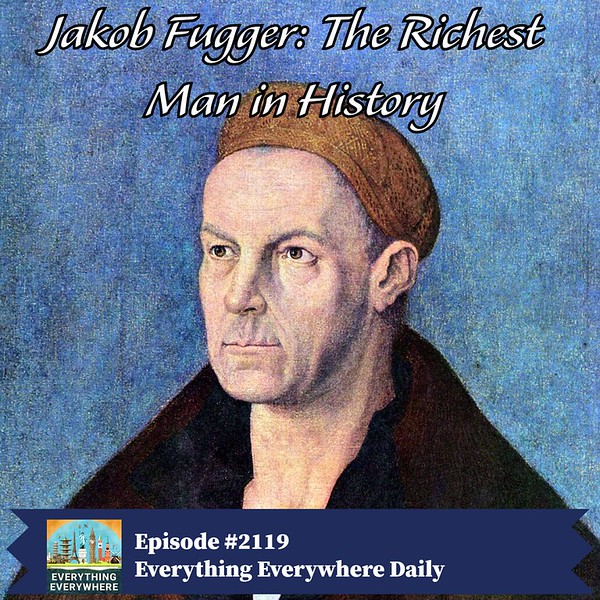
Episode – 2119 : Jakob Fugger: The Richest Man in History
Podcast Transcript
When you think of the richest people in history, you usually imagine kings, emperors, or maybe modern tech billionaires.
Yet 500 years ago, one merchant banker from Augsburg may have been wealthier than all of them.
He financed emperors, influenced papal politics, controlled vital mines, and helped shape the future of Europe.
Despite his wealth and power, few people even know his name today.
Learn more about Jakob Fugger, one of the most powerful businessmen who ever lived, on this episode of Everything Everywhere Daily.
Trying to compare wealth and money over long periods of time is extremely difficult. Most people would rather live a median or even below median life in the modern world than be rich hundreds of years ago. There was no amount of money that could bring you modern conveniences back then because they simply didn’t exist.
Another problem is comparing monarchs who arguably had absolute control over their domains to a business owner. In a previous episode, I covered some of the richest people in history. Some of them, like Mansa Musa of the Mali Empire or Augustus of the Roman Empire, could personally claim much of their nation’s wealth as their own personal property.
In this episode, I want to focus on someone who wasn’t a monarch and also wasn’t a modern tech billionaire with a net worth established by modern public stock markets.
He was a merchant who, through a series of incredibly shrewd decisions, built a net worth that accounted for a significant share of Europe’s entire economy.
He was born Jakob Fugger von der Lilie on March 6, 1459, in the Free Imperial City of Augsburg. The city answered directly to the Holy Roman Emperor rather than any local prince, giving it unusual political autonomy and making it one of Europe’s richest centers of trade, banking, and manufacturing.
At the time of Fugger’s birth, his family was already one of the most prominent in Augsburg, Bavaria’s leading city before it was eclipsed by Munich.
Jakob’s father died in 1469 when Fugger was only ten years old. His mother took over the business until three other surviving sons came of age. Initially, Jakob and his brother Markus were intended for the clergy.
However, the death of one of their brothers in 1473 necessitated a change in plans. At fourteen, Jakob was directed to forgo his religious aspirations and instead join the family business.
Jakob began his education at age 14 in Venice, where he studied modern bookkeeping from 1478 onward.
Fugger’s time in Italy was a turning point in his life. There, he was fully immersed in the era’s most advanced business environment.
Over the course of ten years, he mastered the merchant trade by apprenticing at the Fugger family’s Venetian warehouse before rising to become a partner in the business.Once he had attained partnership, Jakob began to change the mission and scope of his family’s business. He steered the firm away from reselling commodities such as spices, silks, and other textiles and instead began seeking investments that generated income, especially mines, loans, and bills of exchange.
Taking charge of the Fugger business in Innsbruck in 1485, Jakob demonstrated sound business acumen by making the firm a partner in Tyrolean mines that contained rich deposits of silver and copper.His first major financial breakthrough came in 1487. His first transaction that established a relationship with a powerful person was a loan of 23,627 florins to Siegmund, Archduke of Tyrol. Crucially, the loan was secured by a mortgage on the archduke’s prize silver mines in the district of Schwaz.
The deal gave Jakob control over the mines in the Tyrol region as repayment for funding the Duke’s lavish lifestyle. Due to the Fuggers’ industrial activities, people flocked to Schwaz, making it the world’s largest mining metropolis in the first half of the 16th century.His status enabled him to force mine operators to sell their silver directly to the Fugger family, thereby circumventing intermediaries and establishing vertical integration between mining and trade.From 1495, many mines in the area of Banská Štiavnica and nearby Banská Bystrica in present-day Slovakia were controlled by the Fugger family.
As a result of their mining activities, they had a de facto monopoly on the 16th-century copper trade in Europe. Copper, being a highly valuable resource, was essential for producing cannons and bayonets, as well as in coinage.
Fugger also ventured into early global trade. After Vasco da Gama’s discovery of the sea route to India and the establishment of the Portuguese spice monopoly, Jakob Fugger entered the spice trade and, in 1503, opened a manufactory in Lisbon.
This was fundamentally different than the trade his family was previously engaged in, in that he was investing in sourcing the spice, not reselling it from other merchants.
Along with other merchant houses of Germany and Italy, he contributed to a fleet of 22 Portuguese ships led by Francisco de Almeida that sailed to India in 1505 and returned in 1506.
His financial operations were just as significant as his mining ventures. Medieval moneylending had often been fragmented and local. Fugger helped pioneer large-scale international finance.
He lent money to kings, princes, bishops, and popes. He moved funds across borders through networks of agents and branches. He managed exchange rates, collateral, and political risk. He was not the inventor of banking, but he represented a new scale of private finance that hadn’t existed before.
While mining brought in fantastic wealth, Fugger’s banking operations were what gave him political power. European monarchs always needed money for wars and building projects.
The cornerstone of Fugger’s political power was his financial relationship with the Habsburg dynasty, particularly Emperor Maximilian I. Maximilian proved particularly lucrative, combining military and political ambitions with a reputation as “the worst manager of all the Habsburgs.”
By 1510, the two other Fugger brothers in the partnership had died. Fugger then took his four nephews, Hieronymus, Ulrich, Raimund, and Anton, into the firm, which was then renamed “Jakob Fugger and Nephews.”
By this point, Fugger was inextricably involved in the finances of the Holy Roman Empire. In return, Fugger was granted landholdings, a title of nobility in 1511, and further rights as a count in 1514.
The climax of this relationship with the Habsburgs came at the imperial election of 1519. When Maximilian I died, he owed Jakob Fugger around 350,000 guilders. An equivalent price in gold as of the recording of this episode would be approximately $186 million.
To avoid losing this investment, Fugger had to help Maximilian’s grandson, Charles V, ascend the throne. Charles’s unanimous selection by the electors required exorbitant bribes totaling 851,585 guilders. Jakob Fugger contributed 543,385 guilders, roughly two-thirds of the sum, while the remainder came from the Welser banking family and three Italian companies.
Fugger was so confident in his indispensability that he later reminded Charles V of this fact in a now-famous letter. In 1523, he wrote a letter demanding repayment directly to Charles V, then the most powerful man in Europe and arguably, on Earth. In it, Fugger bluntly stated that without his money, Charles would never have won the imperial crown.
Charles V did repay some of his debts to Jakob Fugger and the Fugger firm, but not fully or consistently. Like many rulers of the era, Charles relied heavily on rolling loans, delayed payments, renewed credit, and grants of privileges rather than straightforward repayment.
The Fuggers were compensated partly through interest, tax revenues, mining rights, monopolies, and access to lucrative state contracts, but large portions of royal debt were often restructured or carried forward for years.
The Habsburgs were not the only power center Fugger could influence. He also had ties to the pope. The Fugger family was the first German trading house in a direct business relationship with the Roman Curia.
In 1500, Jakob Fugger loaned the Vatican the funds to build the new St. Peter’s Basilica, the Sistine Chapel, and other buildings within the Vatican. For the new Pope Julius II, Fugger financed the recruitment in 1505–1506 of the Swiss Guard, which still exists today.
The link between Fugger and the Reformation runs deep. Archbishop Albert of Brandenburg borrowed heavily from the Fuggers at interest to buy his ecclesiastical offices. To provide himself with income to repay this debt, Albert paid an additional 10,000 ducats to secure the right to administer the “Jubilee Indulgences” from Pope Leo X, designed to pay for work on St. Peter’s Basilica.
A deal was made whereby the Fugger banks, with branches across the Continent, would collect these revenues for a lucrative share. A Fugger agent who accompanied indulgence preacher Johann Tetzel held the key to the indulgence chest. When it was full, an officer of the company opened it and remitted the amount to the Fugger office in Leipzig. Jakob Fugger took a 3 percent cut on every shipment south
Jubilee indulgences became a symbol of perceived corruption and the selling of spiritual benefits, helping provoke Martin Luther’s criticism in 1517 and igniting the Protestant Reformation.
Fugger also played a key role in reshaping church doctrine on the issue of interest. He influenced the Church’s stance on usury, helping legalize charging interest on loans.
Fugger also used his wealth for extensive philanthropy. In 1521, he founded the Fuggerei, which provided affordable housing for the city’s poorest citizens at a cost of one florin per year, along with the obligation to offer three prayers for the Fugger family.
The Fuggerei still exists today, over 500 years after its establishment. The terms have remained unchanged for half a millennium and have never been adjusted for inflation. It provides housing for 150 citizens of Augsburg. The annual cost of living there is now less than one Euro, and the requirement for three daily prayers still remains.
Fugger was also a patron of art, architecture, and culture. Like Italian merchant princes, he used buildings, chapels, tombs, and commissions to secure his memory.
His family chapel in Augsburg became one of the major Renaissance monuments north of the Alps. This reflected another change of the period. Wealthy merchants were increasingly outshining hereditary nobles in financing public projects.
Jakob Fugger died childless in 1525 in Augsburg at the age of 66. He left behind a business empire of extraordinary scale.
His nephew, Anton Fugger, inherited leadership of the company and continued its operations for decades. Yet over time, changing markets, sovereign defaults, wars, and shifts in trade routes weakened the family’s dominance.
The question that hangs over Jakob Fugger is: exactly how rich was he? As I mentioned at the start of the episode, it is very difficult to compare wealth over long periods. However, that doesn’t mean that people haven’t tried.
American journalist Greg Steinmetz has estimated Fugger’s overall wealth at around 2% of Europe’s GDP at the time, equivalent to about $400 billion in 2015 and about $512 billion today.
For better and worse, Jakob Fugger’s historical importance is enormous. He helped shift Europe from a medieval commercial world of local merchants toward a modern system of credit, international finance, and politically connected capital.
Fugger is often an overlooked figure in history. He wasn’t a general, a king, or a pope. Rather, he was the person behind the power who financed and facilitated so many of the important people and events of the early 16th century. This episode can be found at: https://everything-everywhere.com/jakob-fugger-the-richest-man-in-history/