
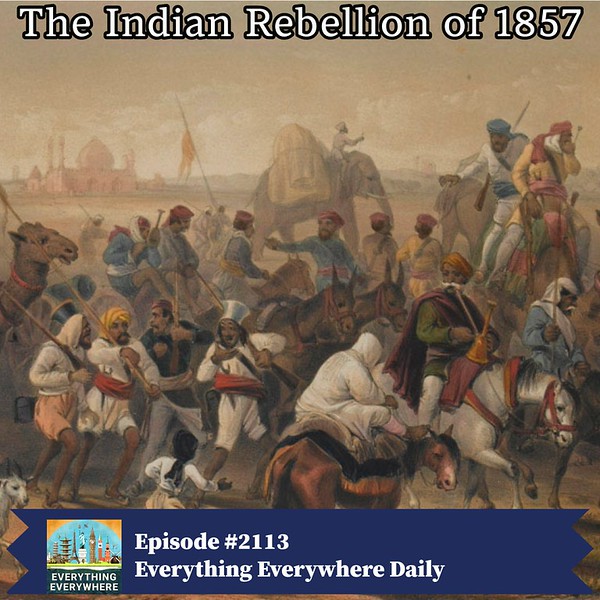
Episode – 2113 : The Indian Rebellion of 1857
Podcast Transcript
In 1857, a rumor about rifle cartridges made with animal fat helped ignite one of the most important uprisings in the history of the British Empire.
What began as a mutiny among Indian soldiers soon became a massive rebellion that swept across northern India, toppled cities, revived emperors, and nearly shattered colonial rule.
The conflict was brutal, complex, and ended one of the most powerful private corporations in history.
Learn more about the Indian Rebellion of 1857 and how a military revolt became a turning point in Indian history on this episode of Everything Everywhere Daily.
British involvement in India dates back to the 16th century, when a group of merchants successfully petitioned the British government for exclusive trading rights to lands east of the Cape of Good Hope.
The group operated under the lengthy name “Governor and Company of Merchants of London Trading with the East Indies.” In 1600, it was simplified into the British East India Company.
Known as the “Company That Ruled The Waves”, the British East India Company became one of the most famous and lucrative enterprises in World History.
Consistently competing with Portuguese and Dutch interests in the Indian Ocean, the British East India Company underwent a seismic shift at the Battle of Plassey in 1757. After the Battle of Plassey, the Mughal Empire crumbled as the central government surrendered control to local rulers, known as Nawabs.
After defeating the Nawab, the Company shifted from a mercantile organization into a political powerhouse, laying the foundation for a century of corporate rule over India.
While consolidating their control over India, the British East India Company relied on Sepoys as its security agents. Sepoys were Indians trained in British military tactics while armed with British weapons.
Approximately 280,000 Sepoys were under its control by 1857. These Sepoy forces were not just security agents for the company; they also played a crucial role in supporting British military campaigns to seize territories, especially by countering French colonial ambitions in India during the 18th century.
By 1857, the British East India Company and its Sepoy legions were operating as the Indian state, with one of the largest standing armies in the world.
The tensions against the British East India Company that led to the events of this episode had been simmering among the people of India for decades.
One of the outstanding issues was the “doctrine of lapse”. Under the doctrine, if the sovereign of an Indian princely state died without a male heir, the principality was absorbed into the East India Company’s holdings. To make matters worse, the Company demanded veto power over any adopted heir, an approval it rarely granted.
The program’s goal was to expand the company’s holdings and broaden its tax base, which created significant tension among Indian elites.
British East India Company rule also had a devastating economic impact on the lower classes in India. Restrictions on agriculture forced Indian peasants to prioritize industrial cash crops, like indigo, over essential food staples to support British textile production.
The lower classes of Indians also suffered under high levels of company-imposed taxes. The Company administration began to infringe on Hindu religious freedoms as they abolished historic customs such as Sati, the immolation of a widow on the funeral pyre of her husband.
Religious anxiety intensified as the Company overturned its long-standing ban on Christian missionaries. Missionaries flooded the countryside, alarming both Hindu and Muslim communities
The Sepoy had their own grievances. Many came from high-caste Hindu or Muslim backgrounds, especially in northern India. They were proud of their military service but increasingly resentful over pay disparities, lack of promotion, overseas service requirements, and cultural insensitivity from British officers.
The immediate trigger for the rebellion was the introduction of the Pattern 1853 Enfield rifle in 1857. Soldiers had to bite open greased paper cartridges before loading them.
The cartridges were rumored to be greased with cow and pig fat. The Sepoys, who were required to bite these open, believed this violated Hindu and Muslim religious prohibitions against beef and pork, leading to immediate outrage and refusal among many soldiers.
Documentation from British arsenals of the period indicates a profound lack of concern for the cultural values of the Indian people. By greasing cartridges with a combination of pork and bovine derivatives, manufacturers totally disregarded the religious beliefs of the Sepoys, who would be the ones using the items.
The Indian Rebellion began when Mangal Pandey, an outraged Hindu Sepoy, attacked British officers on the base at Barrackpore. He waas subsequently subdued and later executed.
The uprising soon spread to the Meerut Sepoy garrison. 85 Hindu and Muslim soldiers refused to use the cartridges on religious grounds. The punishments given to the 85 dissenters were swift, humiliating, and public. They stripped them of their uniforms, clamped them in heavy leg irons, and marched them away to ten years of hard labor.
The next day, the rest of the Meerut Sepoys killed their British commanding officers. They then marched to Delhi to ask the 82-year-old Mughal Emperor, Bahadur Shah Zafar, to lead the effort to expel the British and restore Mughal rule.
Military and civilian uprisings across northern India were inspired by the news of the successful takeover in Meerut and the symbolic legitimacy gained by involving the Mughal Emperor, even though his actual authority was quite minimal.
The rebellion soon spread across northern India, with key cities like Lucknow, Kanpur, and Jhansi becoming centers of fierce fighting.
The rebels were trying to trap the British in their fortified residences, so they would to starve. If they tried to escape, they would face relentless sniper fire from neighboring rooftops.
When the British went on the offensive to retake cities, as they did in Delhi, they had to engage in intense urban combat, literally going door to door to extract rebels.
The rebellion was not a unified uprising across all of British India. While Northern India was fervently behind the Sepoys, Southern India found far less enthusiasm for the Sepoy rebellion. India in the South was far from the Mughal homeland and was less densely populated, resulting in fewer Sepoys than in the North.
In many regions, local princes maintained lucrative trade treaties with the British and prioritized their own stability over the rebellion. These rulers stifled the uprising by forbidding their private armies from joining the Sepoy cause.
The British East India Company knew this area was a British stronghold, and if they could prevent the uprising from reaching Southern India, they could retain control.
Coastal cities to the West also retained loyalty to the British, as they had long-standing business relationships with the East India Company.
Following months of brutal urban warfare, British troops and their Sikh allies successfully captured Delhi and the Red Fort in September 1857. Delhi, which had been a cosmopolitan city of 500,000, was reduced, as British observers noted, to “a city of the dead”.
Estimates of the dead during the siege range as high as 30,000 people. In the countryside, the tactics were equally fierce. In their pursuit of rebel units, British troops frequently employed brutal tactics, such as carrying out gruesome public executions and incinerating entire villages that did not cooperate.
Sergeant George Carter of the East India Company brigade described the execution of suspected rebels by ‘blowing from a gun’, a horrific practice the British used to strike psychological terror into every observer.
Carter noted, “The prisoner is lashed to a gun, the small of the back resting against the muzzle… the word is given, ‘Fire!’—and the prisoner’s body is literally blown to atoms.”
The fall of Delhi was the turning point of the struggle, yet it would take the British East India Company an additional year and a half to completely extinguish the resistance.
One of the leaders of this resistance was a woman named Rani Lakshmibai, who was the queen of the princely state of Jhansi and one of the most famous leaders of the Indian Rebellion of 1857. After the British annexed her kingdom under the Doctrine of Lapse, she led an armed resistance, became renowned for her courage in battle, and died fighting in 1858.
In honor of her commitment to ending foreign rule in India Rani of Jhansi has often been compared to Joan of Arc in British literature and by her British adversaries. Commander Hugh Rose referred to her as “The bravest and best military leader of the rebels”. Indian Nationalists would carry her legacy forward during the 20th-century independence movement.
Ultimately, the 1857 rebellion was a failure. It didn’t result in Indian independence. It brought about brutal crackdowns and resulted in the deaths of tens of thousands. Independence would have to wait another 90 years.
That being said, the revolt did usher in major changes.
The political consequences were immediate and profound. In 1858, the British Parliament passed the Government of India Act, ending the rule of the East India Company. India was transferred directly to the British Crown.
The East India Company existed on paper, managing the tea trade for Britain, but it was never anywhere near the level of importance it once had. They were formally dissolved on January 1, 1874.
Queen Victoria issued a proclamation promising respect for princely states, religious noninterference, and equal protection under law. A new office, the Viceroy of India, replaced Company governance.
A significant restructuring of the military was also undertaken by the British. To minimize the risk of a coordinated revolt, they specifically redesigned the army’s composition by decreasing the ratio of Indian to British soldiers. Recruitment shifted toward groups designated as “martial races,” including Punjabis, Pathans, Gurkhas, and Sikhs. Furthermore, the British ensured that control over artillery remained strictly in their own hands.
Administratively, British rule after 1857 became more cautious and conservative. Officials were less eager to impose social reforms that might provoke resistance. They also cultivated alliances with princes and landlords, creating a more collaborative imperial order.
The rebellion’s legacy remains contested. British writers long called it the “Indian Mutiny,” emphasizing the military revolt and portraying it as a breakdown of discipline.
Many Indian nationalists later called it the “First War of Independence,” viewing it as the first major united struggle against colonial rule. In reality, it was less than a full national revolution but more than a mere barracks mutiny.
The Indian Rebellion of 1857 failed because it lacked unified leadership, national level coordination, and common goals among its many participants. Some rebels wanted to restore the Mughal Empire, others defended local rulers, and others simply opposed the British with no particular plan.
Large parts of India did not join the revolt, while many princes, Sikhs, Gurkhas, and other groups supported the British. The British also had better logistics, modern communications, reinforcements from overseas, and greater military organization.
Yet it laid the groundwork for future independence by ending the British East India Company’s rule and placing India under direct Crown rule, thereby changing how Britain governed.
More importantly, the revolt became a powerful tale of resistance. Later nationalists looked back on 1857 as the first major anti-colonial uprising, celebrating figures such as Rani Lakshmibai and Mangal Pandey as early freedom fighters. It failed militarily, but it helped inspire the political nationalism that eventually led to independence in 1947.This episode can be found at: https://everything-everywhere.com/the-indian-rebellion-of-1857/