
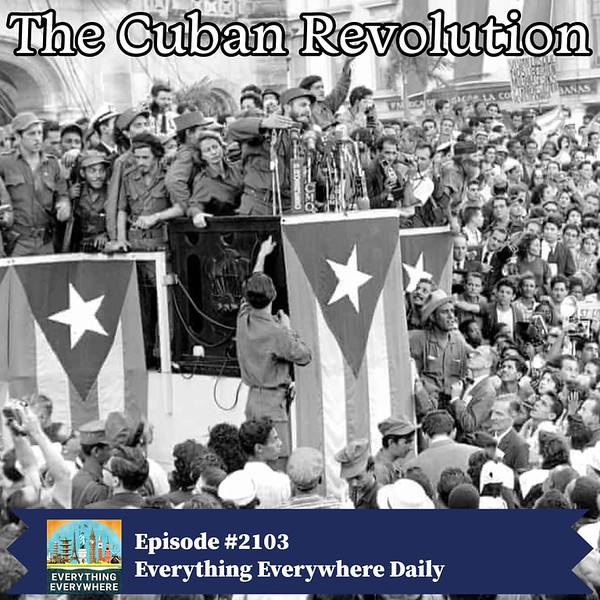
Episode – 2103 : The Cuban Revolution
Podcast Transcript
In 1959, a small band of guerrilla fighters marched out of the mountains of Cuba and toppled a government backed by one of the most powerful nations on Earth.
What began as a rebellion against corruption and inequality quickly became something much bigger, transforming Cuba into a focal point of the Cold War.
The events of 1959 have left a legacy that continues to affect the world today.
Learn more about the Cuban Revolution and how it unfolded on this episode of Everything Everywhere Daily.
The island of Cuba spent centuries under Spanish rule, which ended with the Spanish-American War in 1898. While Cuba formally gained independence in 1902, it remained heavily influenced by the United States, which retained the right to intervene in Cuban affairs and controlled major sectors of the economy, especially sugar production.
Having just fought for independence against Spain, Cuban nationalism was at a high point. Yet during this era, the US Military intervened in Cuban affairs to support American-friendly governments and suppress nationalist movements.
Cuba’s nationalism drew on the ideas of a group of philosophers and authors, especially José Martí. Martí’s 19th-century writings, written during Spanish rule, regained new meaning during the period of American dominance.
Martí was a martyr and activist who died fighting for Cuban independence from Spain, and founded the Cuban Revolutionary Party. Martí’s inspiring words endured into the 20th century, influencing leaders of the Communist Revolution, although Martí himself was not a communist.
During the 1930s, as Cuba suffered under the weight of the Great Depression, nationalism reemerged on the island, demanding “Cuba for Cubans”. This movement, which culminated in island-wide strikes in the summer of 1933, led to the ouster of American-friendly dictator Gerardo Machado.
The collapse of the Machado regime led to a dizzying cycle of political leaders in a short period, culminating in the Hundred Days Government in the fall of 1933. The Hundred Days Government was extremely radical and called for full nationalization of American interests and extensive land reform on the island.
The American Ambassador to Cuba, Sumner Welles, initiated a coup with the help of an army stenographer named Fulgencio Batista. Batista became the head of the army, and the United States installed a series of short-lived yet friendly governments.
Surprisingly, during World War II, Cuba adopted a democratic constitution and held open, fair elections.
Following an unsuccessful bid for the presidency in 1944, Batista opted for self-imposed exile in Florida, residing there until the 1952 elections.
In 1952, an aspiring politician named Fidel Castro ran for a seat in the Cuban House of Representatives. At the time, Castro was a young lawyer, not a radical candidate. He ran as a Marti-inspired nationalist under the Orthodox Party, focusing on a platform to end corruption.
The Orthodox party’s founder and leading presidential contender, Eduardo Chibás, formulated the platform against corruption and led nationwide crusades against dirty officials. However, his campaign did not achieve its intended outcome.
While on his radio program in 1951, he had failed to provide proof for his corruption charges against a leading government official. The shame of his failure prompted him to tell his audience that this would be his last radio address. Chibás shot himself in the stomach moments after he went off air and died 11 days later.
With Chibás’s death, Castro became the party’s primary figure and heir to Chibás’s anti-corruption movement, aiming to restore honest government and end American domination.
Of particular importance to Castro was the strength of American control over Cuba’s sugar production. Castro demanded an end to Cuba’s sugar-based monoculture system and called for the elimination of the large plantation style farms that deprived everyday Cubans of the opportunity to own land.
The 1952 election never happened; with full American support, Fulgencio Batista initiated a successful military coup that year. Marti’s anti-imperialist nationalism once again rang out across the island, turning Fidel Castro from a reformer into a revolutionary.
Castro and 160 Marti loyalists launched the revolution’s opening salvo in an attempted coup against the Batista government by attacking the Moncada Barracks in July 1953. The coup attempt was a disaster for the rebels. Castro’s men were completely ill-prepared, and most of his fellow revolutionaries were captured or killed.
Fidel and his brother, Raúl, were among the few survivors.
At his trial, Castro delivered a four-hour speech against the Batista regime, known as the “History Will Absolve Me” speech. Castro called for the restoration of the Constitution of 1940 and a series of reforms to restore dignity to the Cuban working class.
Castro demanded land reform, profit sharing for miners, and a complete overhaul of the island’s health and education systems. His speech also planted the flag of anti-American nationalism by giving credit to José Martí as his motivational influence when he said: “José Martí is the only intellectual author of the attack on the Moncada.”
Although the court handed Fidel Castro a 15-year prison term, he was released after serving just 22 months due to sentence being commuted by Batista. During his time behind bars, Castro’s status grew until he became a symbol of resistance to Batista.
Batista calculated that releasing Castro would undermine his support and that he and the Moncada revolutionaries would simply abandon their revolutionary aims in gratitude.
Batista’s decision proved to be an enormous miscalculation. Batista’s thinking was that the release would appease his critics and show the island that he wasn’t simply a military dictator. The tactic was designed to strengthen his control over the island by establishing political legitimacy, thereby boosting his popularity.
Instead of simply going away, Castro fled to Mexico in 1955. In Mexico, Castro prepared for his next attempt to liberate Cuba. While in Mexico City in 1955, Castro moved around constantly. Fearing Batista’s long reach, he moved from apartment to apartment, staying with sympathetic Cuban exiles.
One such exile was Maria Antonio Gonzalez. While hosting Castro in July 1955, Gonzalez introduced Castro to Che Guevara. Che Guevara was an Argentine doctor and revolutionary.
Like Castro, Guevara was a zealot. While Castro drew his motivation from José Martí, Guevara drew his inspiration from Simón Bolívar and his Pan-Latin American ideology during the 19th-century revolutions against Spain.
Through his motorcycle travels from Argentina to Mexico, Guevara developed the belief that unity was the region’s best path out of the poverty and instability that defined it.
According to accounts of their meeting at Gonzalez’s apartment that night, the two of them talked until dawn. The meeting ended with Guevara joining Castro in his cause and agreeing to supervise the training his troops would need to overthrow the Batista government.
Castro and Guevara led the men to Rancho Santa Rosa, a mountain encampment outside Mexico City. There, they drilled the growing band in long-distance marching, climbing, wilderness survival, and sharpshooting. They were called the July 26th Movement, after the date of the failed Moncada Barracks attack.
In November 1956, 82 revolutionaries of the July 26th Movement planned to sail back to Cuba aboard the yacht Granma
The landing of the Granma was disaster and nearly ended the revolution before it began. The overloaded boat arrived two days late and missed its rendezvous point with its Cuban allies.
The lost rebels stumbled upon a guide who agreed to take them to the Sierra Maestra Mountains, where they intended to build an outpost similar to their hideout in Mexico. Little did they know that the guide was a Batista sympathizer who betrayed them and led them into an ambush.
The Cuban Army nearly wiped out Castro and his followers. In fact, reports circulated in the international media that Batista’s forces had killed Fidel Castro at the Battle of Alegria de Pio. The myth gained momentum when the Cuban government announced they had an eyewitness to his death less than 24 hours after the initial reports.
Castro and about a dozen men survived the ambush, but Batista had handed Castro another gift with the premature announcement of his death.
Castro was so confident that he told Guevara, “Now we have won the war!” Alegria de Pio was a turning point for Guevara as well.
Wounded severely by a gunshot wound to the neck, he thought he was dying. While sitting under a tree, thinking he would bleed out, he vowed that if he survived, he would fight as a soldier and not simply be a doctor for others who did the fighting. In his autobiography, he attributes this to the day the doctor died and the soldier was born.
Castro led his men into the mountains, where they prepared to build a guerrilla force to fight against Batista and the Cuban government. The announcement of Castro’s death provided him the unique opportunity of building his movement without the intense scrutiny of the Batista regime.
For 43 days, Guevara and Castro hid in the mountains, building their organization. In January 1957, Castro made his move, attacking a small base at La Plata with several dozen of his best-trained men. They took the area by surprise and achieved a complete victory.
The victory also had an additional benefit: it gave Castro the chance to prove he was alive!
Castro ordered Guevara to treat the wounded Cuban army soldiers and addressed them personally. In his address, he told them their betrayal was not their fault; they were merely the dictator’s tools.
Word of Castro’s resurrection began to spread, and he became a living legend.
Guevara devised a unique plan to propel the rebellion. From atop their remote mountain outpost, he established Radio Rebelde. The initial broadcast offered the following message: “Here, Radio Rebelde! Transmitting from the Sierra Maestra, Free Territory of Cuba…”
The radio station spread Castro’s message and won the hearts and minds of the Cuban people.
Radio Rebelde was remarkably effective; the government could not stop it, and new transmission stations began popping up all over the island to ensure everyone could hear Castro’s powerful messages and the call to revolt.
Throughout 1958, Guevara and Castro launched highly successful guerrilla attacks against hapless Cuban forces.
The Battle of Santa Clara was the end of the Batista regime. Guevara, using a borrowed bulldozer, successfully derailed a military train and surrounded the Cuban forces, stealing all of their ammunition.
The Cuban forces lacked the motivation, will, and strategy of the rebel forces. On December 31, 1958, Batista’s family fled with millions of dollars from the Cuban treasury to the Dominican Republic. On January 1, 1959, Castro and his forces were in control of the country.
The Cuban Revolution didn’t end with a grand siege of the capital, but rather with a derailed train and a midnight flight by a fallen leader.
Batista’s exodus left a void, which Fidel Castro filled with a week-long victory parade around the island. Castro fulfilled his mission to be the ‘David’ of Cuba, defeating the Goliath that had impeded the development of Cuba for more than a century.
Oddly enough, there is one word that I haven’t yet used to describe Fidel Castro and his movement: communist. Believe it or not, despite some very clearly communist leaning policies, Castro never claimed to be a communist and never claimed to be leading a communist revolution.
In fact, Castro stated his position during a visit to the United States shortly after the revolution, saying, “I am not a communist.”
However, Castro nationalized American interests on the island, putting him in the crosshairs of the United States, and also found a friend in the Soviet Union. At least at first, this was a friendship of convenience, not ideology.
It wasn’t until April 1961, on the eve of the Bay of Pigs Invasion, two years after the revolution, that Castro formally declared the revolution to be socialist. Later that year, in December 1961, he went further and explicitly stated, “I am a Marxist-Leninist and will be one until the end of my life.”
After that, Cuba became a committed ally of the Soviet Union and a solid member of the communist bloc.
The Cuban Revolution promised freedom, justice, and dignity, but what followed under Fidel Castro was not just a transformation; it was just a consolidation of power.
As happens so often after revolutions, political opposition was silenced, elections disappeared, and generations of Cubans found themselves trading one form of authoritarianism for another. This episode can be found at: https://everything-everywhere.com/the-cuban-revolution/