
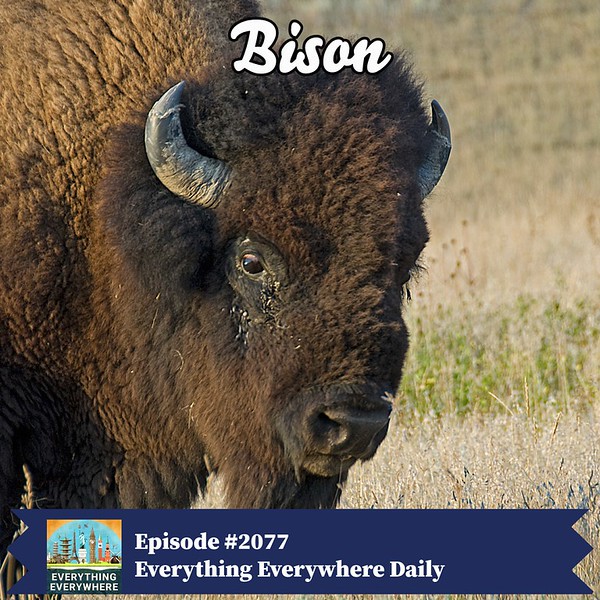
Episode – 2077 : The North American Bison
Podcast Transcript
For thousands of years, one animal shaped the ecology, culture, and history of an entire continent.
In vast herds that once numbered in the tens of millions, the North American bison dominated the Great Plains, sustaining Indigenous societies and transforming the landscape itself.
Yet within a single human lifetime, they were driven to the brink of extinction. Their story is one of abundance, destruction, and survival against extraordinary odds.
Learn more about the North American bison on this episode of Everything Everywhere Daily.
The North American bison has the scientific name Bison bison. There are two subspecies. The wood bison, Bison bison athabascae, lives in Western Canada and parts of Alaska.
The other better-known subspecies is the plains bison, whose scientific name is Bison bison bison.
The North American bison is often incorrectly called a buffalo. True buffalo are different species that live in Africa and Asia, such as the African buffalo and the water buffalo.
Early European explorers in North America used the familiar word “buffalo” for the animal they encountered on the plains, and the name stuck in common usage.
Bison first migrated to the Americas from Asia during the Pleistocene period. Pressure by apex predators such as the Siberian Cave Lion and competition with grazers like the woolly mammoth and wild horses, forced bison to migrate eastward.
Bison migrated to the Americas nearly 200,000 years ago via the Bering land bridge, after sea levels dropped over 300 feet (91 m) during the ice age.
In the Americas, bison found ecosystems well-suited to their needs, with fewer apex predators and less competition for grasslands. The bison that arrived in the Americas belonged to a different species from those present today.
Modern bison descended from massive ancestors. The largest, bison latifrons, had a horn span of nearly 9 feet (2.7 m) and weighed up to 4,000 lbs (1,800 kg).
As the climate warmed in the late Pleistocene, the landscape began to change. The region became more forested and saw the expansion of the American lion and the infamous short-faced bear, the largest carnivore in the Americas.
The impressive horn span offered protection from apex predators but posed challenges in North America’s more densely forested environment. The modern bison emerged as subspecies with a smaller horn span and a smaller, more nimble form.
Early Clovis hunters, dating back 20,000 years, hunted a relative of the modern bison, the Bison antiquus. The ancient bison were moving closer in size to the modern bison, with a much smaller body and a diminished horn span of about 4 feet (1.2 m).
The bison we see today show the adaptations they made from their ancestors to survive the plains. They are much smaller than their Pleistocene counterparts and possess greater agility, enabling them to undertake long migrations.
People are often stunned to see a bison go from a slow walk to a full sprint, reaching speeds of up to 35 mph (55 km/h).
The North American plains bison had a profound impact on the environment of the Great Plains.
The bison use their heads as plows in deep snow; they move their heads side to side to forge a path for themselves and for other animals that cannot move through it.
The sharp hoof shape of a bison provides a natural aeration of the prairie grass. Their dense undercoat captures a great diversity of wildflower seeds, which are spread throughout their migrations. Bison often plant these seeds through one of their most important behaviors: the wallow.
In an effort to take a dust bath, shed their winter coats, or simply roll around and scratch an itch, bison create wallows, which are shallow depressions in the soil.
Bison wallows are about 10-15 feet across (3.3 m) and about 1 foot in depth. These enormous holes fill with rainwater, becoming a vital micro-ecosystem.
The water that gathers in a bison wallow allows wildflower seeds to germinate and spread. Wallows also served a social function, as bison often gather at wallows and roll together and establish dominance for the upcoming mating season.
Unlike cows, which feed on grass to the roots, bison are more selective. Bison do not eat the grass to the root; they act as a natural lawnmower, cutting long grass down to several inches and then moving on, all the while ignoring flowers.
Their selective grazing habits create a quilt pattern on the Great Plains, an unmistakable sign of a herd’s presence. This quilt pattern has one other profound effect on the ecosystem. According to the National Park Service Photosynthesis also increases when bison selectively graze, because with many different kinds of plants, there is increased light availability and reduced competition for water and nutrients.
Through their migratory grazing practices, bison do not overextend the ecosystem’s capacity to provide nourishment, and because they return to a site only every few months, their migrations offer ample time for recovery.
The efficiency of bison did not go unnoticed by early travelers on the Great Plains, as the path that they cut through would be the path of least resistance for wagon travel.
Bison dung is also critically important for the environmental health of the Great Plains. Again, according to the National Park Service Bison feces and urine, when deposited, are important sources of nitrogen, phosphorus, calcium, sulfur, and magnesium for microbes, plants, and other animals.
A single bison dung patty can be home to as many as 300 different types of insects. The insects living on bison dung make a feast for bird life.
A typical bison’s daily output of 10 quarts of dung and 12 gallons of urine, when multiplied by an estimated 60,000,000 bison at their height on the Great Plains, illustrates just how much they were chemically altering the landscape.
The bison of North America left relatives in Eurasia; there, the wisent flourished and ranged across the continent. The wisent shared more than appearance with the North American bison, as it faced many of the same challenges.
Overhunting, forced extermination due to urbanization, and declining habitat led to the Wisent’s approach to extinction by the 20th century. Through conservation efforts, the population of the Eurasian wisent, once reduced to only 12 individuals, has been carefully rebuilt and is now approaching 10,000.
Like the wisent, the American bison was nearly wiped out in the 19th century.
In North America, tribes who lived in the Great Plains had traditionally lived alongside bison and treated them as sacred. Bison were hunted only as needed, and they recognized the value and importance of the animal, as almost everything they needed in life came from them.
Native Americans used every part of the bison that they hunted.
The bison was the basis of the diet for the peoples of the Great Plains. The hides were used as blankets, clothing, shoes, shields, and as teepee covers. Hooves were boiled down into a powerful adhesive, bladders were dried as water vessels, and bones were used for weapons and tools.
Bison, or tatanka in the Lakotah language, meant everything to Native peoples; they depended on them for daily survival and venerated them as part of their religious cosmology. According to Native American author N. Scott Momaday, The Buffalo was iconic and sacred and became so deeply ingrained in the life of the tribe that they could not imagine existence without the Buffalo.
Given the sacred nature of the bison, it must have been extraordinarily difficult for Plains people to watch the extermination of the animal that unfolded in the wake of westward expansion.
The 1880s were a time of crisis for the bison: a population that numbered in the tens of millions was reduced to fewer than 1,000, teetering on the brink of extinction in small herds.
The Indian policies of the post-Civil War period, the demand for leather, and the expansion of the railroad nearly extinguished the bison. Hunters often stripped the bison of their hides and left their carcasses to rot in the sun.
The destruction of the bison was connected to the nation’s Indian policy in the 19th century. The strategy was based on forcing Native Americans onto smaller and smaller plots of reserved land, and one of the fastest ways to make that happen was to take the essence of indigenous nomadic life: the bison.
The expansion of American railroadswere arguable the greatest engine of bison destruction.
Railroads fed their workers through the rapid slaughter of animals that yielded up to 1,000 lbs of meat. Hunters making 80 dollars a day, an extraordinary amount of money at the time, hunted the animals in extraordinary numbers, some hunters boasting kill totals of as many as 4000 per year!
Bison threatened the very nature of rail travel, as they tended to block tracks and their massive girth could derail fast-moving trains.
The effort to restore the bison population fell to a diverse group that included future president Theodore Roosevelt, sympathetic ranchers, a taxidermist at the Smithsonian, and Charles Goodnight, a former bison hunter who tried to breed them with cows and create the catalo.
While Goodnight’s catalo experiment ended in failure, it preserved key populations that would eventually merge with the core restoration population in Yellowstone.
Roosevelt joined forces with the Smithsonian’s taxidermist, William Hornaday, to seek protection for the animal under the American Bison Society. They protected a small group of animals at zoos, including the Bronx Zoo, and realized that, in order to thrive, they needed to be reintroduced to their native habitats.
While tracking a bison to kill for a museum exhibit, Hornaday saw the “ghastly monuments of the slaughter” and, for two weeks, saw only a few bison.
He shot one bull, but realized that the fur was not useful as it had been shed in the spring. Hornaday even brought one calf back alive to the Smithsonian, where it became a sensation, before it died in captivity.
Returning in the winter, he successfully located and killed twenty bison to secure the necessary specimens. This endeavor culminated in a remarkable display for the Smithsonian, which was the museum’s largest exhibit in seventy years. Hornaday’s intention was for the exhibit to inspire appreciation for the animal and galvanize support for their preservation.
Hornaday made the preservation of the bison his life’s work, and Roosevelt’s political connections proved invaluable.
By the time Hornaday conducted his census in 1905, he found only 85 free-range bison on the Great Plains.
Roosevelt and Hornaday successfully advocated for state-level protection laws. Furthermore, Roosevelt secured federal protection for the National Bison Range in Montana, which became instrumental in the bison’s recovery, starting in Yellowstone, the nation’s oldest National Park.
The bison of Yellowstone, which numbered only 25 in 1901, were the last remnants of biologically pure bison that were exempt from attempts at cross-breeding on private farms.
Hornaday’s expertise and Roosevelt’s passion for the great outdoors and reverence for a species he had shot in 1883 helped change political attitudes toward protecting the bison. The US Army, at Roosevelt’s insistence, patrolled the region where the bison lived in Yellowstone to guarantee their safety.
The bison of Yellowstone began to be treated as a national treasure.
Roosevelt and the American Bison Society encouraged the development of a national ethos around bison by securing their image on the famous 1913 “buffalo nickel”. The coin inspired curiosity and hope nationwide for the bison’s survival.
The nation’s wish was granted as the Yellowstone 25 grew into a stable population, serving as a nursery as the herd population stabilized and grew.
Tribal reservations and other National Parks across the country welcomed Yellowstone bison in hopes of extending the comeback. The resurgence of the American bison population represents one of the great stories of the conservation movement.
Today, there are roughly 400,000 to 500,000 North American bison in total. However, only about 20,000 to 30,000 live in truly wild conservation herds. The vast majority are found on private ranches and are managed as livestock.
In recent decades, conservation groups, Native American tribes, and government agencies have worked to restore bison to parts of their historic range and rebuild prairie ecosystems. Programs such as the American Prairie project in Montana aim to create large, connected grassland reserves where bison can roam freely again.
These efforts seek not only to restore the bison, but also the broader prairie ecosystem that evolved alongside them.
The American bison is central to the narrative of North America. Its history encompasses ice age migration, physical evolution, crucial dependence by Native peoples, near-total destruction, and a remarkable comeback.
The Executive Producer of Everything Everywhere Daily is Charles Daniel. The Associate Producers are Austin Oetken and Cameron Kieffer.
Research and writing for this episode were provided by Joel Hermansen.
Today’s one-star review comes from listener Boston Strange, who writes:
Finally!
I discovered this podcast about 2 1/2 years ago and FINALLY have joined the completionist club in Montana. Started in Texas, then Colorado, and retirement in Montana allowed me to knock out the missing episodes. Great podcast – the first listen every day on the walk with my dog. Thank you, Gary, for all the knowledge and versatility.Thanks, Boston Strange! I think that you are either a machoist or you accidentally hit the wrong number of stars when you left your review. Both hypotheses fit the facts of this review.
Remember, if you leave a review on any of the major podcast apps, you too can have it read on the show.
?This episode can be found at: https://everything-everywhere.com/the-north-american-bison/