
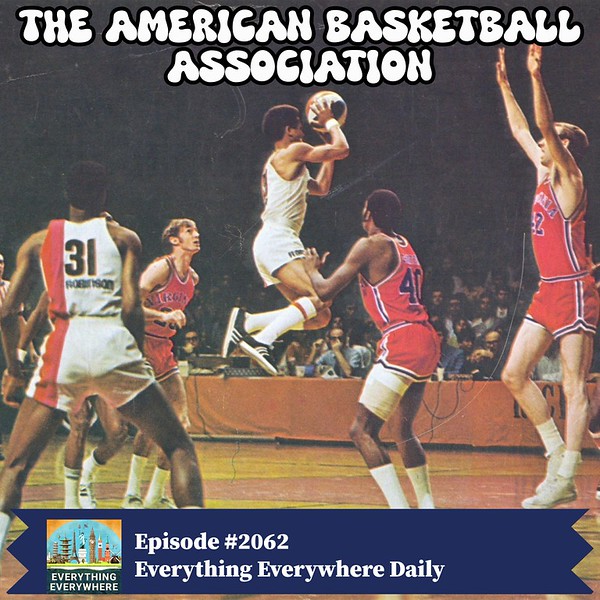
Episode – 2062 : The American Basketball Association
Podcast Transcript
One of the most compelling stories in American professional sports is the rise of the American Basketball Association, or the ABA.
Founded in 1967, the ABA emerged as a rival to the NBA, which had become predictable and stale. The ABA emerged as a flamboyant contrast.
Fans packed tiny gyms to watch the ABA shatter NBA norms, showcasing brilliant dunks, a three-point shot, and an iconic red, white, and blue ball.
Learn more about the American Basketball Association on this episode of Everything Everywhere Daily.
The Boston Celtics of the 1960s are the most dominant dynasty in the history of American professional basketball. Led by legendary center Bill Russell, the Celtics won an absurd 9 out of 10 titles during the decade.
NBA parity was at an all-time low as the Celtics ran roughshod over the league. The NBA had slipped well behind baseball and football in fan interest.
By the late 1960s, the time was right for change.
The ABA was formed by 11 pioneering owners who made a bold bet on themselves. With only a $5,000 investment per franchise, a fraction of the NBA’s fee, they launched an exciting new league. Their goal was to create a product compelling enough to eventually force the NBA into a highly lucrative merger.
The ABA was a classic buy-low, sell-high scheme. To pull off the scheme, however, they needed to fill seats and generate buzz.
Part of the plan was to establish franchises in non-traditional markets to expand professional basketball’s reach. The challenge of making this work was much harder and the league experienced financial difficulties throughout its existence.
The ABA didn’t have a TV contract, so all their revenue came from ticket sales, which was difficult because they had to rent small arenas or high school gyms.
Those teams that survived saw their financial gamble pay off. Perhaps the greatest story of the ABA’s financial difficulities and success were Ozzie and Daniel Silna, the owners of the St. Louis Spirits.
The Silnas pulled off arguably the greatest deal in the history of professional sports. The Spirits were typical of an ABA franchise; the team was a charter member of the league, joining as the Houston Mavericks.They were forced to relocate to North Carolina in 1969, where they played at the Carolina Cougars.
In 1974, the team relocated to St. Louis, seeking to capitalize on the much larger TV market.
The Silna brothers bought the franchise for the hefty sum of $1 million. The business-savvy brothers held out for an NBA offer that never came.
While at first their inability to join the NBA seemed like a failure, what they ultimately secured was far better. The ABA-NBA merger agreement in 1976 forced them to dissolve the franchise, and for this, they accepted a fee of $200,000, in addition to $ 2.2 million for the rights to the team’s players.
The most striking aspect of the agreement was the 1/7th share of the television contract granted to the four ABA teams that joined the NBA, in perputity.
As the NBA’s popularity grew over the years, so did the purse paid to the Silna brothers. By the time the Silna brothers reached a buyout agreement with the NBA in 2014, that TV share had generated more than $800 million.
The ABA’s strategy was to use the playbook the American Football League used to great success. The AFL established a rival league to the National Football League to force a merger.
To entice the NBA to merge, the ABA had to create enthusiasm that drew the attention and concern of the NBA, and the ABA figured out the perfect formula.
The first strategy that separated the ABA from the NBA was its rules on player acquisition. The NBA had a long-term agreement with the NCAA that mandated that players had to complete their college eligibility before they were eligible for the NBA draft.
While this agreement was very beneficial for the college game, it put the NBA at a disadvantage if a rival league emerged with different rules.
The ABA allowed players to join before completing their eligibility. They established a “hardship rule”, a player could be drafted into the ABA before completing their eligibility if they had experienced financial hardship.
Spencer Haywood became the first player to join the ABA under these rules when he left Detroit Mercy in 1969 after his sophomore season. Haywood made it count: he was the Rookie of the Year and ABA MVP in his one ABA season, averaging an astonishing 30 points and 19.5 rebounds per game.
After dominating the ABA, Spencer Haywood had contract issues of his own with the Denver Rockets and left the league to sign an NBA contract with the Seattle SuperSonics.
For Haywood to join the NBA, he had to fight a legal battle that reached the Supreme Court. Haywood won his case, played 14 seasons, and was inducted into the Basketball Hall of Fame in 2015.
The ABA allowed younger players to shine at the professional level and did not stand in the way of their joining the NBA, so more players were eager to follow Haywood’s path.
Haywood’s court victory had provided the NBA with a very limited window for college players; they had to prove financial hardship. The ABA rules were much more flexible regarding underclassmen.
These rules allowed the ABA to win the rights to legendary talents such as Julius Erving ak Doctor J, George “The Iceman” Gervin, and Moses Malone.
Malone’s case was even more revolutionary in that he joined the ABA straight out of high school, paving the way for future players such as Kobe Bryant and LeBron James.
The second strategy to make the ABA stand out was the three-point shot. The Los Angeles and Minneapolis Lakers legend George Mikan, the first commissioner of the ABA, believed the three-point shot was like a home run and included it in the ABA’s rules from day one.
The NBA had long viewed the three-point shot as a gimmick, even after the ABA merger, but finally relented and added it in 1979.
The three-point shot added excitement to the game and space to the offensive schemes. Defenses had to respect the shot, which opened more space for the offenses to operate.
The greatest beneficiary of the rule was the incomparable Rick Barry. Barry had been an all-star in his first two NBA seasons for the San Francisco Warriors after the franchise moved from Philadelphia. His second NBA season saw him average 36 ppg and lead the league in scoring.
His third season had to wait; frustrated by the league’s salary structure, Barry jumped to the ABA’s Oakland Oaks. This was a breakthrough in the league’s battle for credibility.
Barry sat out a season due to a court battle, but when he emerged, he added more excitement and juice to the ABA brand, particularly with his shooting. Barry led the league in scoring his first year, nearly matching his NBA stat line at 34 ppg.
He thrived on hitting deep jump shots and proved that the 3-point shot was no gimmick and could revolutionize basketball.
Perhaps the most defining thing about the ABA that most people remember was the ball itself, which was red, white, and blue. The ball was a statement of the ABA’s independence from the NBA.
The final strategy employed by the ABA to generate excitement came from its cultural attitude. The ABA’s vibe stood in stark contrast to the NBA’s. The NBA functioned more as a conservative institution; the ABA leaned into the social and cultural movements of the day.
The NBA insisted that its players adopt a more traditional ethos in dress and hairstyle, and discouraged players from seeking opportunities to stand out for reasons outside basketball. The league’s premier coaches, like Red Auerbach, insisted on a more clean-cut look and discouraged players from showboating.
The ABA was the complete antithesis of this attitude.
Players entered the arenas in exciting outfits, took the floor with trendy 1970s afro hairstyles, and warmed up to the blaring hits of Motown. The league’s coaches wore outlandish suits and sweaters and indulged their athletes’ flamboyance on the court.
Adding to the excitement, the league even saw hockey-level fighting at times.
The ABA also started the most iconic fashion statement in basketball history, the sneaker. ABA players wore a diverse range of brands in vibrant colors and broke the grip Chuck Taylor All-Stars had on the NBA.
The ABA also became known for pushing social boundaries.
When Ellie Brown was appointed chairperson of the Kentucky Colonels, she became the first female executive in professional sports. She took it one step further by appointing an all-female board of directors. The result was a massive increase in ticket sales and the Colonels’ only championship.
The ABA also cultivated a strong relationship with Black America and demonstrated that it was a place where Black athletes were treated fairly and with dignity. The ABA had the highest percentage of Black athletes in any professional sports league.
The recent Amazon Prime series Soul Power explores how the league became a showcase for Black culture of the time.
George Karl, legendary NBA coach, ABA player, and producer of the series, offered this characterization. He said, I thought the ABA was a godsend for sports, but especially for basketball and especially for the Black athlete.
One manifestation of this is the story of Connie Hawkins. Wrongly accused of participation in a betting scandal, Connie Hawkins was forced out of college and professional basketball for ten years. His exile finally ended when the Pittsburgh Pipers signed him in 1967.
Hawkins produced an MVP season and an ABA title in an astonishing two ABA seasons. The league also afforded him the resources to launch a successful lawsuit against the NBA and the platform to prove his remarkable talents belonged at the highest level of basketball.
The Connie Hawkins story was one of injustice, and the ABA’s opening its doors for him was a clear sign to Black America that this league was doing things differently.
It turns out that the league had one more trick up its sleeve, one that connected it with the playground culture of basketball in urban areas.
The Slam Dunk.
Connie Hawkins turned the slam dunk into a basketball sensation. While NBA players certainly could dunk, it was not part of the league’s more buttoned-up ethos in the 1960s.
While the NBA stressed fundamentals and less showboating, the slam dunk fit perfectly in the ABA. The ABA featured some of the most legendary dunkers in basketball history.
Few players could dunk with the athleticism, skill, and flair of the ABA’s duo of David Thompson and Dr. J. The two possessed such extraordinary athleticism and leaping ability that their dunk highlights are still watched today.
Thompson could reportedly touch the top of the backboard, and Erving’s slam dunk from the free-throw line in the 1976 dunk contest became part of ABA lore.
Dr. J had been the ABA’s brightest star, and it showed in the gate receipts for the games of the New York Nets. Dr. J was a cultural icon, arguably the greatest in professional sports at the time. His influence was felt well beyond the bounds of sports.
Today, the NBA All-Star Game has become a weekend-long celebration of the sport and a showcase of players’ remarkable skill and athleticism. Before the ABA, the NBA All-Star Game was relegated to a boring Tuesday night slot.
The ABA added a touch of flamboyance and glitz to the event. They moved it to the weekend and, in 1976, added the Slam Dunk contest. Won by Erving, with Thompson as the runner-up, the Slam Dunk contest later became a fixture in the NBA.
In 1976, the NBA finally relented. Four teams, the Indiana Pacers, the San Antonio Spurs, the Denver Nuggets, and the New York Nets, were absorbed into the NBA.
While the ABA disappeared, its spirit and vibe became essential to the NBA’s new identity. From the three-point line to the dunk contests, the NBA learned valuable lessons from the ABA.
It is hard to even think of the NBA without slam dunks or three-point shots, but they are all due to a group of owners who took a risk back in 1967 and, in the process, revolutionized the sport of basketball.
The Executive Producer of Everything Everywhere Daily is Charles Daniel. The Associate Producers are Austin Oetken and Cameron Kieffer.
Research and writing for this episode were provided by Joel Hermansen.
Today’s review comes from Podcast Guy 1109 on Apple Podcasts in the United States. They write:
Best podcast, also one question
Love this podcast | listen to it every time I take a shower (not even close to becoming a member of the completonest club idk how to spell that) | just wanna know where is Ben long or the old producer also noticed that the end has been changing a lot hope you read this.Thanks, podcast guy! I can tell you Ben is doing well, and a few months ago, he became a father to a healthy baby boy named Levi.Remember, if you leave a review on any of the major podcast apps, you too can have it read on the show.This episode can be found at: https://everything-everywhere.com/the-american-basketball-association/